
When designing bulk shielding for a fast-neutron source, why is boron-10 commonly added to polyethylene rather than relying on plain polyethylene alone?
Select an answer to reveal the explanation.
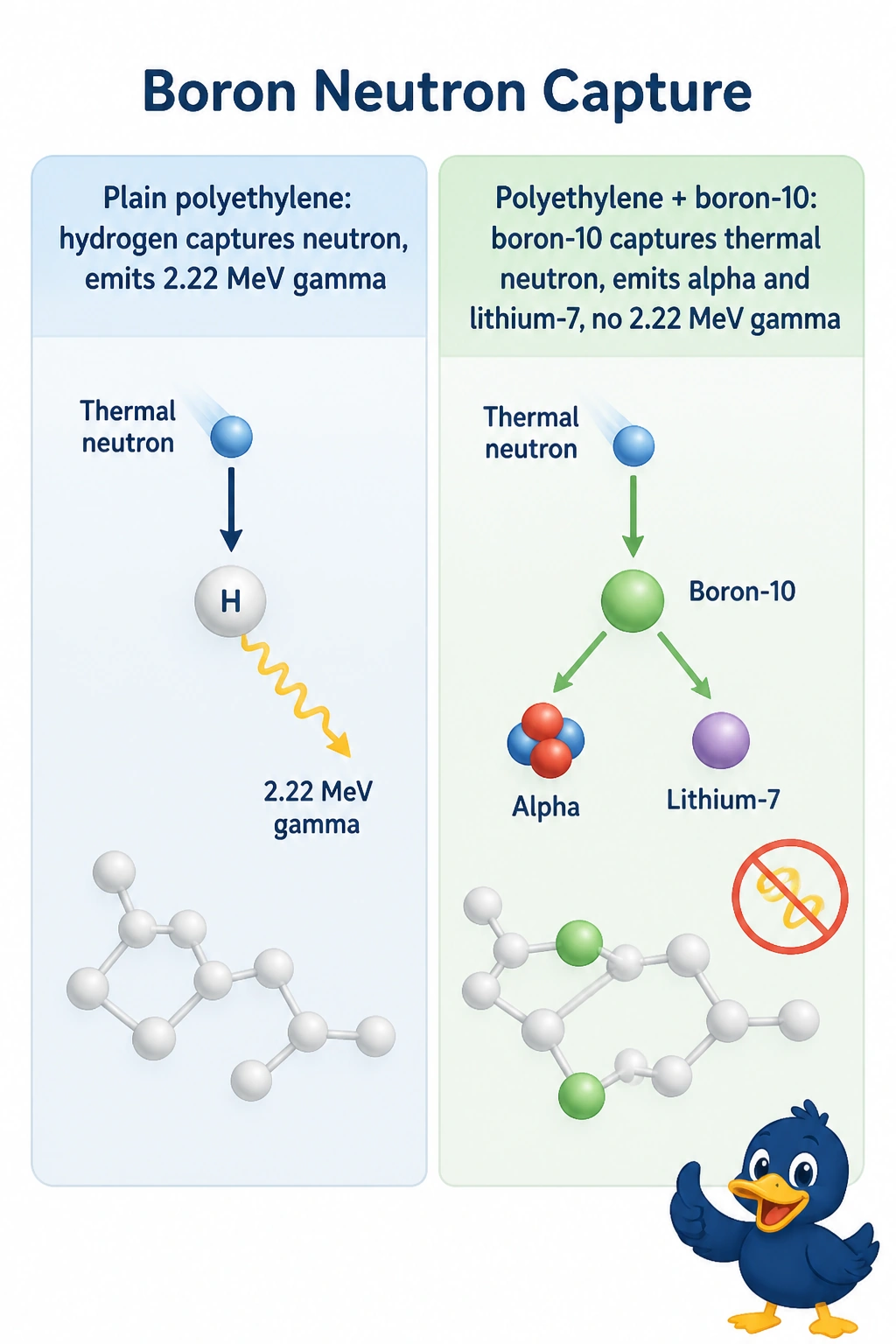
Short Explanation
Think of plain polyethylene as a speed bump that slows fast neutrons down, only for hydrogen to fire off a 2.22 MeV gamma ray when it finally catches one. You avoid that secondary gamma trap by mixing in boron-10, which quietly absorbs thermalized neutrons via an alpha reaction instead of producing high-energy capture photons.
Full Explanation
Polyethylene slows fast neutrons efficiently through elastic collisions with hydrogen nuclei, but once neutrons reach thermal energy, hydrogen capture emits a penetrating 2.22 MeV gamma ray. Adding boron-10 solves this because Boron-10 captures thermalized neutrons via an alpha reaction instead of emitting 2.22 MeV capture gammas, producing a short-range alpha particle and a much softer 0.478 MeV photon that is far easier to shield. The claim that Boron-10 increases the hydrogen density of the plastic to double elastic scattering is incorrect because boron-10 has a higher atomic mass and lower scattering efficiency for fast neutrons than hydrogen. Similarly, Boron-10 absorbs fast neutrons directly before any thermalization is needed fails because the boron-10 capture cross section is small at fast energies and follows a 1/v relationship that peaks at thermal energies. The option stating Boron-10 reflects scattered neutrons back toward the source to prevent skyshine also misses the mechanism, since boron acts as a neutron absorber rather than a reflector. As a caveat, borated polyethylene still emits 0.478 MeV photons and source-associated gammas, so outer high-Z shielding is often required. Before finalizing a temporary neutron shield, survey both the neutron and gamma dose rates on the exterior surface with calibrated instruments.
Prefer to study offline? Printable PDF study book + test engine ($7.50, unofficial). These questions stay free here.