
Why can a CR-39 plastic track-etch dosimeter measure fast-neutron dose equivalent in a mixed neutron-gamma field without being overwhelmed by gamma-ray exposure?
Select an answer to reveal the explanation.
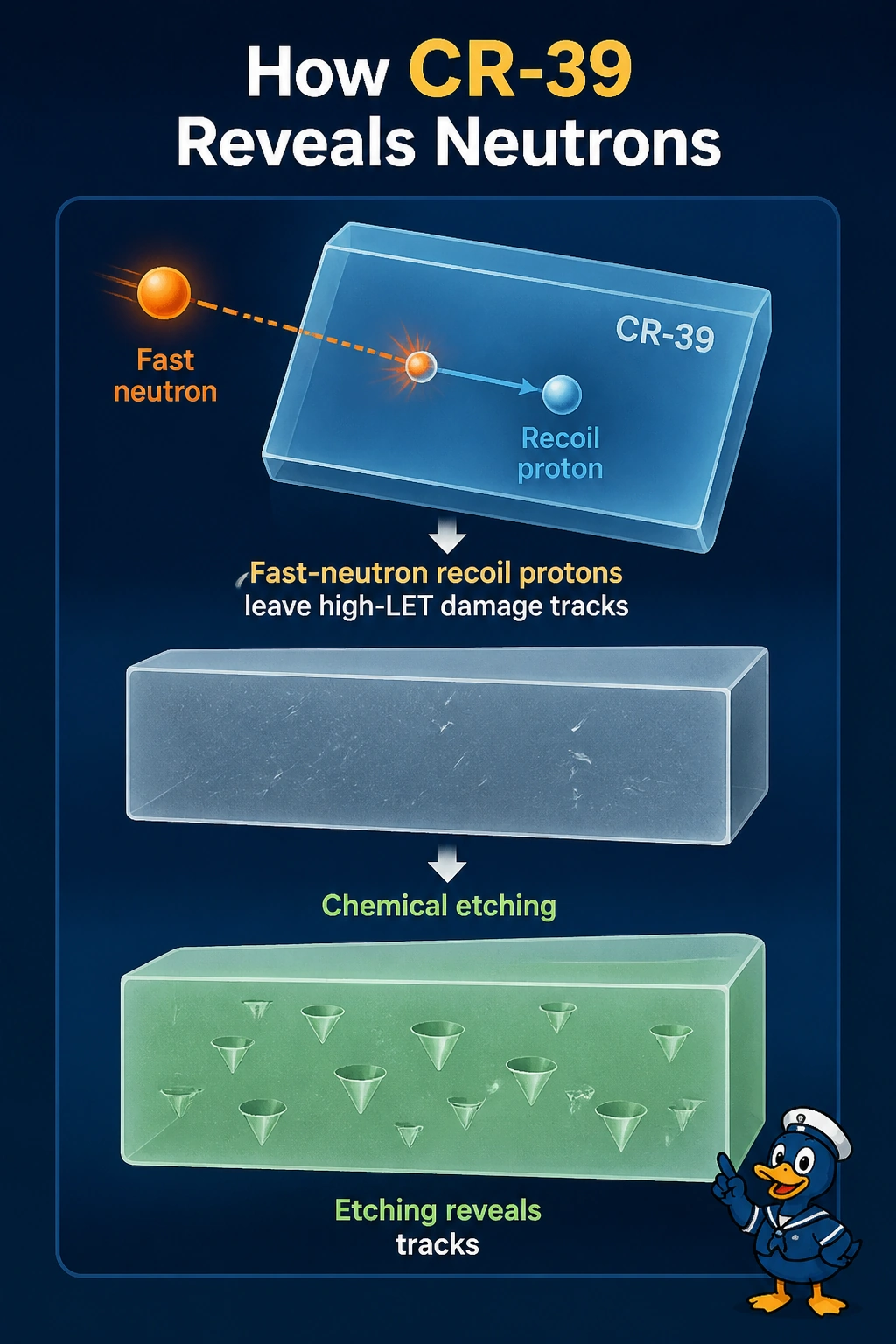
Short Explanation
Think of CR-39 plastic like fresh snow that records heavy bootprints from neutrons while ignoring light gamma raindrops on your badge. When fast neutrons knock protons loose, those high-LET recoil protons leave damage tracks that chemical etching turns into countable pits. The trap is confusing track-etch plastic with OSLDs or fission-foil badges.
Full Explanation
A CR-39 polymer badge works because Fast-neutron recoil protons leave high-LET damage tracks that chemical etching reveals, while low-LET secondary electrons from gamma photons do not deposit enough localized energy to form etchable tracks. After processing in warm alkaline solution, the enlarged proton tracks are counted optically to determine fast-neutron dose. Fast neutrons induce nuclear fission in uranium foil embedded inside the plastic badge describes older fission-fragment track detectors rather than standard personnel CR-39 dosimeters, which avoid radioactive foil inside worker badges. Fast neutrons excite electrons into deep traps that release light during laser readout describes optically stimulated luminescence dosimeters (OSLDs), not track-etch plastics. Fast neutrons ionize gas inside a sealed cavity and discharge a calibrated capacitor describes a pocket ionization chamber rather than a solid-state CR-39 badge. As a dosimetry caveat, CR-39 has an energy threshold near roughly 100 keV and exhibits angular dependence, so it is often paired with an albedo TLD element for thermal and intermediate neutrons. Operationally, ensure workers wear the badge facing outward on the torso and return it on schedule to prevent environmental aging from degrading track contrast.
Prefer to study offline? Printable PDF study book + test engine ($7.50, unofficial). These questions stay free here.