
Why must a personnel albedo neutron dosimeter be worn snugly against the worker's torso with the detector face oriented according to manufacturer specifications?
Select an answer to reveal the explanation.
Short Explanation
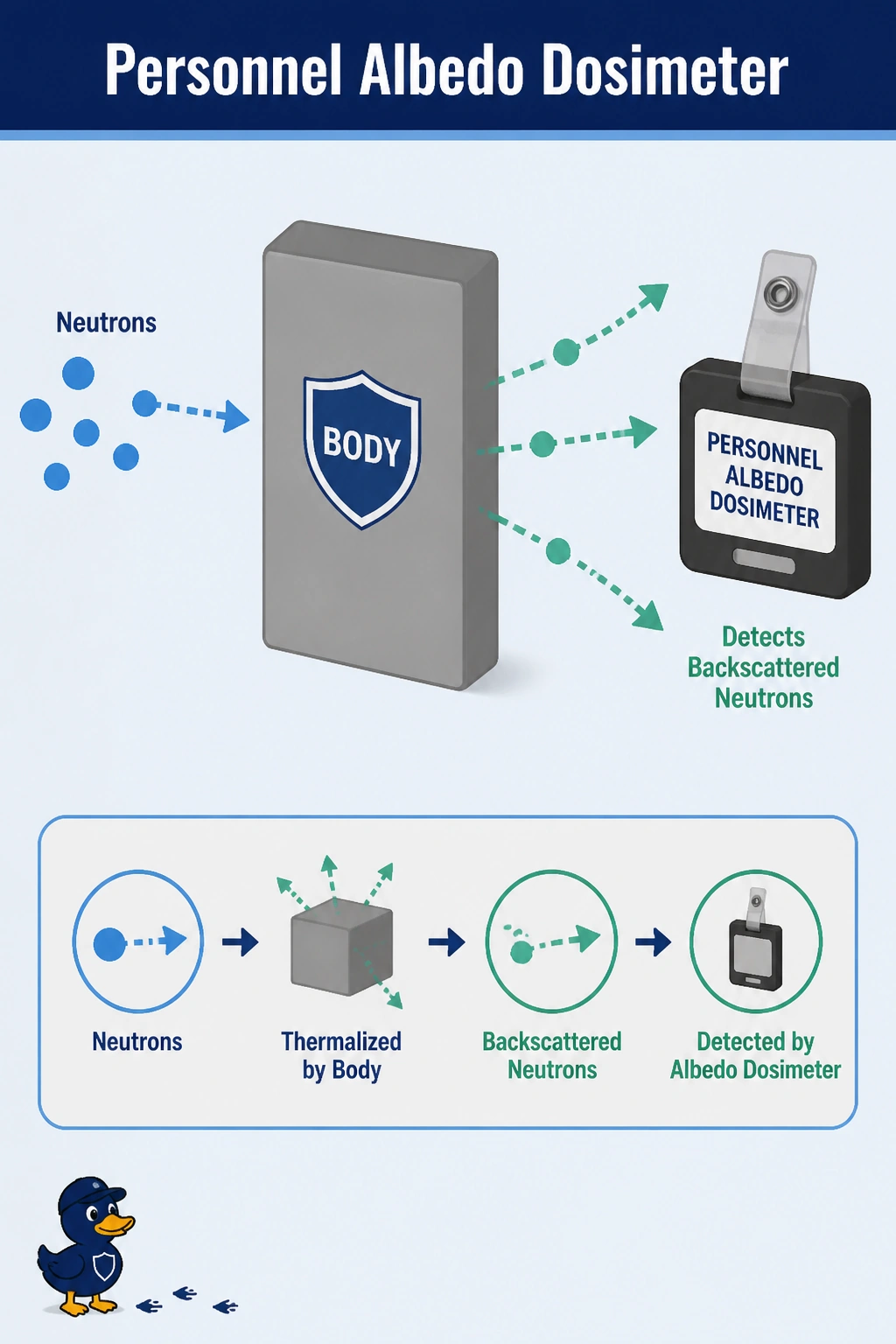
An albedo neutron badge actually uses your own body as part of the detector, catching neutrons that bounce back out after slowing down in hydrogen-rich tissue. The trap is letting the badge dangle loosely on a lanyard, which starves it of that backscattered flux and under-reports your neutron dose.
Full Explanation
Fast and intermediate-energy neutrons interact poorly with standard thin thermoluminescent or OSL elements, so an albedo dosimeter relies on the human body to moderate incident neutrons and scatter thermal neutrons back toward the badge. Wearing it snugly against the torso ensures the geometry needed To detect neutrons thermalized and backscattered by the body, allowing the calibration factor to accurately represent neutron dose equivalent. The option To shield the TLD chip from ambient room light during entry is incorrect because the badge cassette itself is light-tight regardless of how close it sits to the torso. Choosing To prevent low-energy beta particles from penetrating the open badge holder misses the purpose, since beta discrimination is handled by thin and thick filter windows rather than body proximity. Similarly, To keep the badge's internal battery warm in cold rooms does not apply to passive albedo TLD or OSL badges, which contain no batteries. As a caveat, albedo dosimeters are strongly energy-dependent and require neutron field calibration factors matched to the work area spectrum. During pre-entry checks, confirm that workers clip neutron badges firmly to the chest or waist rather than on loose outer lanyards.
Prefer to study offline? Printable PDF study book + test engine ($7.50, unofficial). These questions stay free here.