
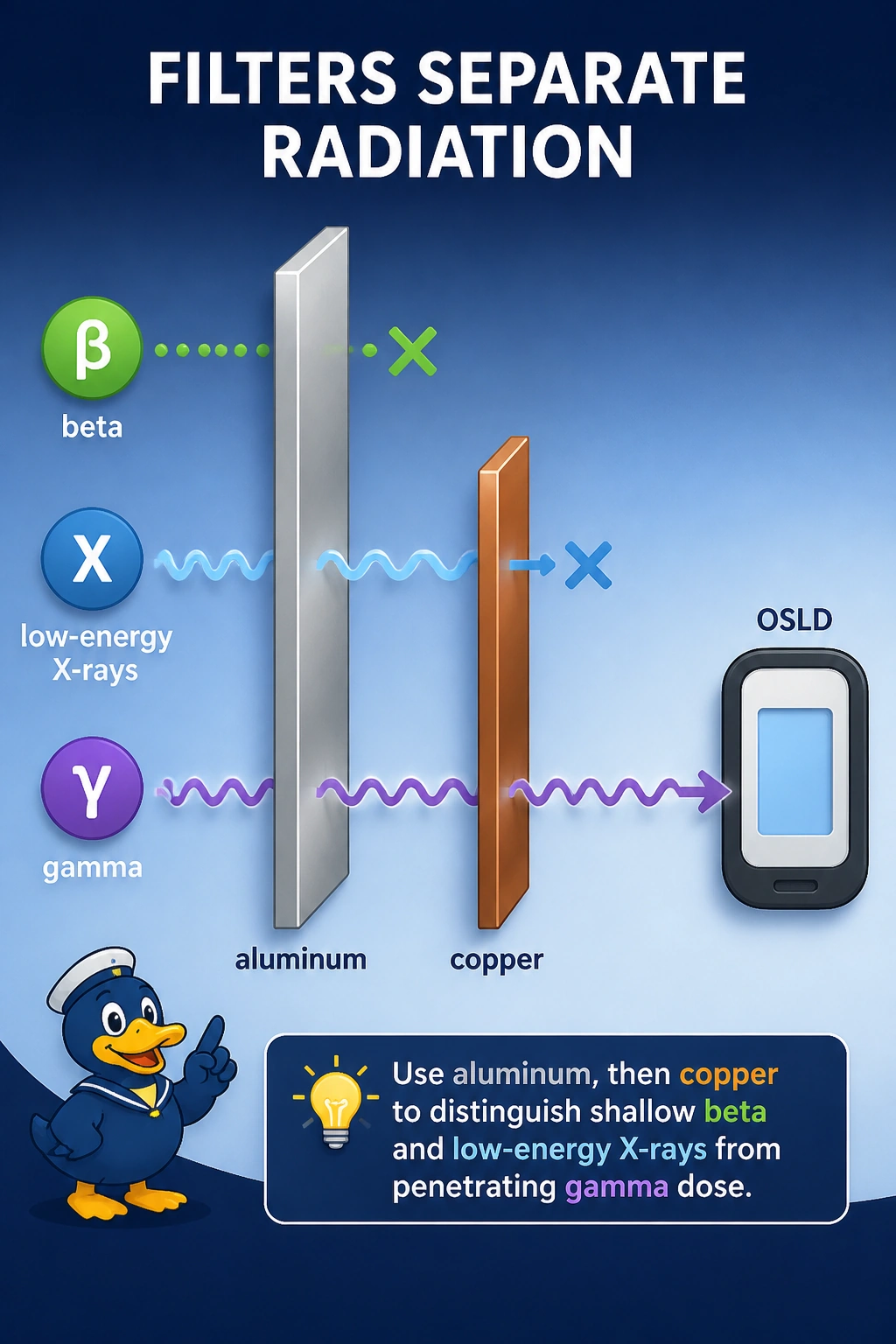
A radiation worker's whole-body optically stimulated luminescence dosimeter (OSLD) badge contains multiple detector elements behind an open window, a thin plastic filter, and thicker metal filters such as aluminum and copper. Why does the badge use these different filter thicknesses?
Select an answer to reveal the explanation.
Short Explanation
A single bare chip in your badge can tell you total energy absorbed, but it cannot tell you whether a beta particle or a high-energy gamma ray delivered it. The trap is assuming the metal filters are just rugged packaging or energy amplifiers. Each filter attenuates radiation differently by energy and type, letting the reader separate shallow skin dose from deep penetrating dose.
Full Explanation
Multi-element passive badges place thin plastic, aluminum, and copper filters over separate OSLD elements—alongside an unshielded open window—to characterize radiation quality and penetration depth. Comparing the response ratios behind these absorbers allows the dosimetry processor to distinguish shallow beta and low-energy X-rays from penetrating gamma dose, enabling accurate reporting of shallow-dose equivalent (0.007 cm), lens dose equivalent (0.3 cm), and deep-dose equivalent (1.0 cm). The filters are not there to shield the detector elements from ambient room light and moisture during field use; a light-tight opaque wrapper performs that role, because room light would optically bleach the OSLD signal. Nor are the metal filters designed to convert fast neutrons into thermal neutrons for direct capture in the aluminum; standard OSLD photon-beta badges do not moderate fast neutrons, which require dedicated neutron dosimeters such as albedo TLD pairs or track-etch detectors. Finally, filters attenuate radiation rather than act to increase the badge's physical sensitivity by amplifying incident photon energy. As an operational caveat, wearing a badge backwards or placing thick objects in front of the open window distorts filter ratios and corrupts shallow-dose algorithms. Operationally, inspect the badge holder before each wear period to confirm the open window faces outward and the case is intact.
Prefer to study offline? Printable PDF study book + test engine ($7.50, unofficial). These questions stay free here.