
Why is a sodium iodide thallium-activated NaI(Tl) gamma scintillation crystal hermetically sealed inside a metal housing with an optical window?
Select an answer to reveal the explanation.
Short Explanation
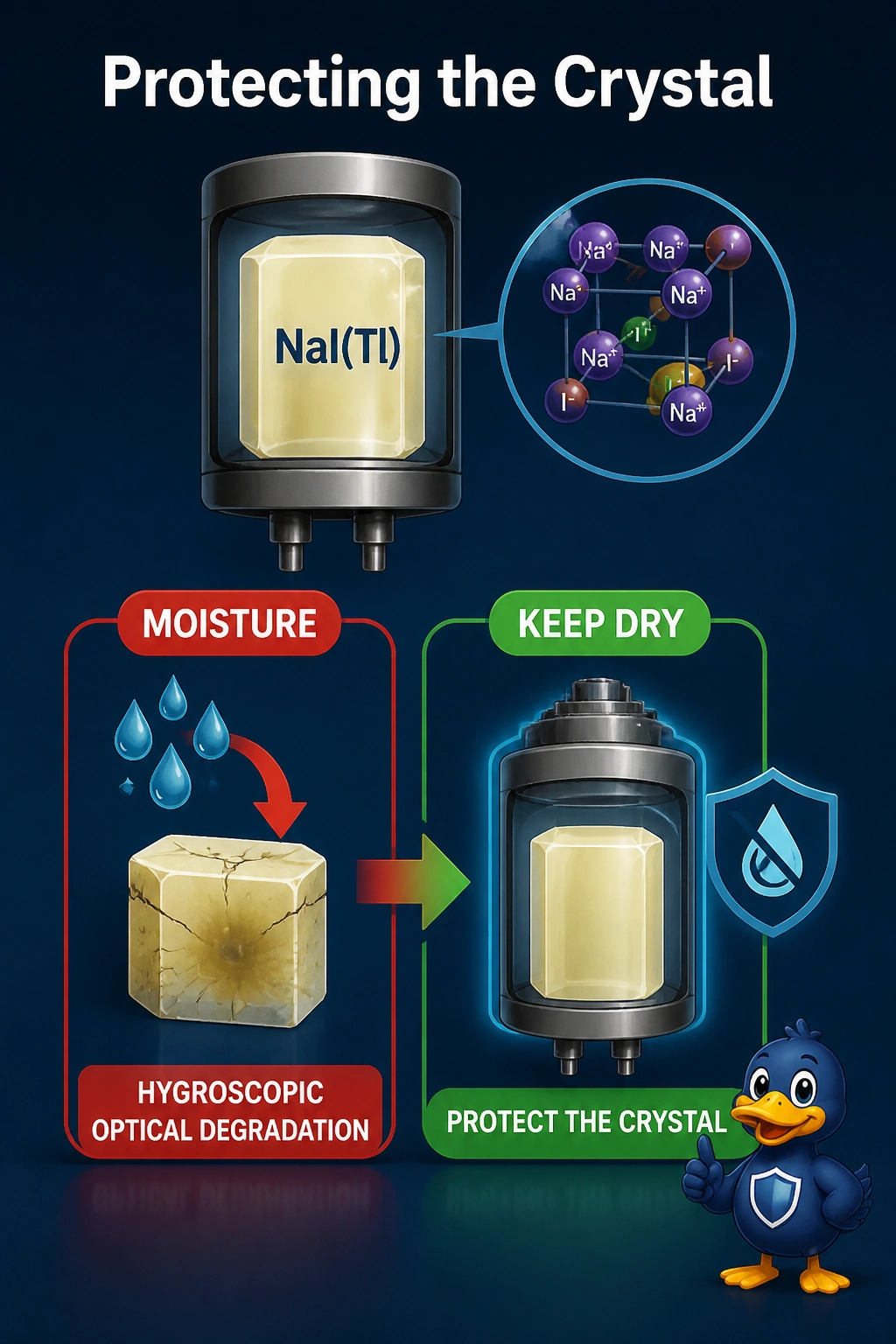
You can remember the key point: hygroscopic sodium iodide absorbs moisture, which can cloud and yellow the crystal and reduce its optical performance. The housing is not a pressurized gas chamber, and neither atmospheric nitrogen nor aluminum oxidation explains the need for the seal.
Full Explanation
A NaI(Tl) crystal must be hermetically sealed because sodium iodide is hygroscopic and degrades optically when exposed to moisture. Absorbed water vapor can make the crystal yellow and opaque, attenuating scintillation photons before they reach the photomultiplier tube and impairing energy resolution. Atmospheric nitrogen does not quench thallium luminescence centers at room temperature: nitrogen does not chemically quench solid-state thallium activator sites in the crystal lattice. A high-pressure fill gas for secondary ion multiplication is not required; that mechanism belongs to gas-filled proportional or Geiger-Mueller tubes, not solid inorganic scintillators. Air exposure does not cause aluminum housing oxidation to shift the gamma photopeak energy, since normal surface oxidation of aluminum does not change gamma photon energies or the crystal’s light yield. As an exam caveat, distinguish moisture-related optical degradation from a shift in gamma photopeak energy: the seal protects the crystal, and aluminum oxidation does not explain that protection. In practice, inspect the probe’s housing seams and entrance window for damage or yellowing, then check photopeak stability with a Cs-137 source.
Prefer to study offline? Printable PDF study book + test engine ($7.50, unofficial). These questions stay free here.