
Why is a portable air-filled ionization chamber operated at a bias voltage in the ionization saturation region rather than in the proportional region when measuring gamma exposure rates?
Select an answer to reveal the explanation.
Short Explanation
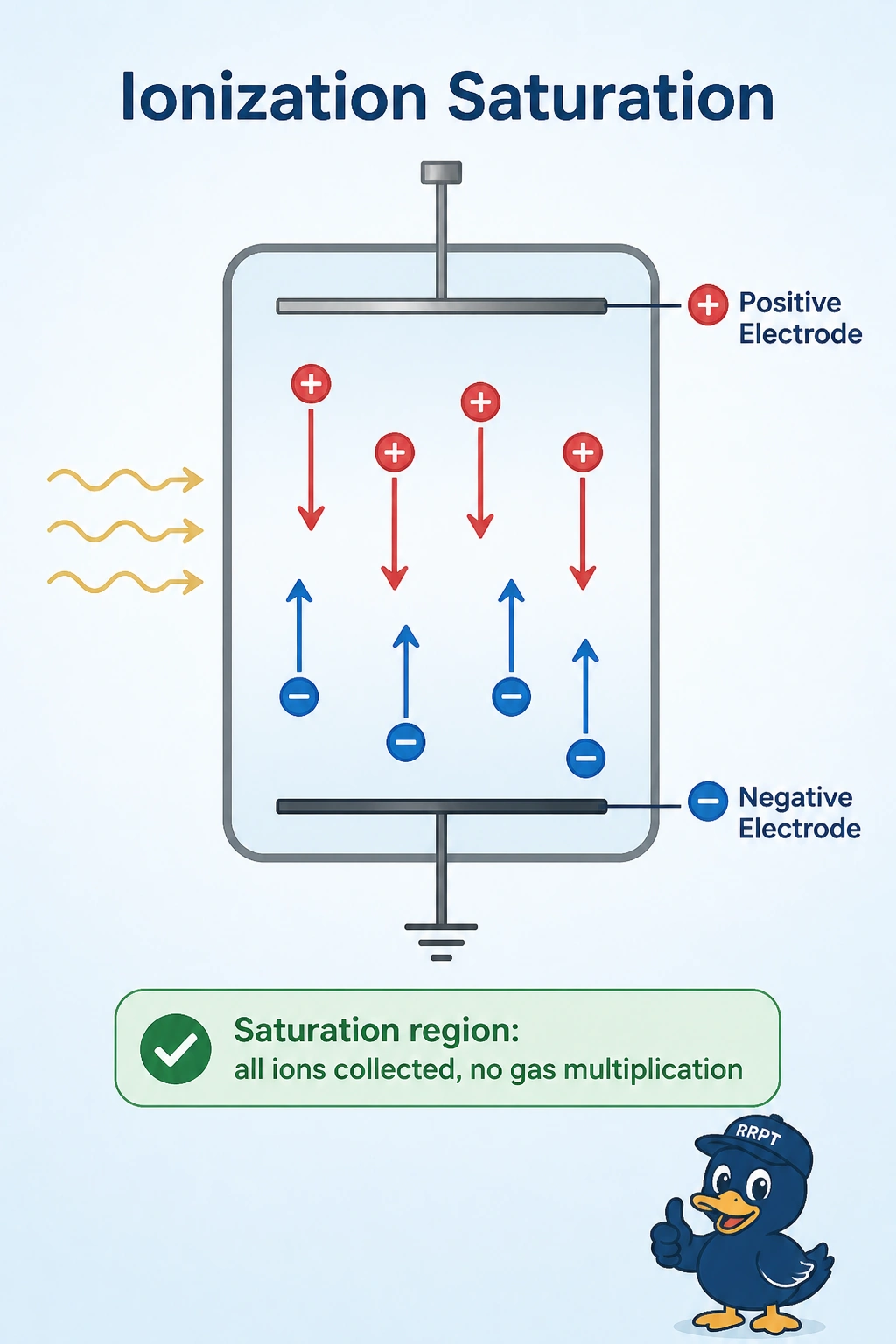
In the ionization saturation region, your meter acts like a faithful accountant—counting every primary ion pair created in air without multiplying them. That flat plateau keeps the current tied directly to roentgens per hour even if battery voltage drifts slightly. The trap is confusing ion chambers with proportional counters or spectrometers that amplify pulses.
Full Explanation
Operating in the saturation region ensures that All primary ions are collected without gas multiplication, keeping output proportional to exposure, which is why ionization chambers serve as standard exposure-rate instruments. The applied electric field is strong enough to sweep primary ion pairs to the electrodes before they recombine, yet below the threshold for secondary Townsend avalanches. The saturation region produces large avalanches that eliminate the need for electrometer amplification describes the Geiger-Mueller or proportional regions, whereas an ionization chamber produces tiny currents requiring a sensitive electrometer. The saturation region prevents photons from interacting with the chamber wall by Compton scattering is false because bias voltage controls charge collection, not photon interactions in the wall. Operating in the saturation region allows the chamber to resolve individual gamma-ray photopeaks confuses a current-mode air chamber with a pulse-mode spectroscopy detector such as HPGe or NaI(Tl). As an operational caveat, if battery voltage sags below the saturation plateau, ion recombination causes the meter to read artificially low. Always perform a battery and check-source check before entering a radiation field.
Prefer to study offline? Printable PDF study book + test engine ($7.50, unofficial). These questions stay free here.