
A radionuclide undergoes branched decay through two competing modes with partial decay constants of 0.10 per hour and 0.30 per hour. Using ln(2) equals 0.693, what is the overall physical half-life of this radionuclide?
Select an answer to reveal the explanation.
Short Explanation
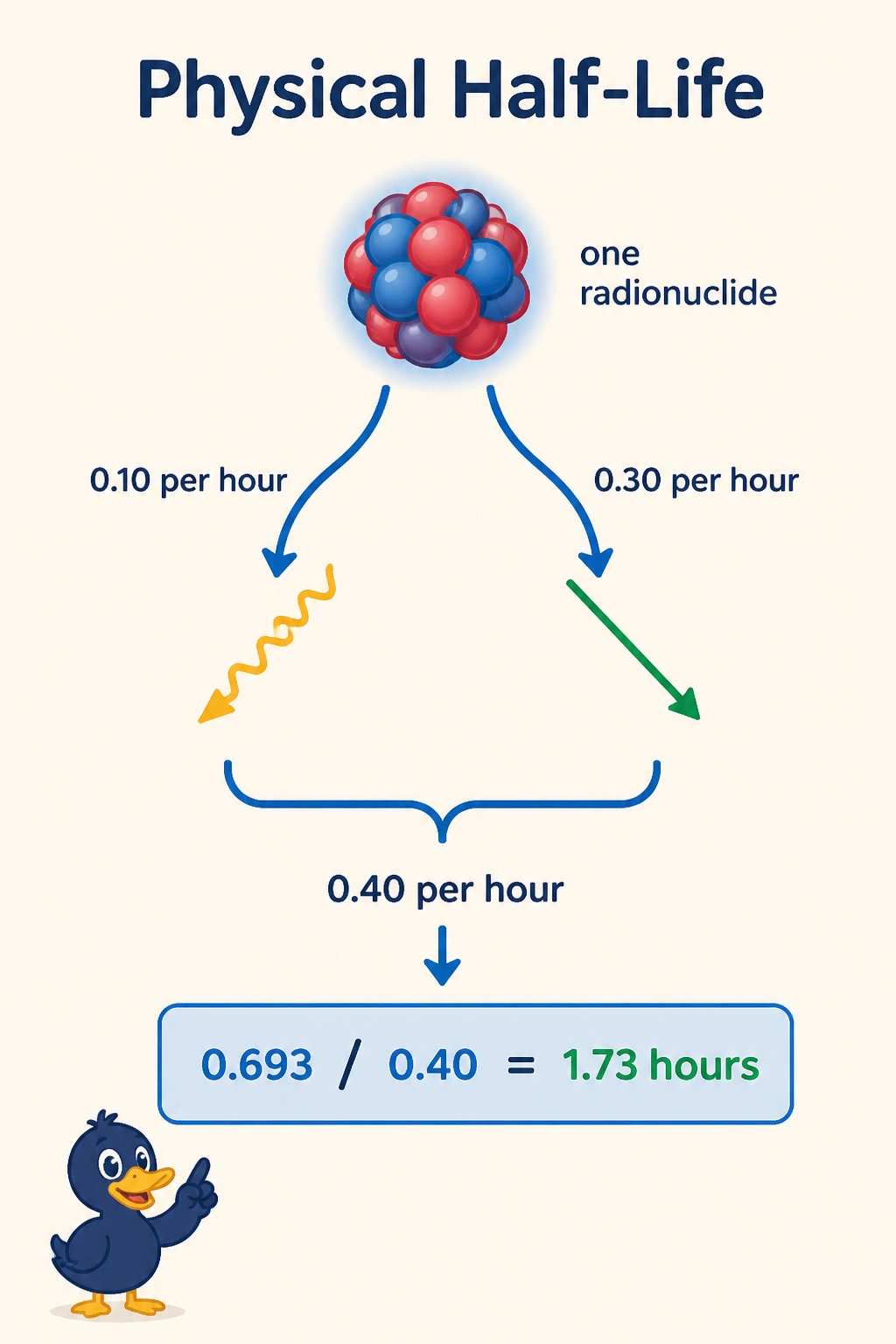
When a nucleus has two ways out, the decay rates add up like two drains emptying the same tub—so the total half-life is shorter than either branch alone. You add the partial decay constants first (0.10 plus 0.30 gives 0.40 per hour) and then divide 0.693 by 0.40 to get 1.73 hours. The trap is computing each partial half-life separately and adding them together to get 9.24 hours.
Full Explanation
For a radionuclide with competing decay modes, the total probability of decay per unit time is the sum of the individual partial decay constants: lambda_total equals lambda_1 plus lambda_2. Adding 0.10 per hour and 0.30 per hour gives a total decay constant of 0.40 per hour, and dividing ln(2) (0.693) by 0.40 per hour yields "1.73 hours total half-life". Choosing "9.24 hours total half-life" is a common error where the partial half-lives (6.93 hours and 2.31 hours) are added together, which would wrongly imply that opening a second decay channel slows down decay. Selecting "2.31 hours total half-life" accounts only for the 0.30 per hour branch while ignoring the 0.10 per hour branch. Picking "6.93 hours as the overall half-life" accounts only for the 0.10 per hour branch while ignoring the faster 0.30 per hour mode. As a caveat, both decay branches govern the disappearance of the parent nuclide at the same 1.73-hour half-life, even though each branch produces its own distinct daughter or radiation signature. As an operational check, verify that the calculated overall half-life is always shorter than the shortest partial half-life.
Prefer to study offline? Printable PDF study book + test engine ($7.50, unofficial). These questions stay free here.