
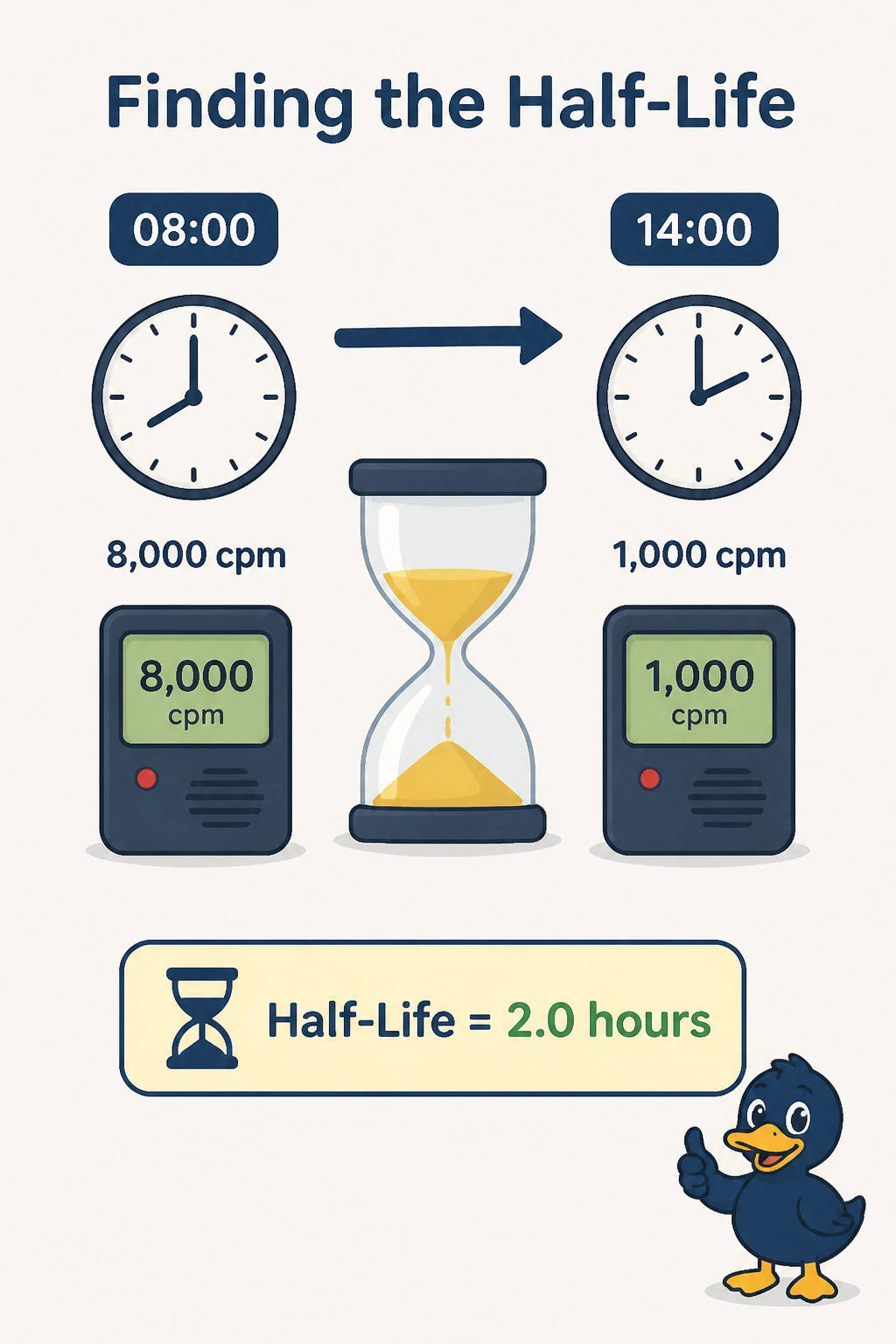
A radiochemistry technician counts a short-lived sample at 08:00 and records a net count rate of 8,000 cpm. Counting the exact same sample geometry at 14:00 yields 1,000 cpm. What is the physical half-life of this radionuclide?
Select an answer to reveal the explanation.
Short Explanation
Whenever a count rate drops by a clean power of two, you can count the halvings on your fingers instead of wrestling with logarithms. The classic trap here is dividing the total elapsed time by the factor of eight instead of the number of half-lives, which will steer you straight to the wrong answer.
Full Explanation
2.0 hours is correct because the net count rate drops from 8,000 cpm to 1,000 cpm, an eightfold reduction that equals three physical half-lives (2^3 = 8) over the 6-hour interval from 08:00 to 14:00, giving 6 hours divided by 3 equals 2.0 hours per half-life. 1.5 hours is incorrect because it assumes four half-lives occurred over the 6-hour span, which would have reduced an initial 8,000 cpm sample down to 500 cpm rather than 1,000 cpm. 3.0 hours is wrong because it reflects only two half-lives in 6 hours, which would leave 2,000 cpm remaining instead of 1,000 cpm. 0.75 hours is the classic error of dividing the 6-hour elapsed time by the activity ratio of 8 rather than by the number of halving steps. As an exam caveat, this shortcut only applies when a single pure radionuclide is present; a mixture of two isotopes with different half-lives will not follow a single straight exponential curve. Operationally, confirm that detector dead time at 8,000 cpm is negligible and subtract a fresh background count before using sequential net rates to verify an isotope's half-life.
Prefer to study offline? Printable PDF study book + test engine ($7.50, unofficial). These questions stay free here.