
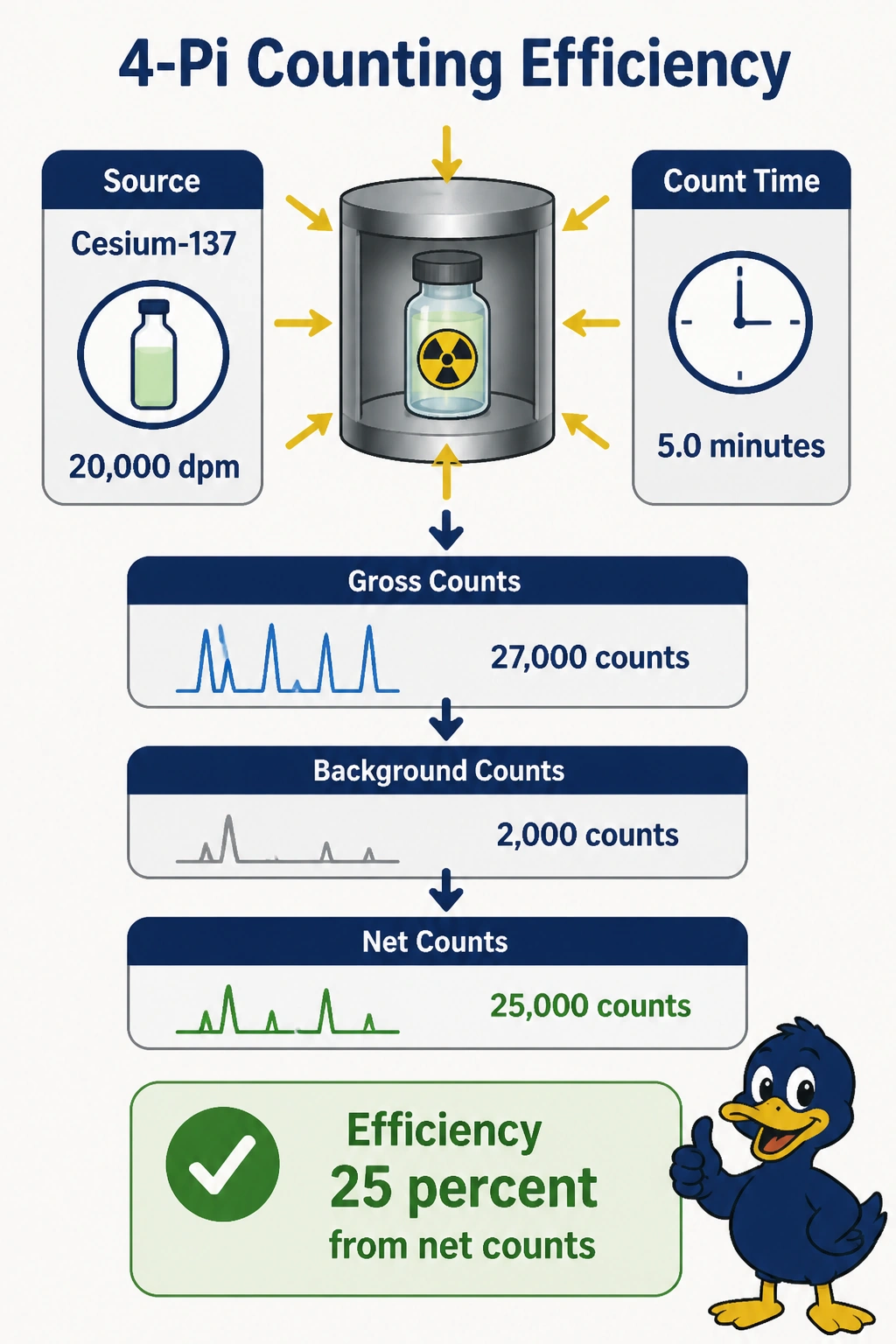
A technician counts a NIST-traceable Cesium-137 check source certified at 20,000 dpm for 5.0 minutes and records 27,000 gross counts. A 5.0-minute background count yields 2,000 counts. What is the detector's 4-pi counting efficiency for this geometry?
Select an answer to reveal the explanation.
Short Explanation
Before you divide counts per minute by disintegrations per minute, always strip out the background! Dividing 27,000 gross counts by 5 minutes gives 5,400 cpm, and subtracting the 400 cpm background leaves 5,000 net cpm—which is 25 percent of 20,000 dpm. The trap is using the gross count rate directly, which inflates your efficiency to 27 percent.
Full Explanation
Detector counting efficiency (in counts per disintegration) is defined as the net count rate divided by the known source disintegration rate. First, convert the 5.0-minute total counts into count rates: 27,000 gross counts divided by 5.0 minutes equals 5,400 cpm, and 2,000 background counts divided by 5.0 minutes equals 400 cpm. Subtracting background gives a net count rate of 5,000 cpm. Dividing 5,000 net cpm by the certified 20,000 dpm source activity yields 0.25, or 25 percent efficiency from net counts. 27 percent efficiency from gross counts is a classic error caused by dividing the 5,400 cpm gross rate by 20,000 dpm without subtracting the 400 cpm background. 20 percent efficiency from net counts and 50 percent efficiency from net counts result from arithmetic errors, such as miscalculating the net rate or misreading the 5.0-minute count duration. Keep in mind that 4-pi efficiency depends strongly on source-to-detector distance, backscatter, and beta energy, so an efficiency determined with Cesium-137 does not apply unchanged to low-energy beta emitters. Before counting smears, verify that the sample shelf position and planchet geometry match the calibration geometry.
Prefer to study offline? Printable PDF study book + test engine ($7.50, unofficial). These questions stay free here.