
A technician is replacing a leaking pump seal inside a posted Contamination Area where wet beta-gamma contamination is present. Why do radiological work procedures require wearing two pairs of gloves (inner and outer) rather than a single thick pair?
Select an answer to reveal the explanation.
Short Explanation
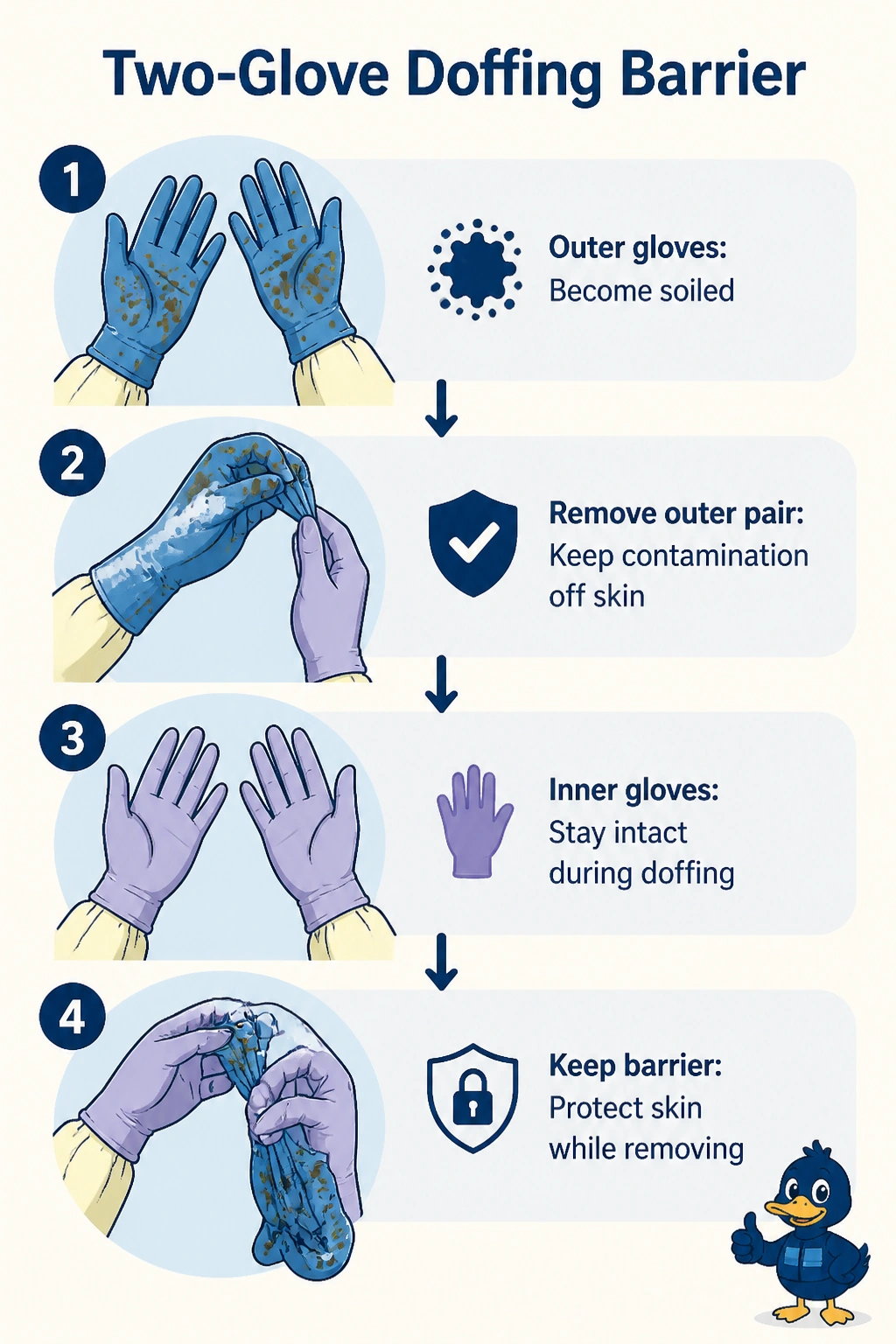
Double gloving gives you a clean safety net when your outer gloves get soaked in contamination. By peeling off the dirty outer pair first, your hands stay protected behind the intact inner gloves while you finish undressing at the step-off pad. The trap is thinking thin rubber gloves can shield penetrating gamma or high-energy beta radiation.
Full Explanation
The key benefit of two-layer gloving is that Removing soiled outer gloves prevents skin contamination while keeping an intact inner barrier during doffing, which stops cross-contamination when a worker handles clean fasteners or unlaces inner protective clothing. Outer gloves can also be swapped mid-job if torn without exposing bare skin. Two glove layers completely shield high-energy beta particles from reaching the hands is wrong because thin elastomer gloves stop alpha and very low-energy betas but cannot fully attenuate high-energy beta particles. Double gloving eliminates the need to frisk hands at the step-off pad upon exit is false because whole-body and hand frisking remain mandatory whenever exiting a Contamination Area. Two pairs of gloves reduce the worker's deep-dose equivalent from gamma emitters is incorrect because thin rubber has negligible attenuation for penetrating gamma rays. As a work-control caveat, double gloving slightly reduces tactile dexterity, which can slow intricate tasks and increase external stay time if workers are not practiced. Operationally, tape or secure the inner glove cuff to the coverall sleeve and inspect outer gloves periodically for pinholes or tears during wet work.
Prefer to study offline? Printable PDF study book + test engine ($7.50, unofficial). These questions stay free here.