
When low-LET gamma rays irradiate human cells, how does the majority of DNA damage occur at the molecular level?
Select an answer to reveal the explanation.
Short Explanation
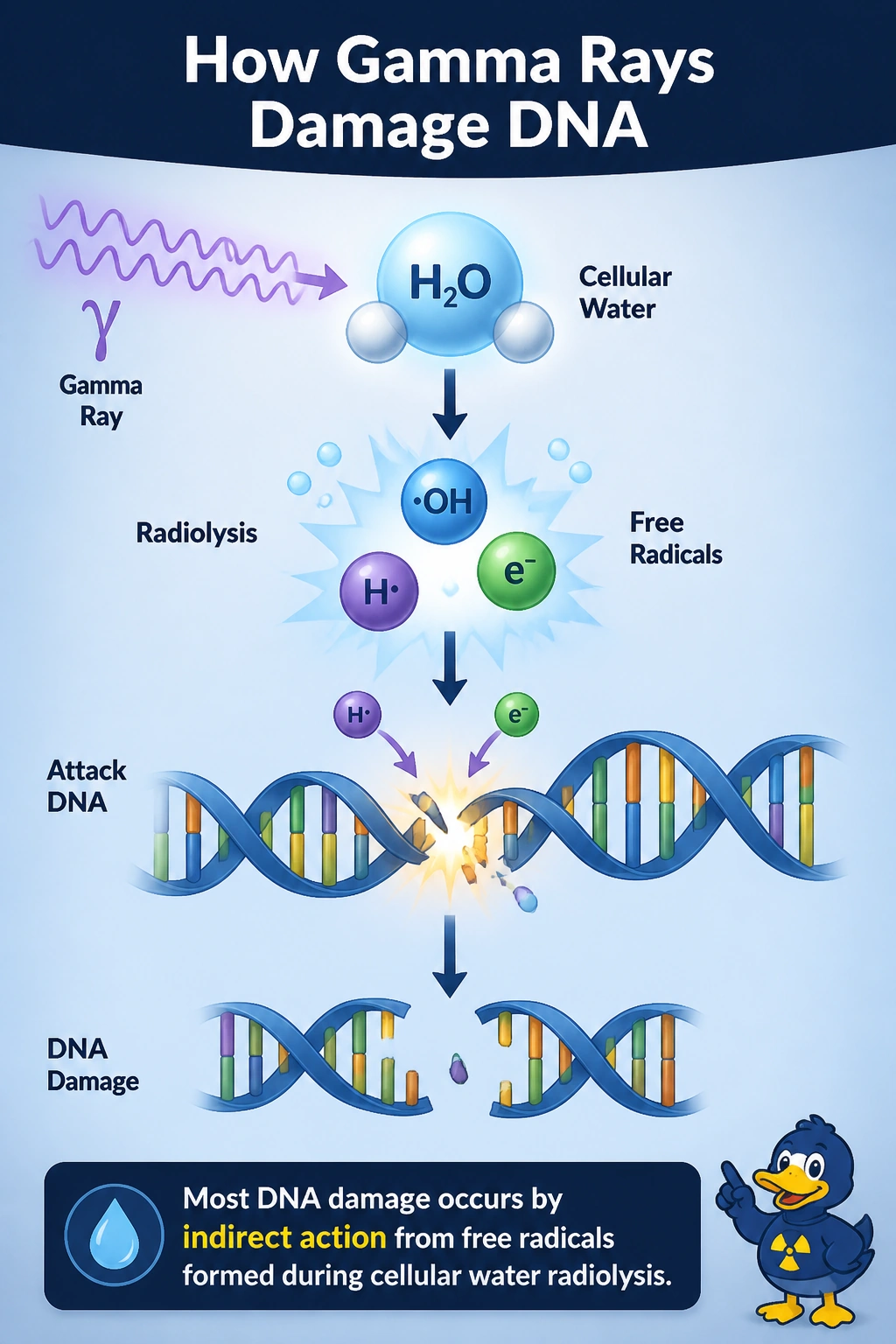
Because human cells are mostly water, incoming gamma rays are far more likely to hit water molecules than a tiny strand of DNA. The trap is assuming radiation must strike the DNA helix directly to break it. For low-LET photons, your real culprit is the swarm of reactive free radicals created by water radiolysis.
Full Explanation
Low-LET photons deposit energy sparsely across tissue, which is roughly three-quarters water, so Indirect action from free radicals formed during the radiolysis of cellular water accounts for most DNA lesions. Ionizing water produces highly reactive hydroxyl and hydrogen radicals that diffuse short distances and chemically break DNA strands or alter bases. Direct elastic collisions between gamma photons and atomic nuclei in the cell membrane mischaracterizes photon interactions, which primarily ionize orbital electrons rather than bouncing off nuclei, and ignores DNA as the critical target. Thermal heating of intracellular proteins that denatures double-stranded DNA helices is wrong because even lethal whole-body radiation doses raise tissue temperature by only thousandths of a degree. Direct nuclear transmutation of stable carbon atoms inside the DNA sugar backbone does not occur at diagnostic or occupational photon energies, which are far below photonuclear thresholds. As a caveat, high-LET particles such as alphas deposit dense ionization tracks along DNA itself, making direct action far more prominent and less dependent on dissolved oxygen. For an operational check, recognize that chemical radical scavengers and hypoxia strongly modify low-LET biological response, whereas high-LET RBE remains high regardless of oxygen status.
Prefer to study offline? Printable PDF study book + test engine ($7.50, unofficial). These questions stay free here.