
An adult worker receives an accidental acute whole-body gamma dose of 3.5 Gy (350 rad) and develops the hematopoietic (bone marrow) subsyndrome of Acute Radiation Syndrome. Which clinical complications pose the primary life-threatening risk during the manifest illness stage?
Select an answer to reveal the explanation.
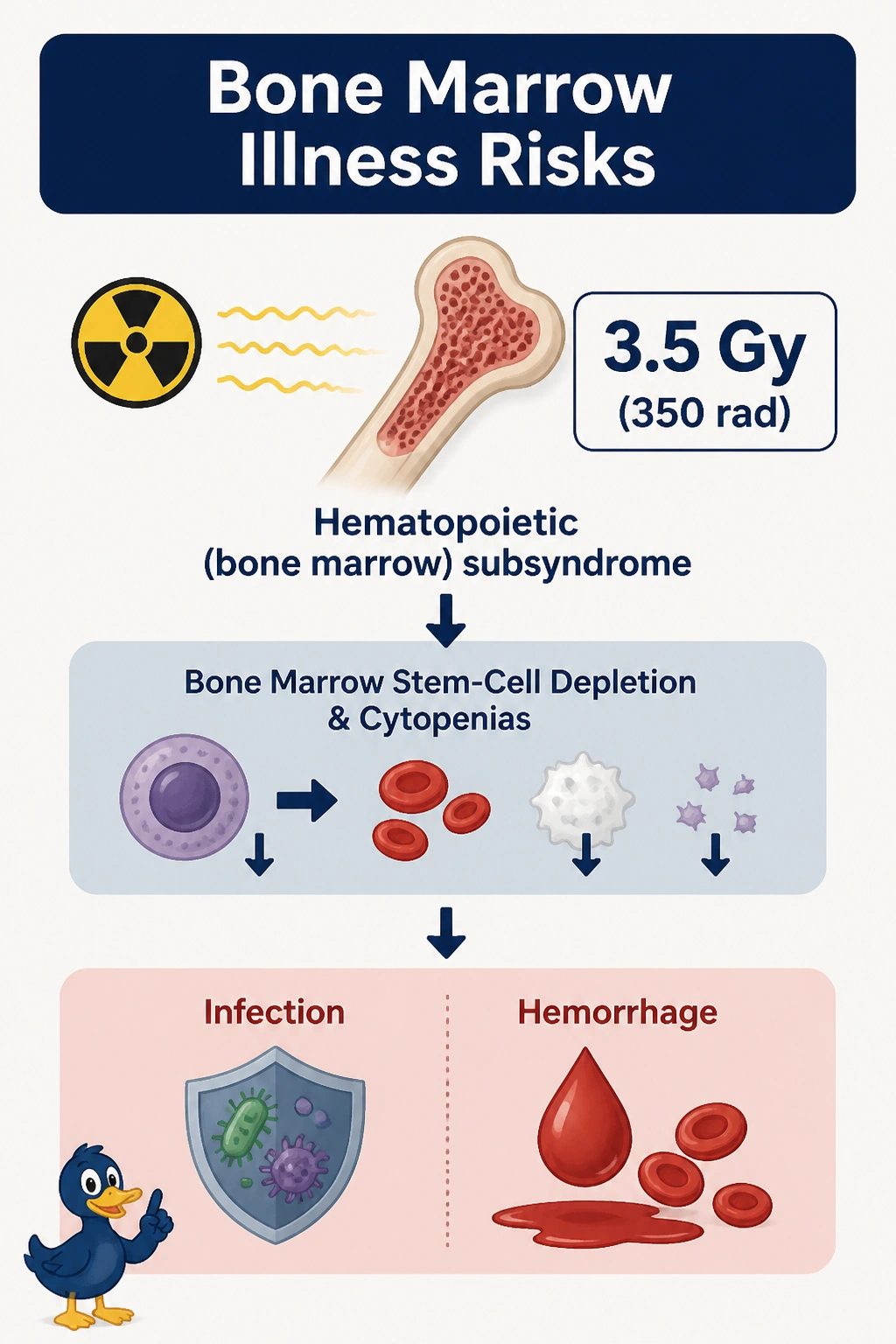
Short Explanation
At 3.5 Gy, the bone marrow is the most radiosensitive vital system, so your main concern in the weeks ahead is what happens when blood-cell production stalls. Without enough white blood cells and platelets, infection and hemorrhage become the primary life-threatening risks. The exam trap is mixing up the hematopoietic dose range with the much higher doses that trigger gastrointestinal or neurovascular collapse.
Full Explanation
Hematopoietic progenitor cells divide rapidly and are highly radiosensitive, making bone marrow the critical organ for acute whole-body doses near 2 to 6 Gy. Selecting Infection and hemorrhage resulting from bone marrow stem-cell depletion and cytopenias is correct because destruction of stem cells causes severe leukopenia (neutropenia) and thrombocytopenia over the following weeks, leaving the patient vulnerable to opportunistic infections and uncontrolled bleeding. Selecting Rapid cerebral edema and vascular collapse occurring within hours of the initial exposure describes the cerebrovascular or central nervous system subsyndrome, which requires massive acute doses typically exceeding 20 to 50 Gy. Selecting Denudation of the small-intestinal mucosal lining causing severe fluid loss within days describes the gastrointestinal subsyndrome, which dominates at higher acute doses around 6 to 15 Gy. Selecting Immediate thermal necrosis of the epidermis followed by irreversible pulmonary fibrosis early on describes localized high-dose skin burns and late deterministic lung injury rather than the acute whole-body hematopoietic syndrome. As an exam caveat, human LD50/60 without medical support lies near 3.5 to 4.5 Gy, though antibiotics, transfusions, and growth factors improve survival. As an operational check, collect serial complete blood counts (tracking absolute lymphocyte depletion) over the first 48 hours to guide triage.
Prefer to study offline? Printable PDF study book + test engine ($7.50, unofficial). These questions stay free here.