
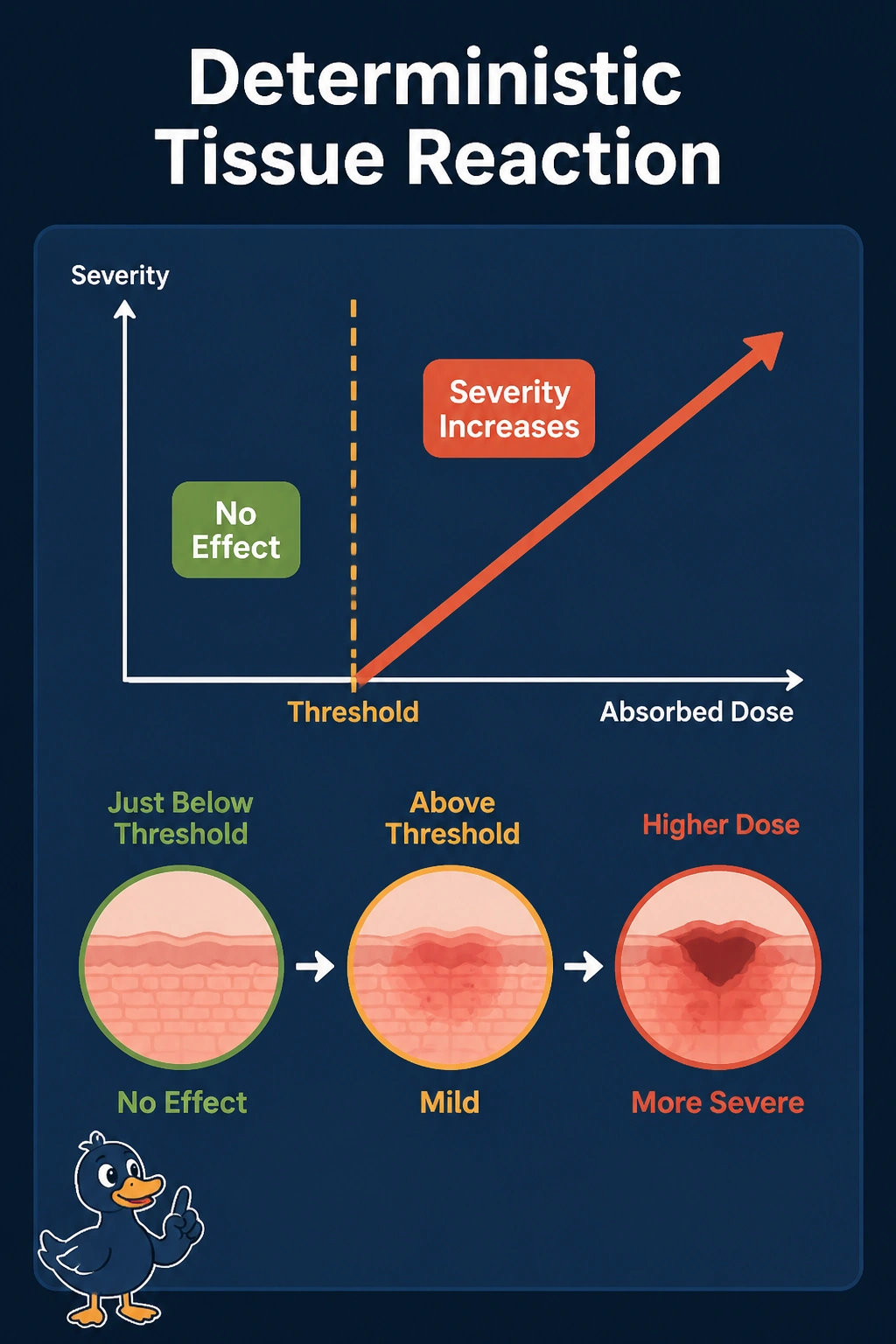
After an accidental localized skin overexposure, a worker develops erythema whose severity increases with the absorbed dose above a specific threshold. How is this biological outcome classified?
Select an answer to reveal the explanation.
Short Explanation
Think of deterministic effects like a sunburn: nothing happens below a threshold, but once you cross it, more dose means a worse burn. Stochastic effects are the opposite—like buying lottery tickets, where more dose raises your odds, not the severity. Keep those two rules straight so you never mix up erythema with cancer risk.
Full Explanation
Skin erythema results from the killing or functional impairment of enough cells in the basal layer of the epidermis to cause visible tissue damage, making it A deterministic tissue reaction. Deterministic effects (also called tissue reactions) exhibit a practical dose threshold below which the clinical effect does not appear, and once that threshold is exceeded, the severity of the injury increases with increasing dose. A stochastic effect with no threshold describes outcomes such as radiation-induced cancer, where the probability of occurrence—not the severity of the disease—increases with dose and no threshold is assumed for radiation protection purposes. A heritable genetic mutation effect is also a stochastic effect involving germ cells rather than an acute localized skin injury. A linear non-threshold carcinogenesis refers to the dose-response model used to estimate stochastic cancer risk at low doses, not a threshold-governed tissue reaction. As a caveat, dose protraction or fractionation over time allows cellular repair, raising the total dose required to produce a deterministic skin reaction compared to a single acute exposure. Operationally, any suspected localized extremity or skin overexposure triggers prompt shallow-dose reconstruction, medical evaluation, and regulatory dose assessment.
Prefer to study offline? Printable PDF study book + test engine ($7.50, unofficial). These questions stay free here.