
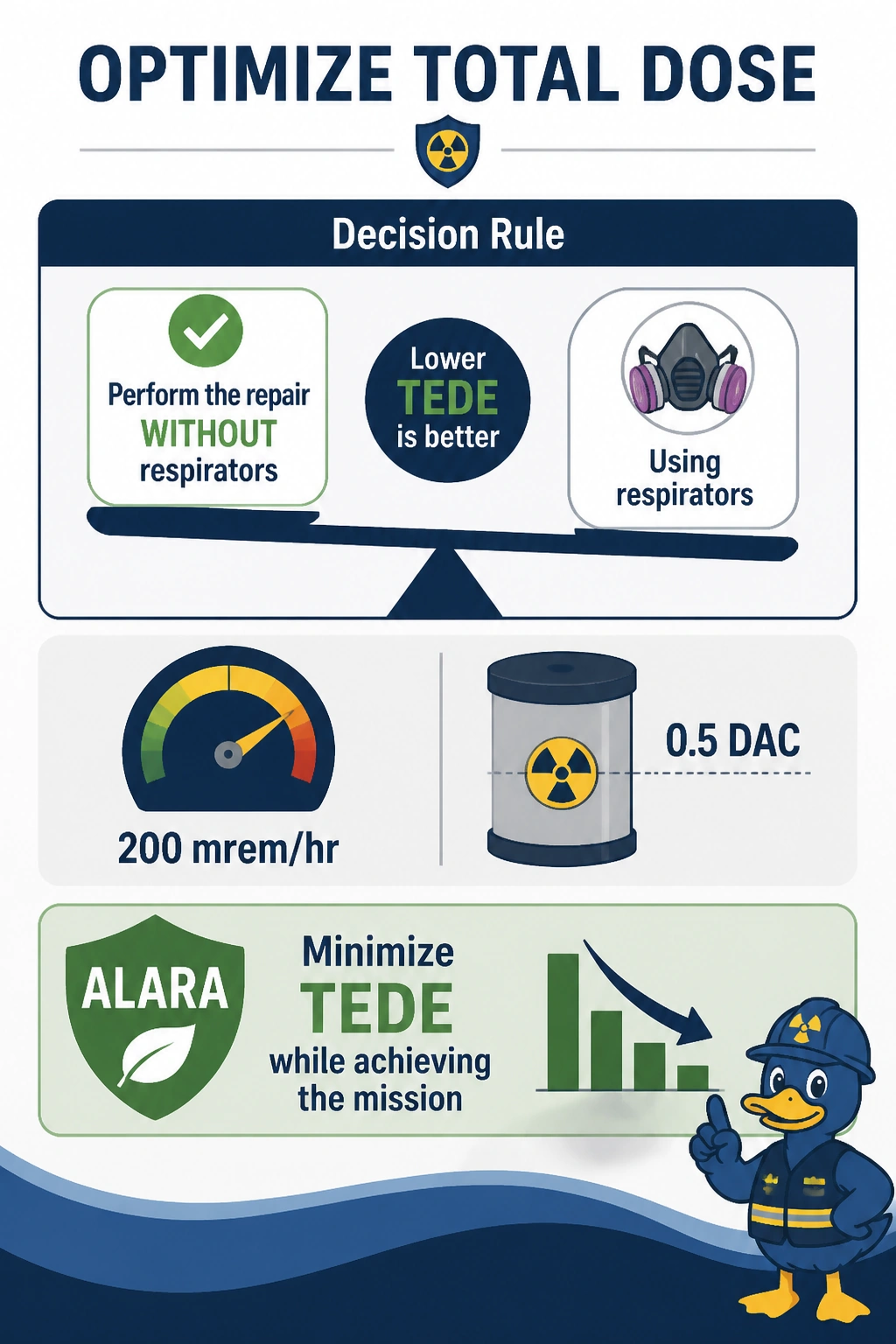
A crew must repair a valve in a 200 mrem/hr gamma field where airborne concentration is 0.5 DAC. Wearing full-face respirators would double the repair time because of reduced visibility and communication. Applying ALARA TEDE optimization, what should the planner do?
Select an answer to reveal the explanation.
Short Explanation
ALARA is about minimizing total dose, not chasing zero internal dose at the cost of a huge external dose penalty. When a respirator slows your crew down in a 200 mrem/hr gamma field while airborne activity is only 0.5 DAC, keeping masks off can actually cut total effective dose equivalent. The trap is treating respiratory protection as mandatory without weighing external stay-time penalties.
Full Explanation
Under NRC 10 CFR 20.1702 and ALARA principles, respiratory protection must not be used if it increases the total effective dose equivalent (TEDE), which sums external deep-dose equivalent (DDE) and internal committed effective dose equivalent (CEDE). In a 200 mrem/hr gamma field and 0.5 DAC airborne area. One hour unmasked in this field adds 200 mrem deep-dose equivalent and only 1.25 mrem CEDE (0.5 DAC times 2.5 mrem per DAC-hour). Doubling that hour because of respirators adds another 200 mrem external dose to avoid about 1.25 mrem internal dose. So the planner should Perform the repair without respirators if total effective dose equivalent is lower. Require full-face respirators anyway to eliminate any internal CEDE contribution fails because eliminating a tiny internal dose by adding a much larger external gamma dose violates TEDE optimization. Require supplied-air hoods to maximize respiratory protection factor during the job worsens the problem by adding hose-management delays and further extending stay time in the 200 mrem/hr field. Divide the work among twice as many technicians while still wearing respirators may lower each person's individual dose, but collective person-rem remains unnecessarily inflated by the respirator delay factor. Note that this optimization assumes airborne concentrations remain stable and well below acute hazard levels. Before waiving respirators, verify air-sampling trends and document the TEDE comparison in the Radiation Work Permit.
Prefer to study offline? Printable PDF study book + test engine ($7.50, unofficial). These questions stay free here.