
A technologist must perform a brief visual inspection of a valve located near an unshielded gamma source, and no temporary shielding is available. Applying ALARA principles for external exposure, which action provides the greatest immediate dose reduction if the inspection duration is fixed?
Select an answer to reveal the explanation.
Short Explanation
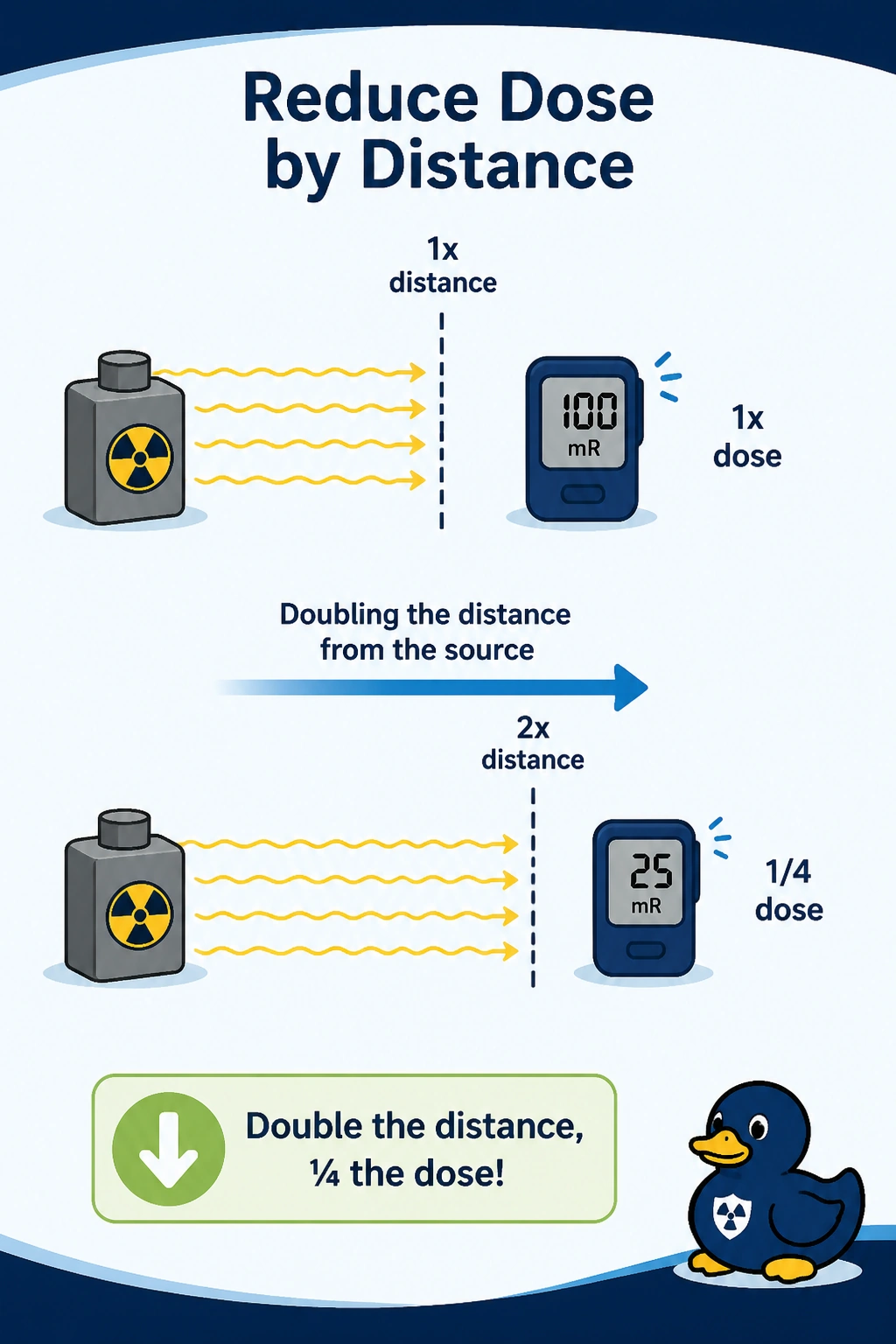
With the inspection time fixed and no temporary shielding available, doubling your distance from the gamma source is your strongest immediate control. For a point source, the inverse square law reduces the dose rate to one-fourth; an X-ray apron offers little protection from high-energy gamma rays, and changing or completing dosimetry does not reduce exposure.
Full Explanation
External radiation protection relies on three fundamental controls: time, distance, and shielding. Since the inspection duration is fixed and temporary shielding is unavailable, doubling the distance from the source applies the inverse square law: for a point source, the exposure rate falls to one-fourth of its value at the original distance, giving an immediate dose reduction during the inspection. Wearing a standard lead apron rated for X-rays, typically 0.25 to 0.5 mm lead equivalent, provides negligible attenuation for high-energy gamma rays; its weight can also slow movement and increase exposure time. Using a pocket ion chamber instead of a TLD changes how dose is measured: the ion chamber allows real-time dose tracking rather than delayed readout, but neither dosimeter reduces the radiation field. Completing a post-job dose rate survey happens after the exposure and cannot reduce the dose received during the inspection. One caveat is that moving farther away must still permit a clear visual inspection. Before starting, verify the dose rate at the planned distance with a calibrated survey meter.
Prefer to study offline? Printable PDF study book + test engine ($7.50, unofficial). These questions stay free here.