
A PCT records afternoon vitals for a stable adult postoperative patient receiving fluids: temperature 101.8°F, pulse 122, respirations 26, blood pressure 88/54, and oxygen saturation 91% on room air. The patient is drowsy but arousable and denies chest pain. Which recognition and reporting action best addresses values outside reference ranges?
Select an answer to reveal the explanation.
Short Explanation
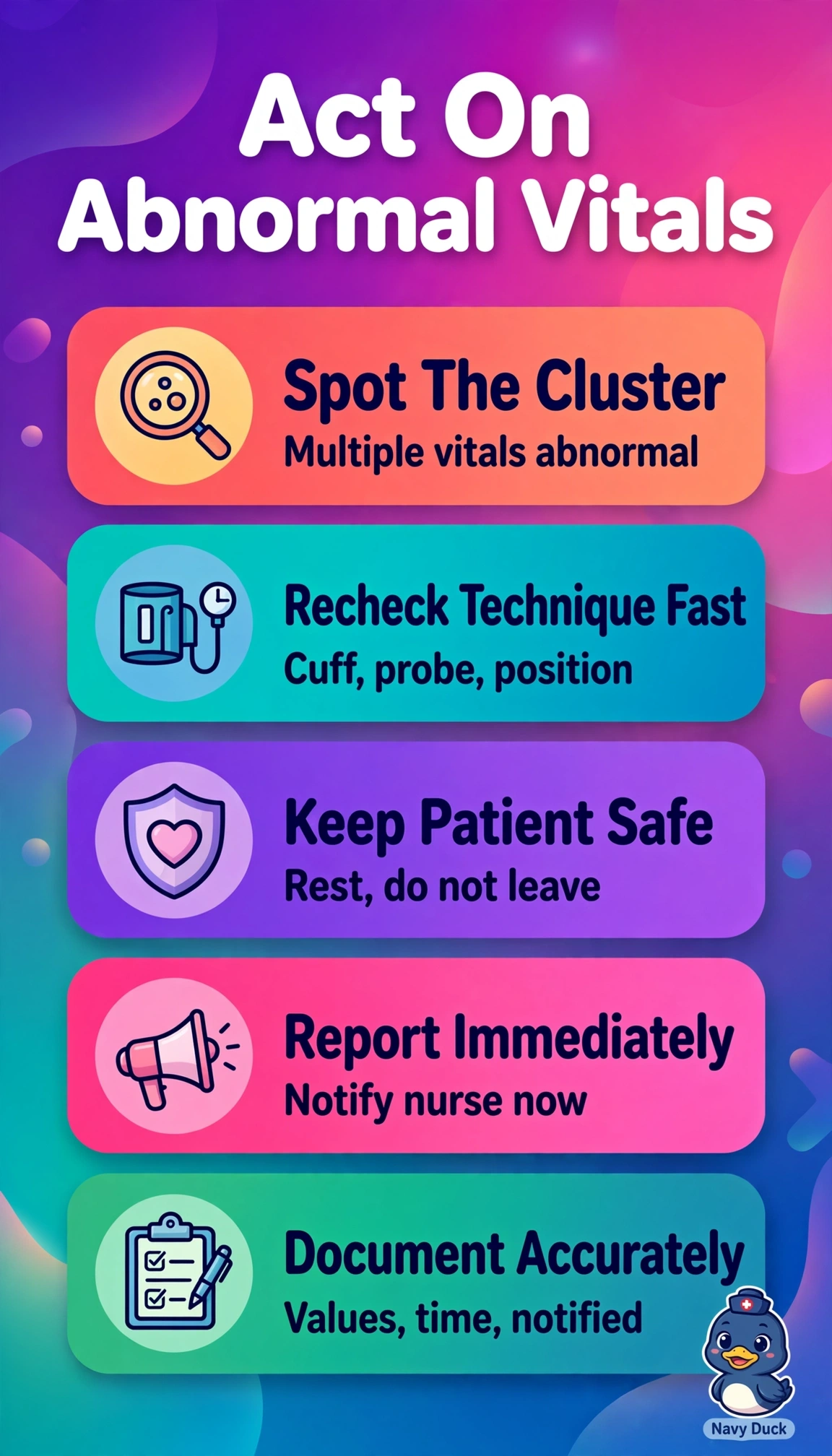
One red flag deserves attention, and a whole cluster demands backup now. Timely reporting turns your rechecked numbers into rapid rescue.
Full Explanation
The correct response is appropriate because all five values fall outside adult reference ranges — fever, tachycardia, tachypnea, hypotension, and hypoxemia — in a postoperative patient receiving fluids who is drowsy, which together suggest acute deterioration such as sepsis or hypoperfusion requiring urgent nursing evaluation, and the PCT role is to verify measurement quality and escalate the complete picture without delay rather than interpret or treat. Delaying notification to re-observe for an hour applies a stable trending concept that is unsafe here because hypotension with tachycardia, tachypnea, and low oxygen cannot wait for routine reassessment. Reporting only hypotension applies appropriate prioritization but violates completeness because fever, tachycardia, tachypnea, and hypoxemia are essential context for the nurse to recognize systemic compromise. Reporting immediately without rechecking technique applies appropriate escalation but omits verification because cuff size, probe placement, motion, and thermometer technique commonly cause error and rechecking prevents false alarms while confirming urgency. The exam caveat is to choose immediate full-set escalation over watchful waiting whenever multiple vitals are abnormal with altered mentation, even if the stem notes denial of chest pain or stable history. A practical check is to re-take vitals with correct cuff, probe, and patient positioning, ensure the patient is arousable and safe, and hand off exact numbers, time, symptoms, fluids, and postoperative status using closed-loop communication.