
A post-surgical technician is asked to assist the nurse with a sterile abdominal dressing change for an afebrile adult, then remove a saline-locked peripheral IV from the forearm per facility protocol after the nurse assesses the site. The overbed table is cleared for a sterile field. Which technician action best supports sterile and aseptic dressing changes and safe peripheral IV removal?
Select an answer to reveal the explanation.
Short Explanation
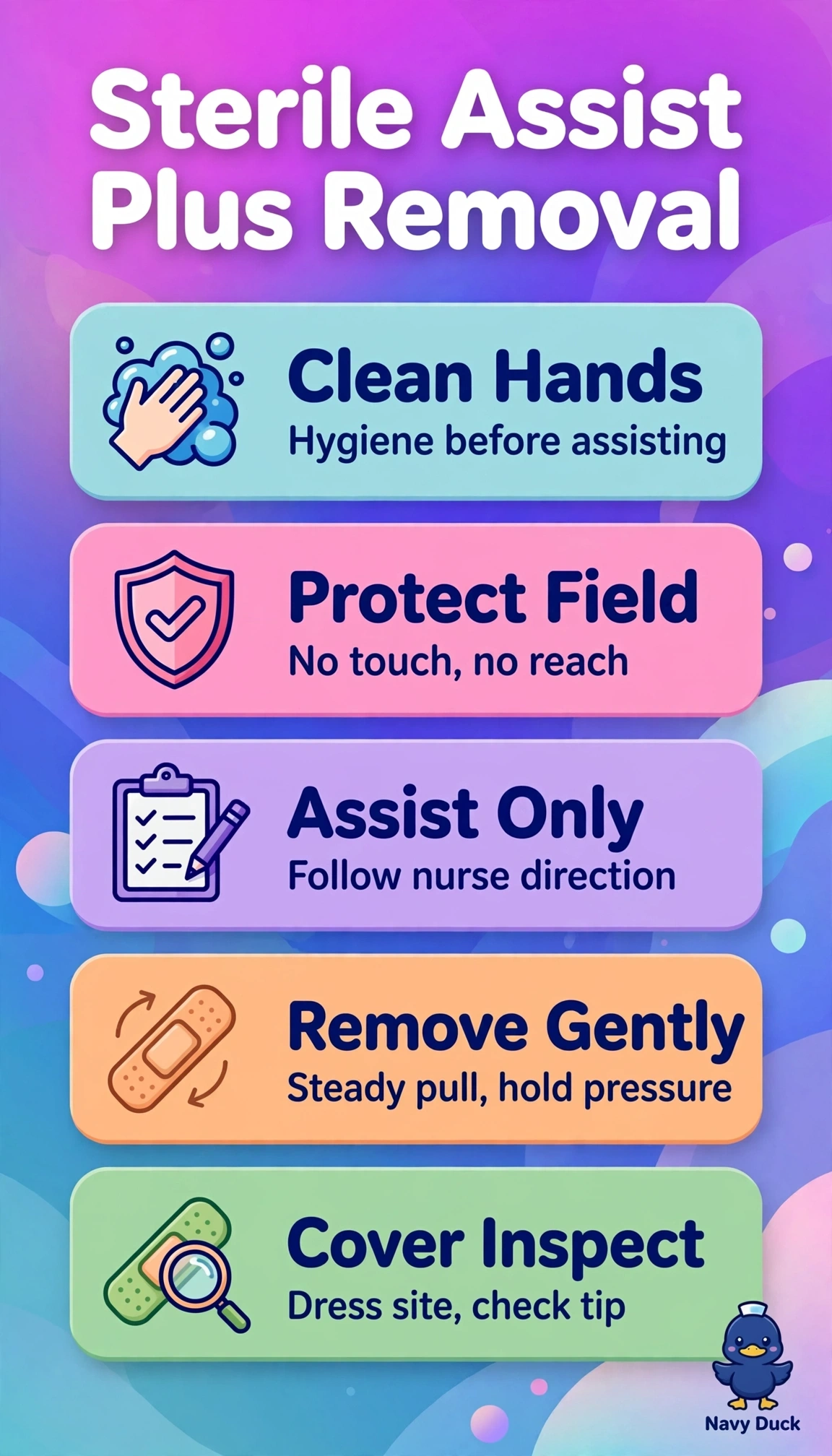
You’ll help most by performing hand hygiene, opening supplies without crossing the field, and assisting as directed. When the nurse has assessed the site, you can remove the forearm IV gently and hold pressure to protect the sterile field and control bleeding.
Full Explanation
The correct action combines aseptic technique with safe role boundaries: hand hygiene reduces bioburden, and opening sterile supplies without crossing the field helps maintain sterility on the cleared overbed table. Assisting as directed keeps the post-surgical abdominal dressing change under nursing responsibility; after the nurse assesses the IV site, gentle removal of the saline-locked forearm catheter and pressure support hemostasis. Performing the dressing change independently to save time fails on delegation: a post-surgical sterile dressing change requiring nursing judgment is not the technician’s to complete independently, even with proper preparation. Disconnecting infusion tubing and flushing fails on device accuracy: the IV is saline-locked, with no continuous infusion, so disconnecting tubing or flushing before removal is not appropriate. Removing the IV before the nurse completes the site assessment fails on sequencing: assessment for inflammation, infiltration, or drainage guides documentation and follow-up. An exam caveat is that an action that may be appropriate in another setting can be wrong when it conflicts with qualifiers such as assisting as directed, removal after assessment, or a saline-locked device. As a practical check, confirm hand hygiene, field integrity, nurse direction, and completed site assessment before removal; then apply pressure and cover the site.