
An emergency department technician collects a court-ordered urine drug screen from an adult trauma patient who cannot consent, with a nurse witness present, using a sealed kit that requires locked storage. The provider orders continuous documentation of every handler until lab pickup. Which chain-of-custody action should the technician complete to preserve forensic specimen integrity?
Select an answer to reveal the explanation.
Short Explanation
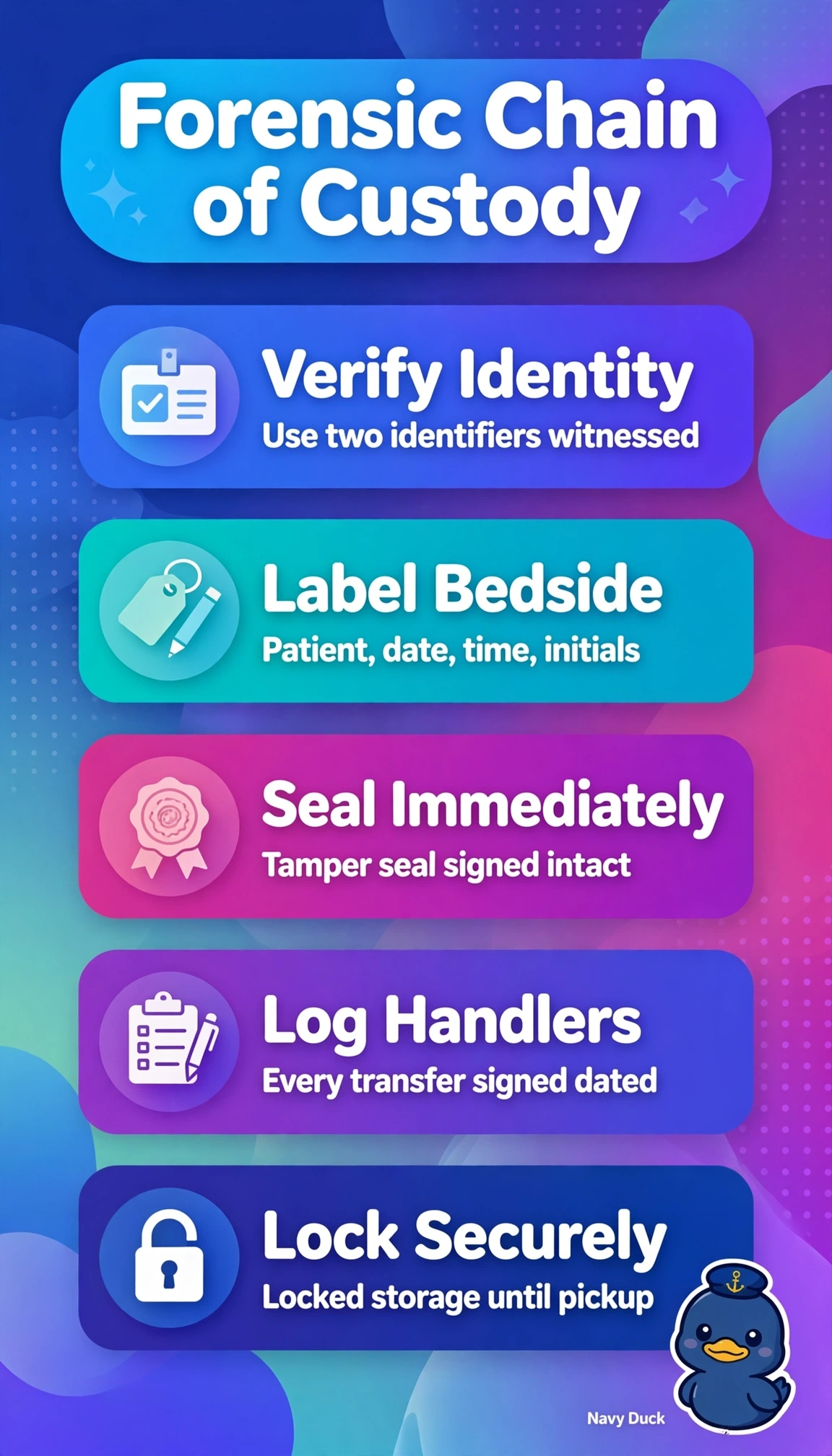
You are the specimen's bodyguard from bedside to lab. Keeping it sealed and signed at every handoff blocks claims of tampering.
Full Explanation
For a court-ordered specimen from a patient unable to consent, forensic integrity requires proving identity, preventing tampering, and accounting for every custodian until lab pickup, which bedside labeling with tamper-evident sealing plus a complete witnessed signature log into locked storage satisfies together. Moving sealing to the central workstation even with witness observation and locked storage fails on immediacy because transporting an unsealed forensic container creates an unobservable interval where substitution or contamination cannot be disproven, so the seal must occur at bedside before movement. Documenting only collection and pickup times despite correct sealing and locked storage fails on continuity because endpoints leave interim transfers unaccounted for, while a court requires an unbroken record of each handler to defeat challenges about access. Placing a correctly sealed and logged kit in the routine refrigerated specimen area fails on security because refrigeration preserves stability but allows shared access, whereas locked storage proves exclusive control and restricted access required for admissibility. As an exam caveat, routine clinical urinalysis often permits workstation labeling, endpoint charting, and shared refrigeration, but forensic questions add bedside seal, every-handler accounting, and locked custody as mandatory even when the collection technique looks otherwise identical. As a practical check, complete labels, seals, witness signatures, and the first log entry before leaving the bedside and place the kit directly into designated locked storage with a signature for each later handoff.