
A PCT coaches a 58-year-old post-laparotomy patient who is drowsy, splints the incision, has a nasal cannula at prescribed flow, and needs to clear secretions. The nurse delegated incentive spirometer, oral suction available only, and TCDB exercises. Which combined technique should the PCT use for oxygen, spirometer, suction and TCDB?
Select an answer to reveal the explanation.
Short Explanation
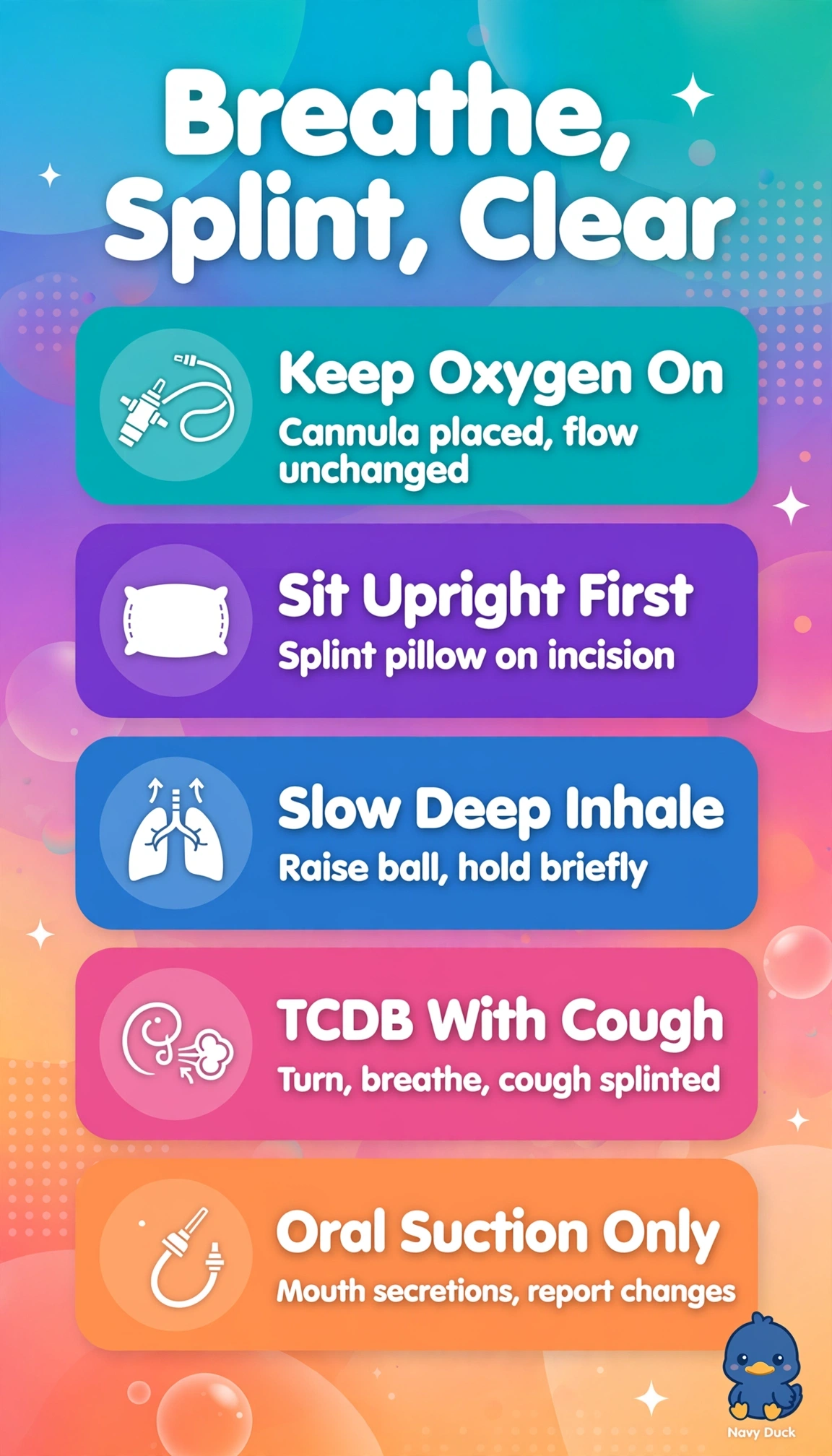
You'll keep the cannula on while you coach slow spirometer breaths with holds, then have your patient splint, cough, and let you clear the mouth with oral suction. You're easing stiff lungs open gently, like slowly unsticking a zipper, so you get better airflow without pain spikes.
Full Explanation
The correct approach maintains prescribed oxygenation during exertion while achieving lung recruitment and safe clearance: keeping the cannula at ordered flow prevents desaturation in a drowsy patient, slow spirometer inhalation with end-inspiratory hold sustains alveolar inflation to prevent postoperative atelectasis, and pillow-splinted TCDB stabilizes the laparotomy incision to allow an effective productive cough with oral Yankauer suction for expectorated secretions within PCT scope. The upright unsplinted version fails incision protection because without firm splinting pain inhibits cough effort and increased intra-abdominal pressure strains the wound, even though oxygen, spirometry and suction are correct. The without-holds version fails sustained inflation because a deep breath that is immediately exhaled does not maintain distending pressure long enough to open collapsed alveoli, which is the distinct purpose of incentive spirometry versus ordinary deep breathing. The flat-supine version fails positioning safety because drowsiness plus supine impairs diaphragmatic excursion and raises aspiration risk, whereas semi-Fowler upright positioning optimizes ventilation and secretion mobilization. On exams remember PCTs never change oxygen flow or advance suction beyond the mouth without nurse direction and scope authorization, and in practice always verify ordered flow, oximetry, upright positioning, pillow in place, suction tested, and readiness to pause if dizziness or severe pain occurs.