
You are assisting a post-surgical adult with a new colostomy who is anxious about odor and leakage, plus a different patient prescribed a cleansing enema for constipation who prefers privacy and clear instructions in a small shared room. Which ostomy and enema assistance approach should you provide within your scope for these tasks?
Select an answer to reveal the explanation.
Short Explanation
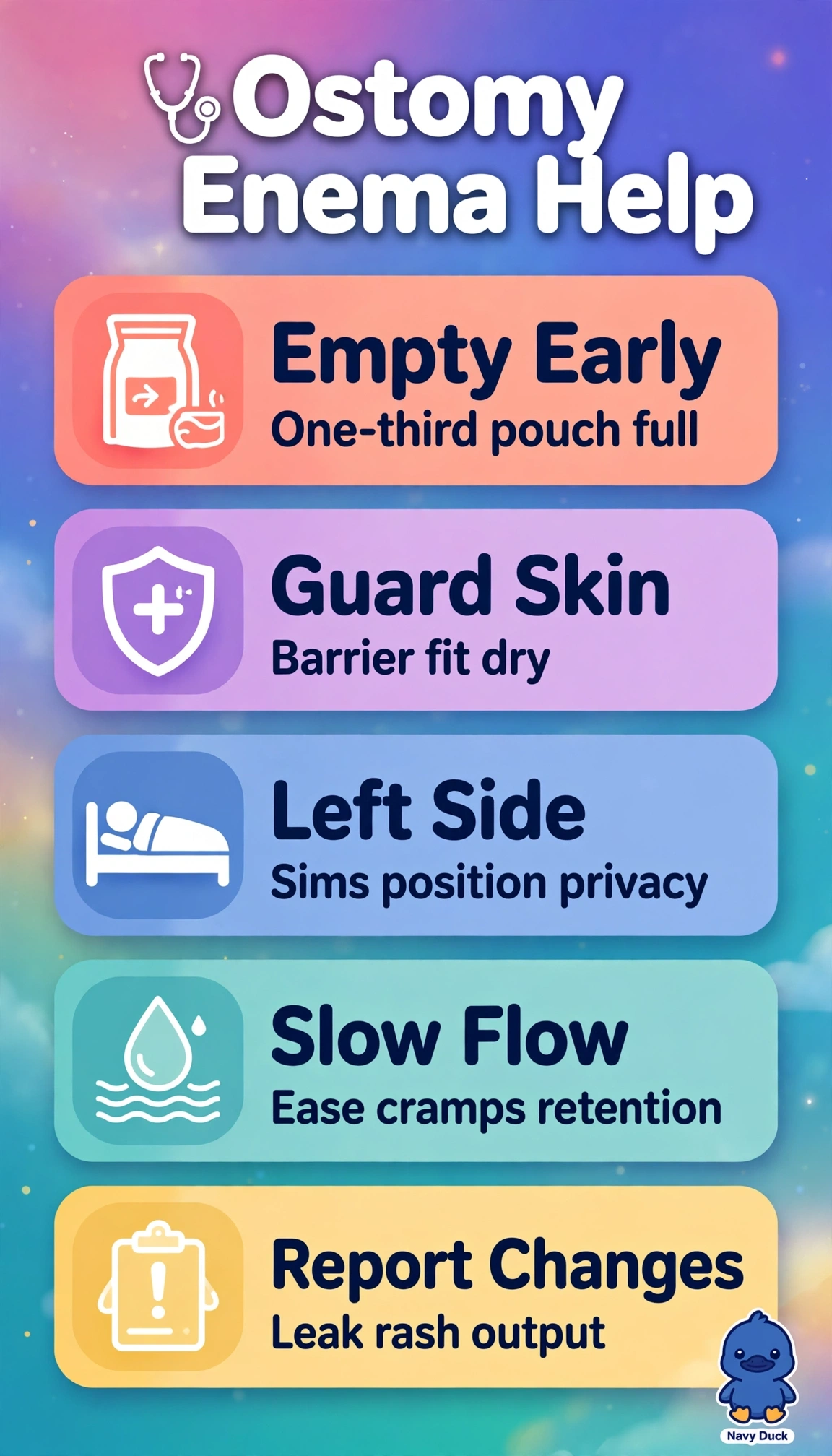
You're keeping flow gentle and skin guarded on both jobs. Timely emptying plus slow inflow works like easing water into a funnel without splashing. That gentle-containment approach prevents leaks, cramps, and skin breakdown.
Full Explanation
The correct approach reflects combined colostomy and enema principles because emptying when one-third full limits weight pull on the new wafer seal thereby reducing leakage and odor that fuel anxiety, consistent peristomal skin protection preserves barrier function and supports healing after surgery, and left-side positioning uses sigmoid anatomy to facilitate gravity flow while slow administration minimizes cramping and improves retention and effectiveness. The approach using right-side positioning despite correct ostomy care fails on anatomy because fluid must travel with the descending colon on the left, so right-side placement reduces distribution and cleansing result even with controlled flow. The approach waiting until two-thirds full fails on ostomy seal management because increased volume and weight strain adhesion and raise leak and odor risk, which undermines confidence for a new anxious postoperative patient. The approach that masks odor without checking skin fails on skin integrity because early redness, moisture damage, or seal leakage around a new stoma require prompt barrier care, and covering odor alone allows breakdown to progress unnoticed. An exam caveat is to not confuse enema laterality with procedures favoring the right side and to not generalize stable long-term ostomy routines to a new postoperative situation where stricter emptying and skin surveillance apply. A practical check is to ensure curtains closed for privacy in the shared room, give clear instructions, confirm consent and prescription, verify fill level and skin condition, maintain left Sims position, run fluid slowly, monitor tolerance, and document outcomes within scope.