
A technician is assigned vital signs for a frightened 6-year-old in clinic, an older adult with fragile skin and tremor in long-term care, and an adult with a casted arm on a surgical unit. Each needs accurate temperature, pulse, respirations, blood pressure, and pain screening. Which vital signs technique correctly adapts measurement for special populations?
Select an answer to reveal the explanation.
Short Explanation
You get truer numbers when the tools fit and the patient feels safe. Small tweaks calm wiggles and shivers alike. That adaptation keeps readings accurate across ages and conditions.
Full Explanation
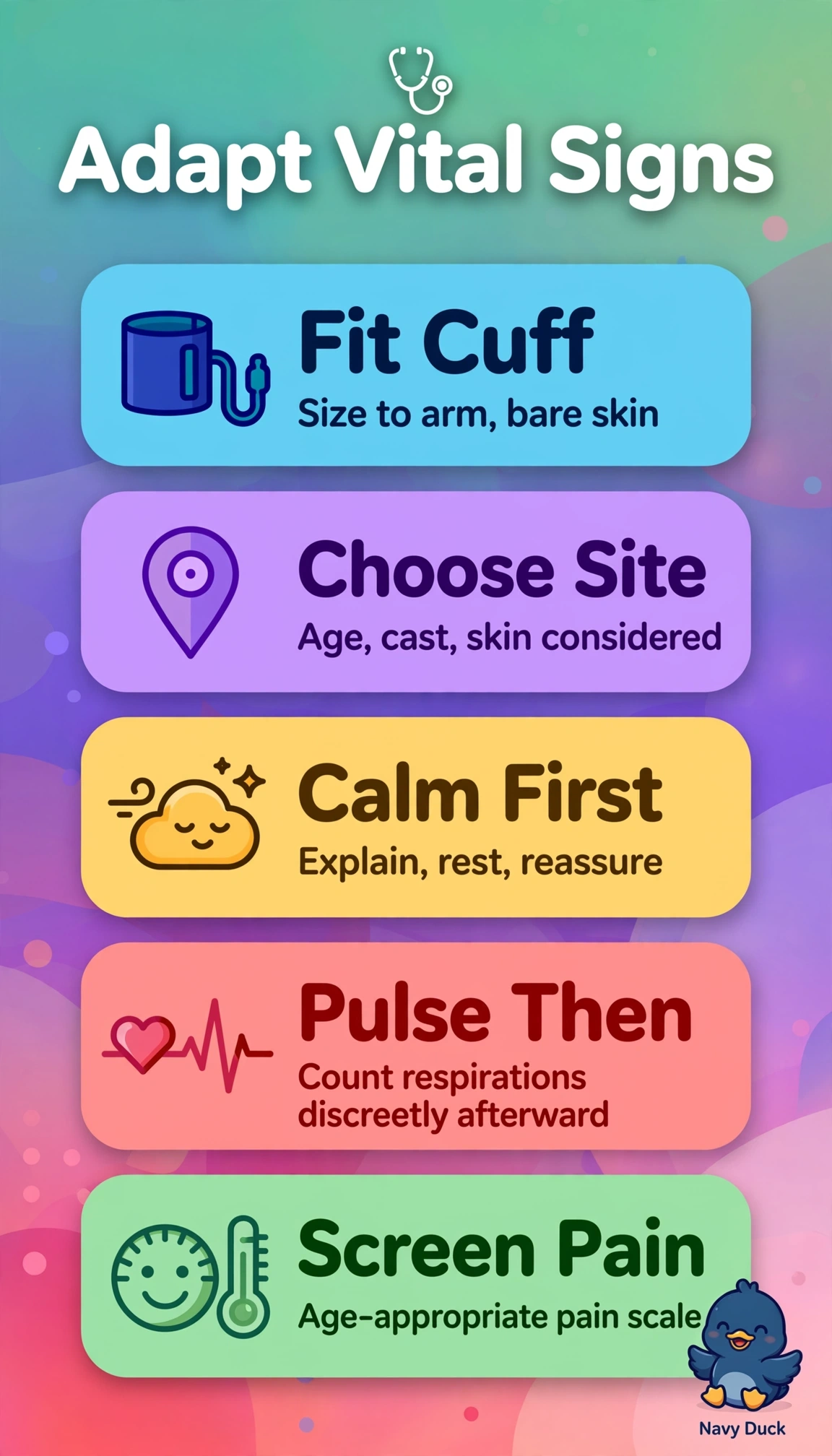
The correct technique succeeds because it integrates fit, site, communication, and discreet observation: sized cuffs prevent falsely high readings when too narrow and falsely low readings when too wide, site choice avoids the casted arm, protects elderly skin from friction and pressure, and matches temperature method to safety, while explanation with parent presence lowers fear and sympathetic stimulation in the 6-year-old, and counting respirations discreetly after pulse preserves natural rate and rhythm. The uniform oral thermometry approach fails because a frightened child may not keep the mouth sealed and an older adult with tremor risks biting, mucosal injury, or error from mouth breathing, though oral measurement remains routine for stable cooperative adults. The open counting during conversation approach fails because awareness and speech alter depth and rate, so reassurance must come from demeanor and distraction while silently observing excursion, ideally for a full minute if irregular. The casted-arm pressure approach fails because rigid material prevents even compression, causes pain, obscures neurovascular assessment, and yields false values, requiring the unaffected arm or approved alternative with support. An exam caveat is that pain is a vital sign requiring proactive age-appropriate screening, and writers often pair otherwise sound care with one special-population contraindication to test discrimination. A practical check is to verify bladder width near 40% of limb circumference, support the limb at heart level, keep fingers on pulse while silently counting respirations, then document site, limb, position, and pain scores.