
On a hectic orthopedic floor the nurse asks you, a PCT checked off for vital signs and ambulation, to help a fresh post-operative patient with stable vitals walk to the bathroom now using a walker while you have three call lights ringing. Which application of the Five Rights of Delegation best supports safe acceptance?
Select an answer to reveal the explanation.
Short Explanation
Nice discipline when everything rings at once. Pausing to confirm task, patient, and supervision keeps delegation safe instead of rushed, vague, or beyond your role.
Full Explanation
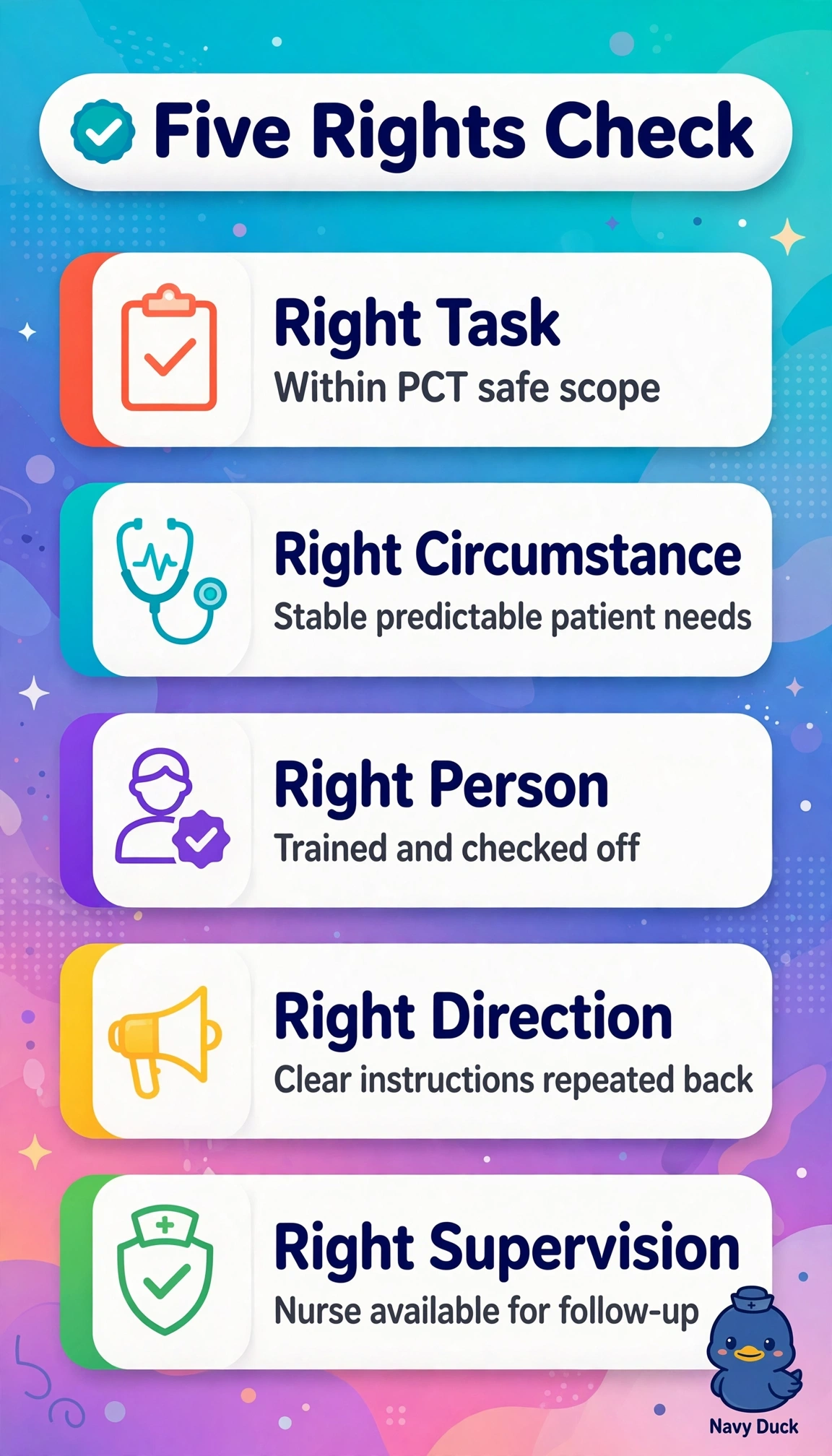
Safe delegation requires the right task, circumstance, person, direction, and supervision, and the correct response integrates all five by verifying you are the checked-off person for walker ambulation, the patient and task are appropriate given stable vitals yet fresh post-operative status, and the direction including bathroom timing, walker use, and supervision and reporting plan are explicit before starting. Proceeding with ambulation now on the basis of stable vitals and prior check-off alone is common and covers person and task but fails right direction and supervision because it assumes instructions, distance, assistance level, and who monitors the floor and the patient during competing call lights. Postponing the bathroom walk until call lights are cleared is a sound workload strategy but fails right circumstance and direction in this scenario because the request is now for toileting, where delay risks incontinence, falls from attempting alone, and noncompliance with an explicit time-sensitive instruction. Accepting the walk and adding a focused post-op assessment to update the care plan exceeds right task boundaries because systematic assessment, clinical interpretation, and care-plan modification remain nursing responsibilities, while the PCT role is to follow the delegated ambulation, observe and report expected findings such as dizziness, pain, pallor, or drainage increase, and seek help. An exam caveat is that stability and competency do not alone authorize independent action when communication and supervision are unstated, especially with fresh post-operative patients and competing demands. A practical check is to use closed-loop communication: restate patient identity using two identifiers, destination, equipment, and what to report and to whom, and confirm who watches the other lights while you are occupied.