
An adult scheduled for preoperative screening needs a resting 12-lead EKG in a chilly outpatient room, has light chest hair and oily skin, and is anxious about exposure and cold electrodes. The order requires a clean tracing with correct anatomical placement. Which patient preparation and electrode placement should the PCT perform for 12-lead acquisition?
Select an answer to reveal the explanation.
Short Explanation
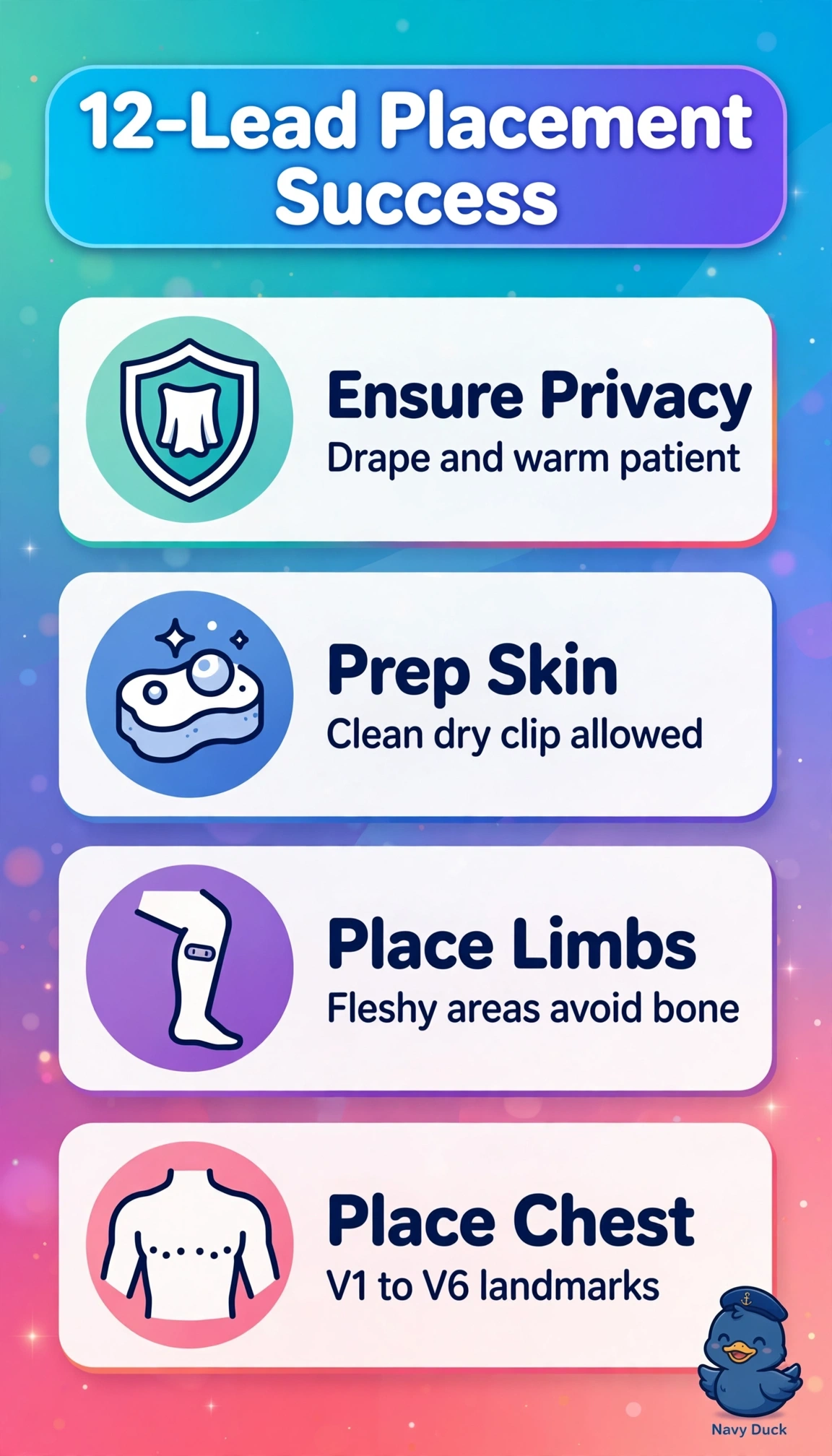
You’ll help your patient feel comfortable and get a clear tracing by providing privacy and warmth, then cleaning and drying the skin for good electrode contact. Place the limb and V1–V6 electrodes at their correct anatomical sites for a reliable resting EKG.
Full Explanation
The correct preparation supports a clean, reproducible preoperative tracing: privacy and warmth reduce anxiety and shivering, while cleaning oily skin, drying it thoroughly, and managing light hair improve electrode contact and reduce baseline wander or signal dropout. Supine positioning and anatomically placed limb and V1–V6 electrodes preserve the expected axis, voltages, and R-wave progression. Torso limb leads can reduce motion for exercise testing or continuous monitoring, but they shift frontal-plane axis and QRS amplitude and are not interchangeable with distal limb placement for a diagnostic resting tracing. Dry skin and distal limbs do not compensate for placing V4–V6 along the nipple line; nipple position varies with age, sex, and body habitus, whereas precordial electrodes belong at specific intercostal and chest landmarks, so misplaced leads can distort the lateral view and mimic or mask abnormalities. Correct skin preparation and anatomical leads also do not eliminate artifact from leaving a patient cold: shivering and muscle tension can cause somatic artifact and baseline wander. An exam caveat is that modified torso placement is appropriate only when monitoring, stress testing, or a Mason-Likar setup is specifically indicated; a resting EKG generally uses distal limbs and precise landmarks. As a practical check, locate the sternal angle, count to the fourth and fifth intercostal spaces, confirm all electrodes lie flat on dry skin, and verify a stable baseline before transmitting the tracing.