
An older adult needs routine venous labs, has small fragile hand veins that roll, is well hydrated and warm, has no fistula or mastectomy restriction, and becomes anxious with repeated sticks while the PCT has evacuated tubes, a winged set, and a syringe available at the bedside. Which venipuncture technique should the PCT choose to collect blood safely on the first attempt?
Select an answer to reveal the explanation.
Short Explanation
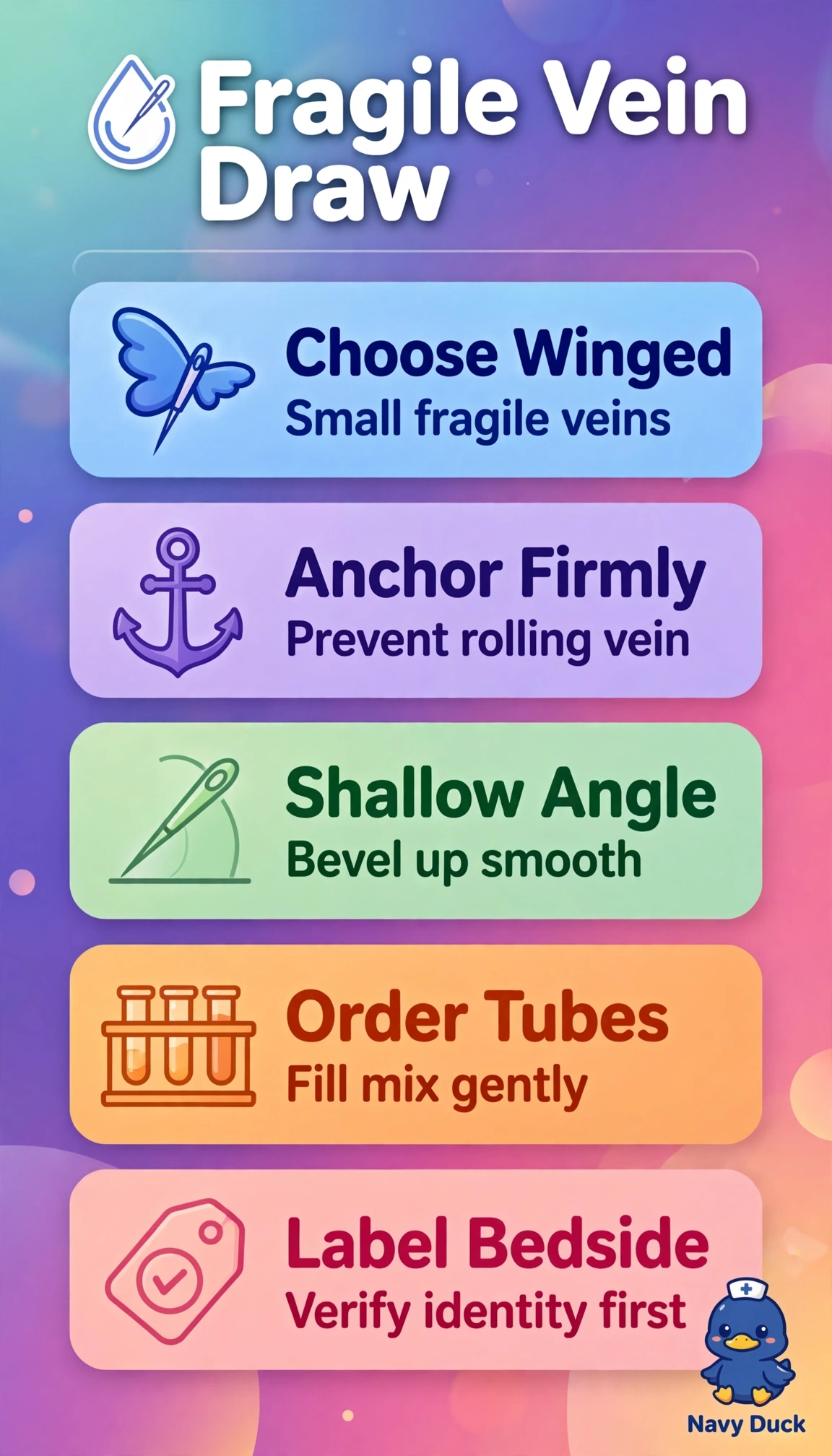
You've got a tricky stick, so you'll want finesse over force for your best first try. Steady that rolly hand vein with firm anchoring using your winged set, like holding fabric taut to thread a needle.
Full Explanation
A winged infusion set with a smaller gauge is well suited to small fragile rolling hand veins, and firmly anchoring below the site, inserting at a shallow angle with bevel up, then allowing vacuum tubes to fill in proper order of draw minimizes through-and-through puncture, hematoma, and hemolysis while improving first-stick success for an anxious patient. Using a large straight needle without anchoring and probing laterally increases pain, vein damage, and hematoma risk and violates the principle of a single smooth insertion with redirection only when appropriate. Attaching a syringe and pulling forcefully creates excess negative pressure that can collapse a fragile vein and hemolyze the sample, rather than gentle steady collection. Drawing above an infusing IV line dilutes the sample with fluid and medications and contaminates results, so collection must avoid infusion sites unless specifically approved with the infusion paused per protocol. Exam caveat is that order of draw and site restrictions are frequent test traps, so verify fistula, mastectomy, edema, and infusion sides, and practical check is to confirm identity, apply tourniquet briefly, release on flow, mix tubes gently, and label at bedside.