
On a busy medical-surgical unit, a nurse urgently asks the PCT/A to program an IV pump, assess a wound, and give a PRN pain pill because staffing is short. The PCT/A is trained in ADLs, vitals, EKG, and phlebotomy only. Which decision best keeps the PCT/A action within the lawful scope of practice?
Select an answer to reveal the explanation.
Short Explanation
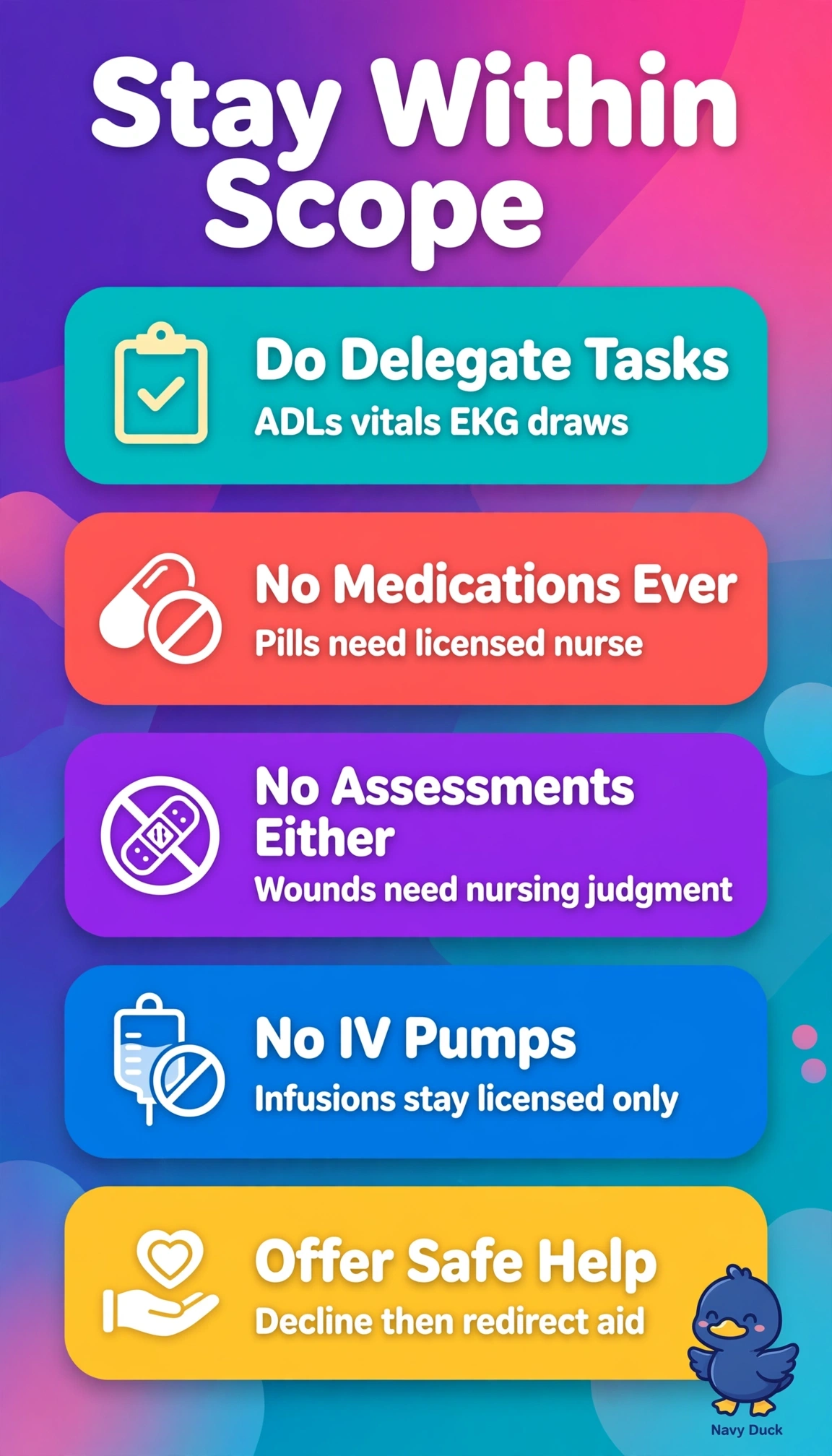
Saying no kindly is actually saying yes to patient safety. Sticking to delegated ADLs and testing tasks preserves boundaries that licenses and facility policy set for you.
Full Explanation
PCT/A scope is limited to delegated routine tasks such as hygiene, mobility, vital signs, specimen collection, and EKG acquisition, while assessment, medication administration, and IV therapy require nursing licensure and cannot be delegated to unlicensed assistive personnel even when staffing is short. Giving a single pain pill still constitutes medication administration with rights, interactions, and assessment requirements, so simplicity does not make it delegable. Performing wound assessment constitutes nursing assessment and clinical judgment about healing, infection, and escalation, which is outside PCT/A training and legal accountability. Programming an IV pump constitutes medication infusion management with dosage calculations and monitoring for infiltration or reactions, which remains a licensed responsibility despite no direct touch. Exam caveat is that urgency, nurse request, or prior observation never expands scope, and the correct response is to decline clearly and offer an in-scope alternative. Practical check is to state training limits, notify the charge nurse of the unmet need, and document only care actually provided within scope.