
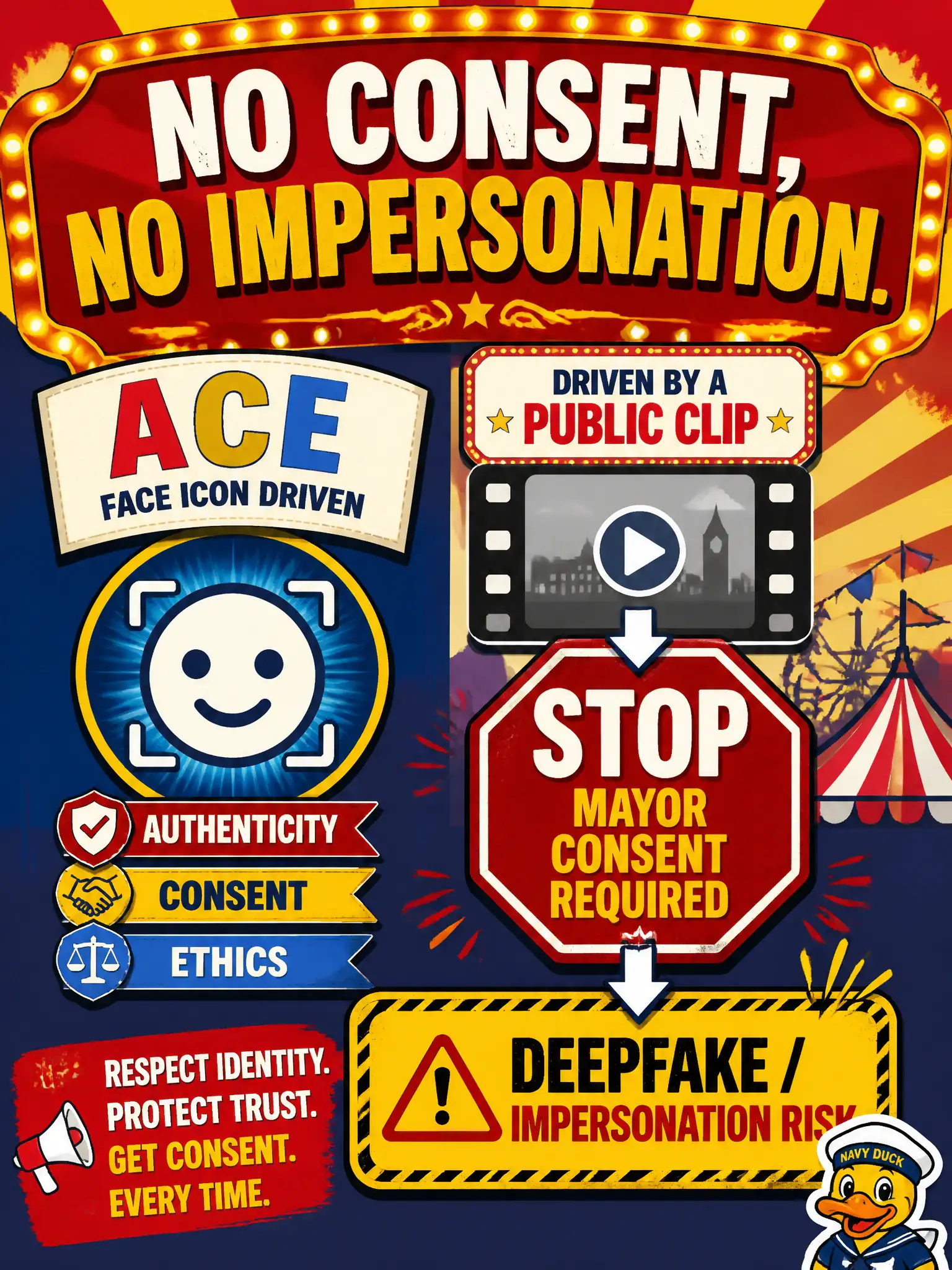
A carnival photobooth offers “hear the mayor say your name” by driving an ACE face from a public clip without the mayor’s consent. What is the trustworthy-AI judgment?
Select an answer to reveal the explanation.
Short Explanation
Making a fake mayor greet strangers is not a harmless parlor trick. Without consent, face-plus-voice ACE playback is impersonation—and that fails trustworthy AI.
Full Explanation
A carnival photobooth offering “hear the mayor say your name” by driving an ACE face from a public clip without the mayor’s consent should be refused: name the deepfake / impersonation risk of non-consensual face and voice reuse. Public availability of a clip does not authorize civic impersonation toys.
Approving the bit because public clips are always free to impersonate fails consent and deepfake ethics. Allowing it if Audio2Face latency stays under a second fails: speed does not legalize or ethicize impersonation. Treating it as Domain 5 charting once guests rate the joke funny fails domain and seriousness.
Exam caveat: non-consensual face/voice reuse for impersonation is a Domain 7 refuse—even as a “joke,” even from public clips.
Operational check: block mayor-impersonation jobs without explicit consent; add policy language to the photobooth; escalate attempted deepfake reuse to the city’s trustworthy-AI review. In municipal trustworthy-AI stewardship, record the disclosure, consent, or bias decision and the rejected shortcuts in the gallery change log so future stewards protect residents from undisclosed synthesis and stereotyped generation. Re-audit labels, consent records, and bias samples after the next model or exhibit update to keep the city's public trust intact.