
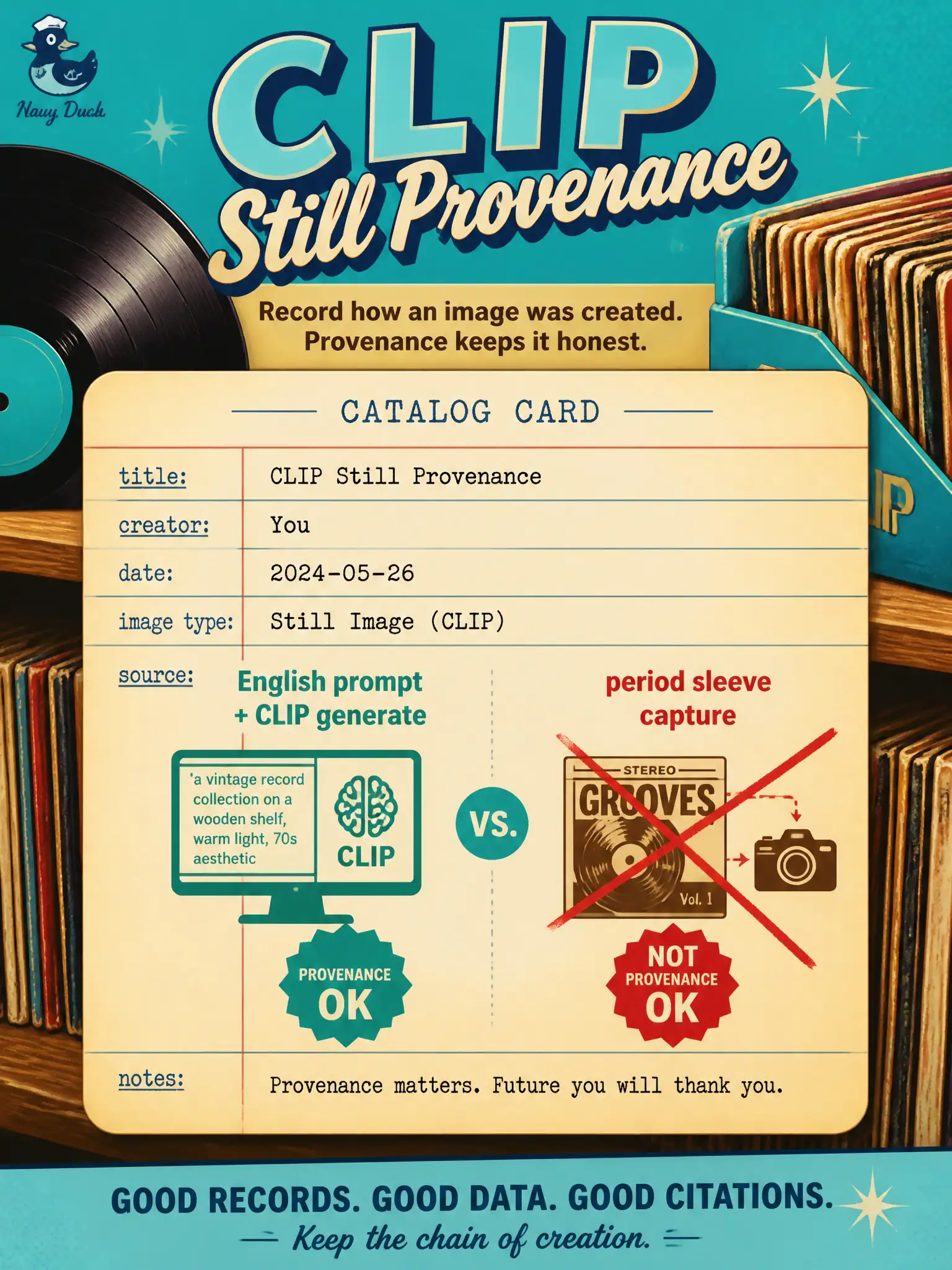
A cylinder-record parlor prints English-prompt stills from a CLIP path as if they were period sleeve photos. What provenance should the catalog card carry?
Select an answer to reveal the explanation.
Short Explanation
A catalog card should say how the picture got there. If CLIP grew it from an English line, say so—do not file it as a dusty original sleeve shot.
Full Explanation
A cylinder-record parlor that prints English-prompt stills from a CLIP path as if they were period sleeve photos should carry provenance that each still was generated from an English prompt on a CLIP path, not filed as a captured sleeve photo. Catalog cards must not launder synthesis into archival capture for civic music history.
Claiming Kubernetes Helm values prove the sleeve was photographed in 1920 fails absurdly—charts do not create photographic provenance. Claiming higher guidance scale converts a render into an archival capture fails: guidance is a generation control, not a time machine. Claiming Domain 1 experiment logs replace any need for source labels fails disclosure duty.
Exam caveat: CLIP-path stills need generation provenance on the catalog card. Serving configs and guidance knobs never mint capture status.
Operational check: print “generated from English prompt (CLIP path)” on each card; segregate true sleeve photos; audit the municipal parlor catalog for misfiled renders. In municipal trustworthy-AI stewardship, record the disclosure, consent, or bias decision and the rejected shortcuts in the gallery change log so future stewards protect residents from undisclosed synthesis and stereotyped generation. Re-audit labels, consent records, and bias samples after the next model or exhibit update to keep the city's public trust intact.