
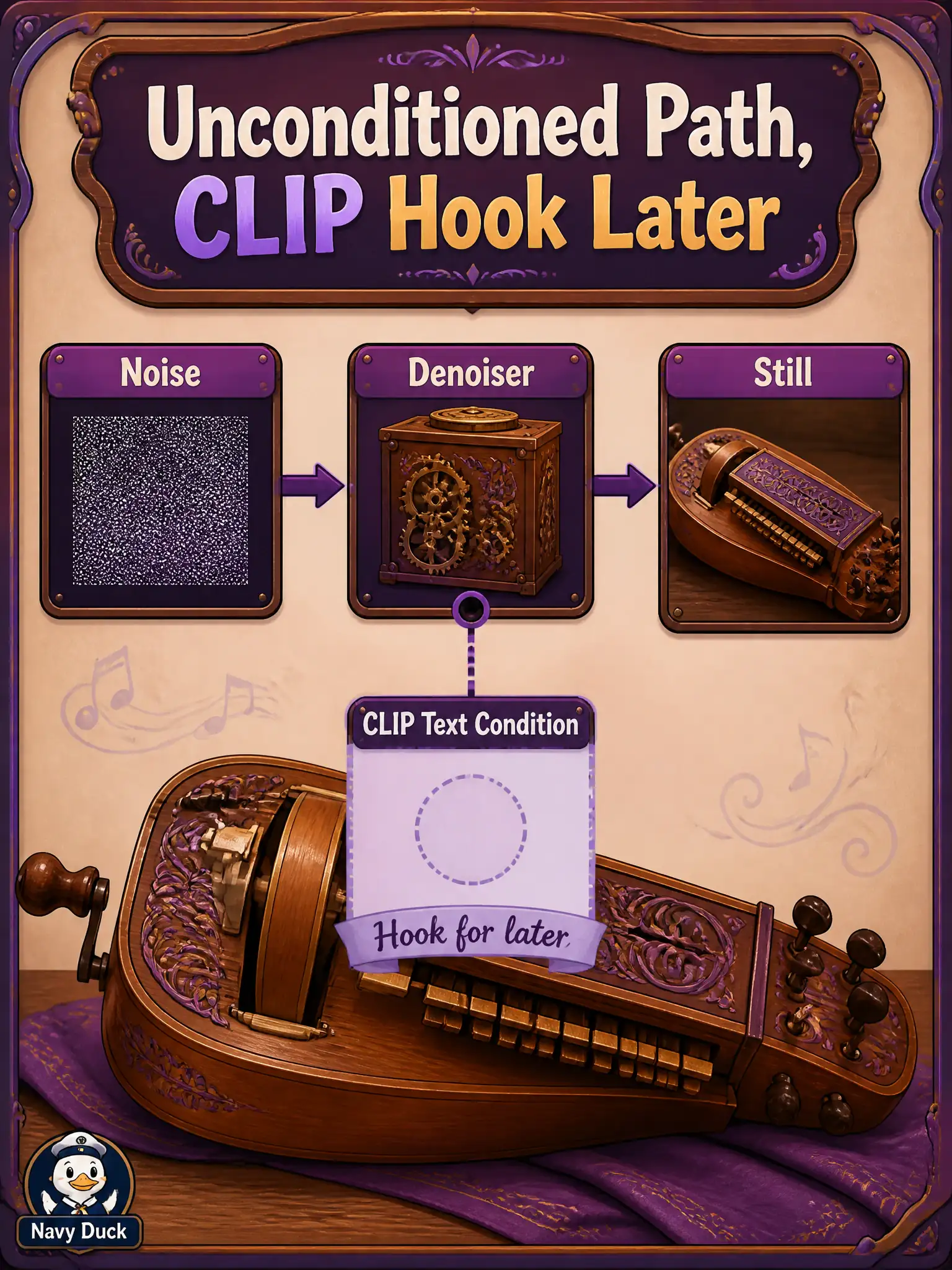
A hurdy-gurdy loft first implements “noise in, still out,” then will add an English prompt. How should the unconditioned path be assembled?
Select an answer to reveal the explanation.
Short Explanation
Build the plain generate pipe first, and leave a clean socket for CLIP’s English prompt later. Don’t tangle this with Domain 3 pairing chores.
Full Explanation
First implementing “noise in, still out,” then adding an English prompt later, means assembling the unconditioned generate path so a later official CLIP text condition can hook in. That assembly order is correct for the hurdy-gurdy loft. Civic generators can ship unconditioned stills first, then attach CLIP conditioning without rewriting Domain 3 corpora as a blocker.
Hard-wiring Domain 3 pairing so generation cannot run without a caption corpus fails the unconditioned path. Merging CLIP conditioning into Domain 3 data collection before any denoiser exists confuses domains. Replacing the denoiser with Riva ASR because text prompts require speech first fails modality routing.
Exam caveat: unconditioned generate is a valid Domain 4 milestone before CLIP conditioning. Operational check: assemble civic noise-to-image first, expose a hook for CLIP text condition, then add the English prompt path. Align this choice with the agency’s published multimodal runbook so civic operators can audit why the configuration was accepted. Record the civic software choice in the service README—named modules, inputs, and domain—so operators can replay the same path during audits and handoffs. Prefer explicit, reversible civic decisions over silent assumptions when multimodal data or software paths move toward production.