
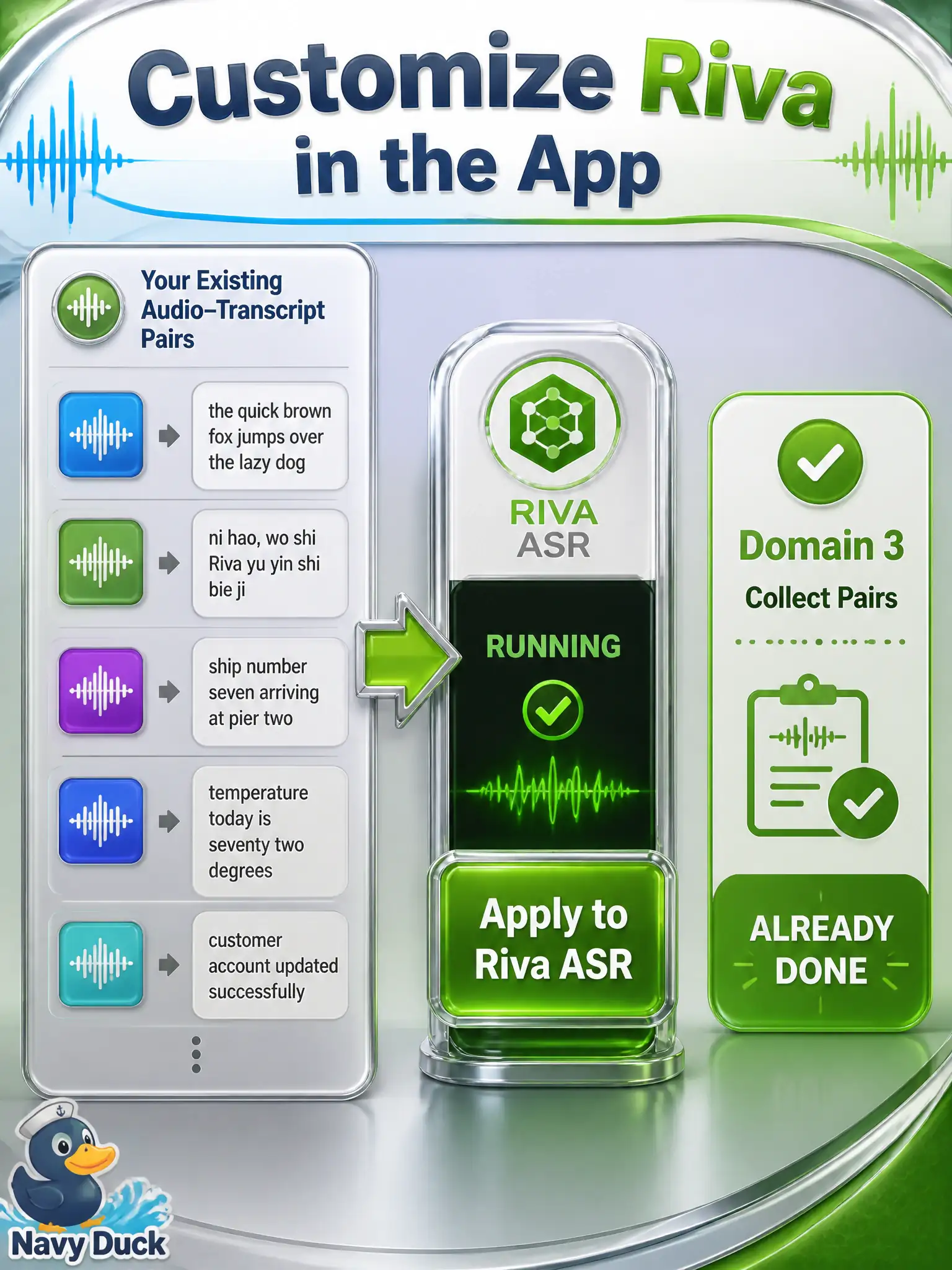
A looking-glass shop already has paired audio–transcript rows. Today they apply that set to a Riva ASR customization in the running app. How should that step be labeled?
Select an answer to reveal the explanation.
Short Explanation
The pairs already sit on the shelf; today you bolt them into the running Riva ASR service. That’s software wiring (Domain 4), not another collecting day (Domain 3).
Full Explanation
Applying paired audio–transcript rows to a Riva ASR customization in the running app is Domain 4: applying and wiring the speech customization in software, not recollecting the corpus. That labeling is correct for the looking-glass shop. Civic teams must distinguish Domain 3 collection from Domain 4 apply/wire steps.
Calling it Domain 3 corpus collection because every apply step rebuilds pairs from scratch fails; the pairs already exist. Calling it Domain 1 denoising-step experiments fails modality and domain. Calling it Domain 6 Helm performance tuning with no Riva service change fails by skipping the speech customization entirely.
Exam caveat: applying an existing speech corpus in software is Domain 4 implementation. Operational check: keep civic pair files stable, apply them in the Riva customization path, and label the work Domain 4—not recollect or Helm-only. Align this choice with the agency’s published multimodal runbook so civic operators can audit why the configuration was accepted. Record the civic software choice in the service README—named modules, inputs, and domain—so operators can replay the same path during audits and handoffs. Prefer explicit, reversible civic decisions over silent assumptions when multimodal data or software paths move toward production.