
A mask-carver’s first app will either load stills of unfinished faces or stream a spoken note. What should decide which encoder module to import?
Select an answer to reveal the explanation.
Short Explanation
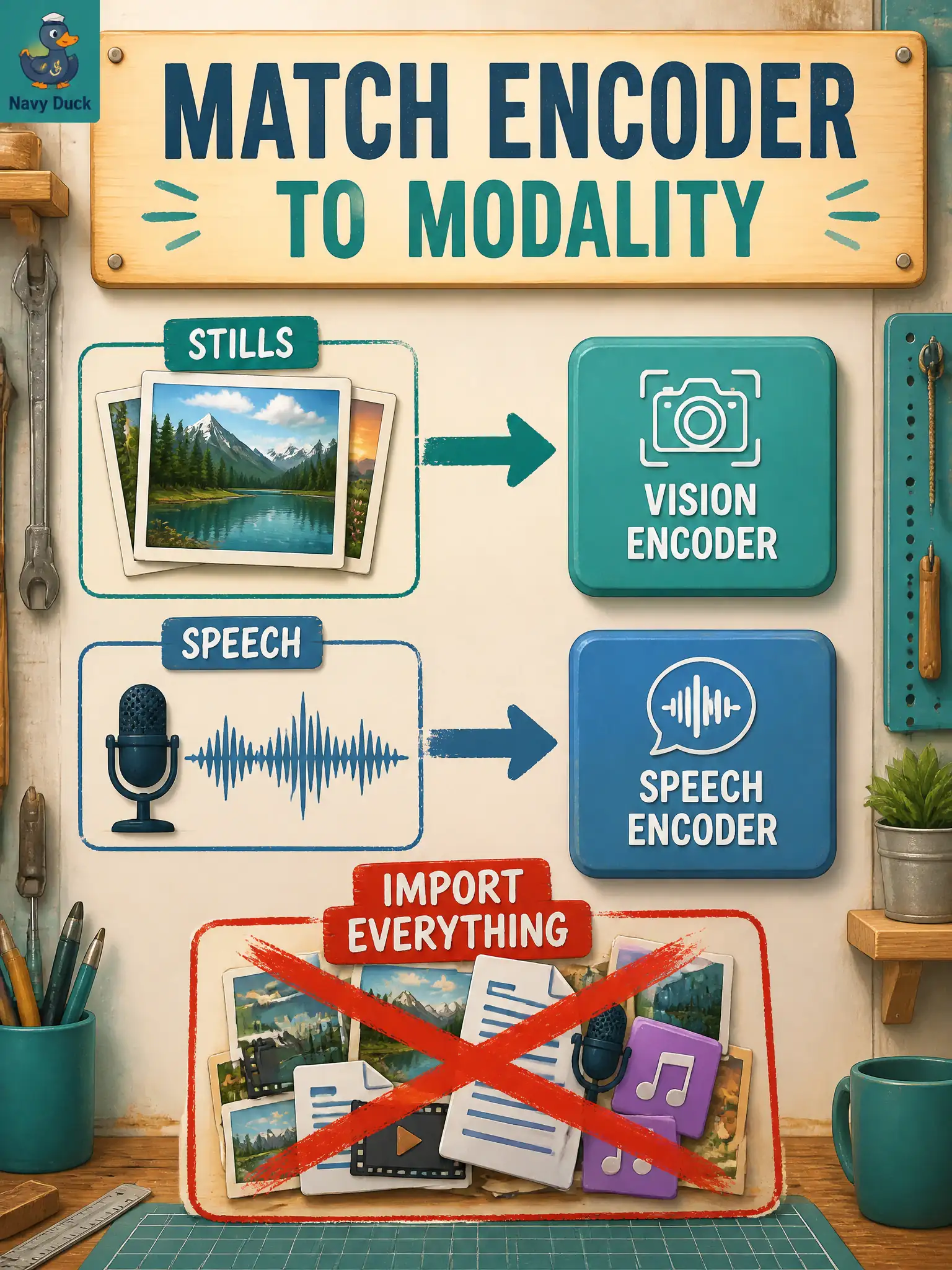
Pick the tool that fits the ingredients you’ll cook with. If the app loads stills, wire a vision encoder; if it streams speech, wire a speech module—not both by default.
Full Explanation
Implementation imports the encoder module that matches the modality the app will load—vision for stills, speech for audio. That choice is correct for the mask-carver’s first app: wiring follows the civic input the service will actually pass. Importing unused encoders adds complexity without serving residents.
Importing both vision and speech encoders regardless of what the app will pass fails lean associate implementation. Always importing a CNN definition lecture module before any project wiring fails by substituting study artifacts for callable encoders. Skipping encoders and feeding raw JPEG or WAV bytes straight into the head fails the decode/encode step modern multimodal apps require.
Exam caveat: module choice tracks runtime modality, not maximal library shopping. Operational check: list civic app inputs, import matching encoder modules only, and verify tensors/features—not raw undifferentiated bytes—reach the head. Keep municipal reviewers in the loop whenever modality claims, fusion labels, or agent scripts are promoted from lab notes into the production corpus used by public-facing services. Record the decision, owner, and date beside the dataset manifest. Align this choice with the agency’s published multimodal runbook so civic operators can audit why the row was accepted or rejected.