
A coach-painter already has a pretrained stills model that nearly matches shop pigments. They can adapt a small last stage or retrain every weight. Which choice is the official less-computation path when the source is close?
Select an answer to reveal the explanation.
Short Explanation
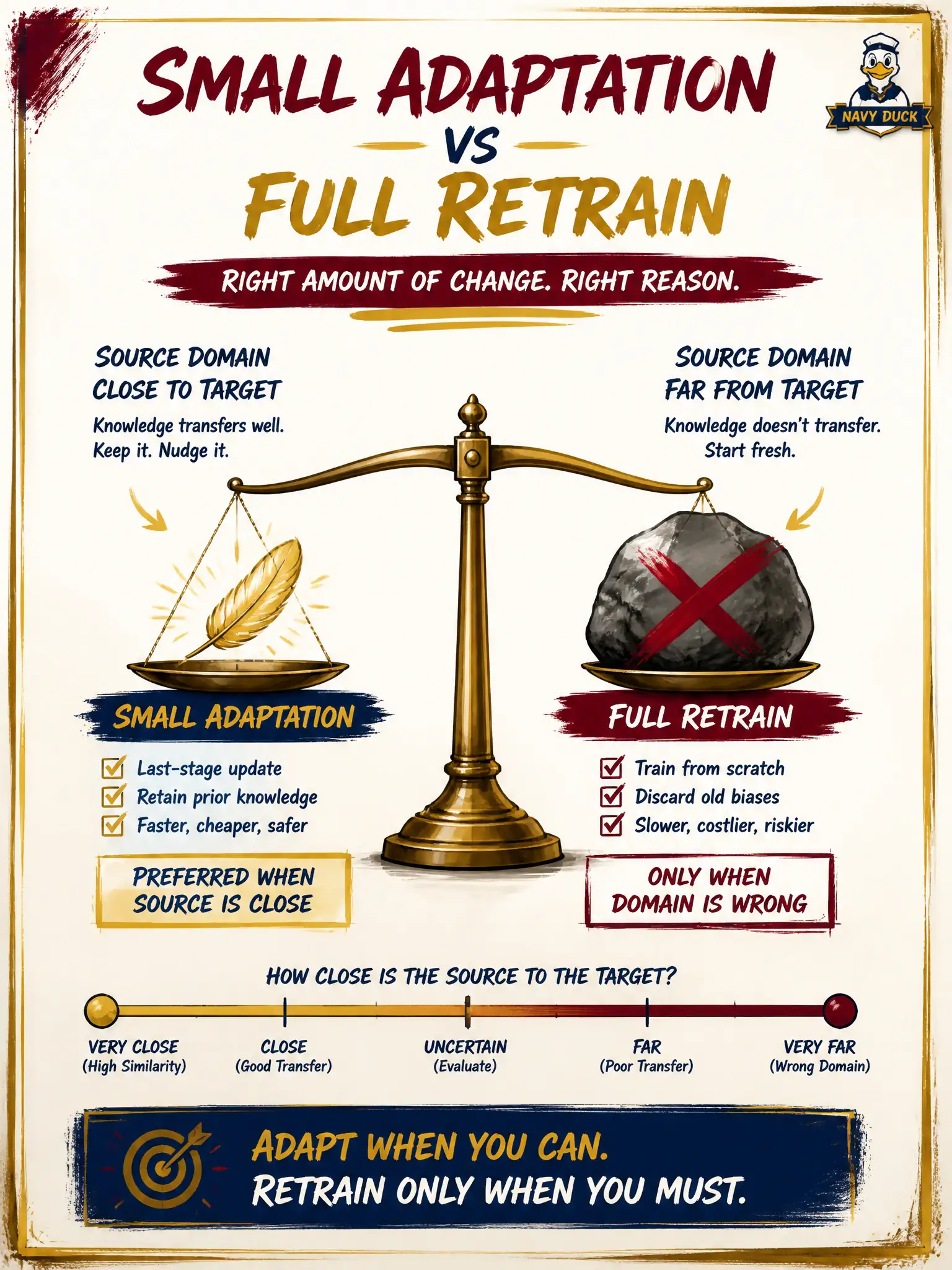
When the pretrained palette is already close, a light last-stage touch-up beats a full retrain. Save the heavy compute for when the source domain is clearly wrong.
Full Explanation
A coach-painter with a pretrained stills model that nearly matches shop pigments should adapt the small last stage rather than retraining every weight. That official lesson saves computation while exploiting near-domain transfer for civic pigment recognition.
Retraining every weight by default to prove thoroughness fails the efficiency goal when a small last-stage adaptation suffices. Discarding the pretrained model because near-match still counts as the wrong domain fails: near-match is exactly when transfer should help. Replacing pigment adaptation with an Edify product that is not on the skill list fails by inventing an off-list product distractor.
Exam caveat: near-domain → light adaptation. Full retrain is not the default badge of seriousness, and off-list product names are not answers.
Operational check: freeze most layers; train the last stage on pigment close-ups; compare to a full retrain’s cost; keep the light recipe unless civic holdout metrics demand deeper unfreezing. In municipal platform operations, record the chosen performance lever and the rejected alternatives in the change record so future on-call engineers understand the failure modes avoided for citizen services. Re-check the decision after the next traffic spike or model update to ensure the same answer still holds for the city's estate.