
An enamel kiln records a short firing clip and a typed question for an NVIDIA AI Blueprint with VIA. How should that material be treated as data?
Select an answer to reveal the explanation.
Short Explanation
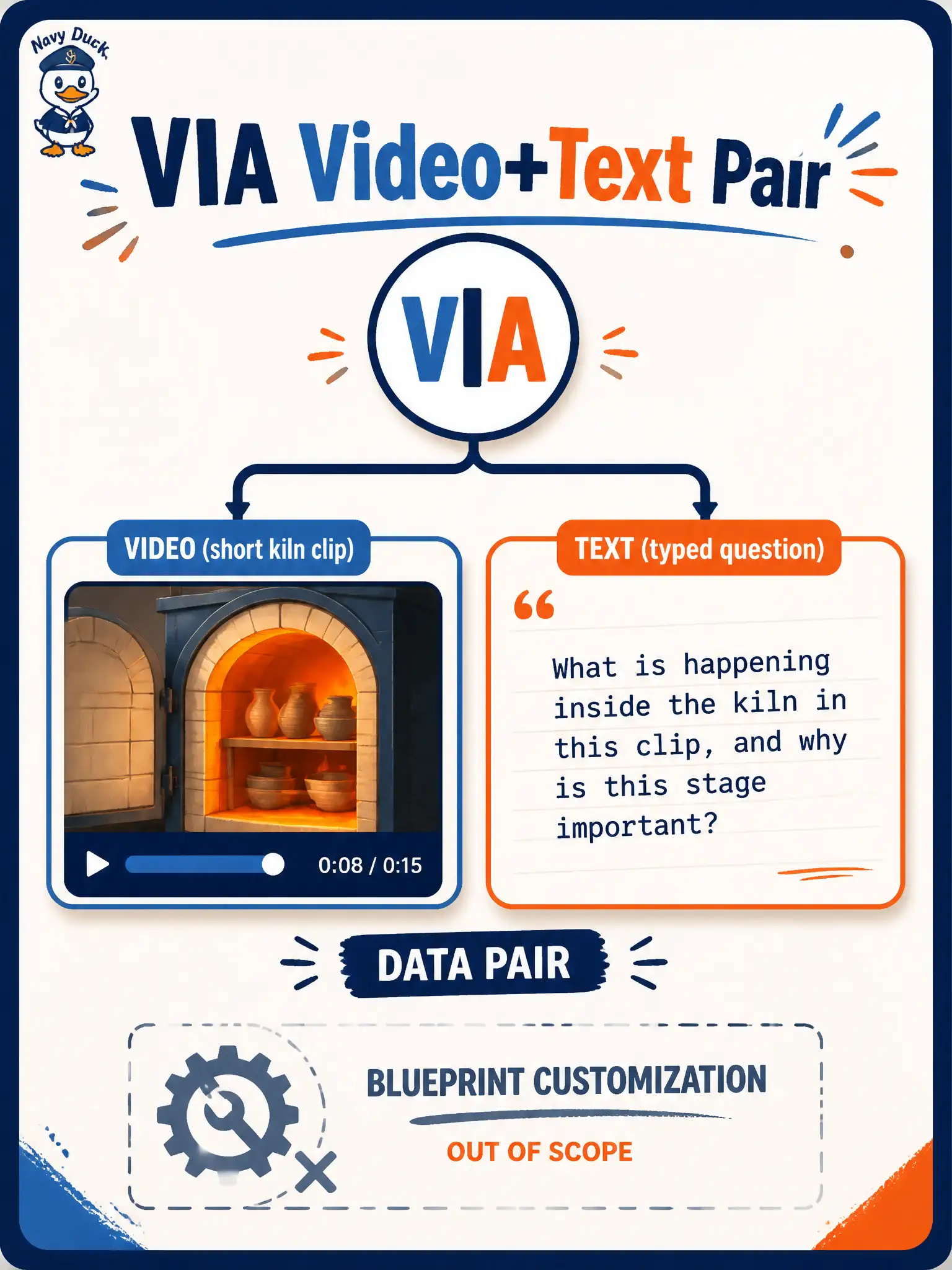
Clip plus typed question is a video+text data pair under VIA initials. Build the row; leave Blueprint customization for another domain.
Full Explanation
At multimodal-data depth, a short firing clip plus a typed question for an NVIDIA AI Blueprint with VIA is a video+text paired row under official VIA initials—without customizing the Blueprint in the data step. That treatment is correct: Domain 3 constructs the pair; Domain 4 customization is a later software act. Civic video desks that answer questions about short clips must first store clip+question as paired data under the named path.
Treating it as a Domain 4 Blueprint rewrite before storing files fails by jumping domains. Discarding the clip for a CLIP-only still caption task fails the video+text job. Inventing any custom video stack beyond VIA wording fails associate scope.
Exam caveat: keep VIA as initials and separate data pairing from Blueprint customization. Operational check: save civic clip–question pairs with shared ids under VIA-allowed wording; defer Blueprint customization to Domain 4 implementation work. Keep municipal reviewers in the loop whenever modality claims, fusion labels, or agent scripts are promoted from lab notes into the production corpus used by public-facing services. Record the decision, owner, and date beside the dataset manifest. Align this choice with the agency’s published multimodal runbook so civic operators can audit why the row was accepted or rejected.