
A parchment studio must choose whether to record its Riva ASR set over the scraping bench or in a quiet side room. The finished kiosk will listen on the busy floor. How should the recording-condition choice be framed?
Select an answer to reveal the explanation.
Short Explanation
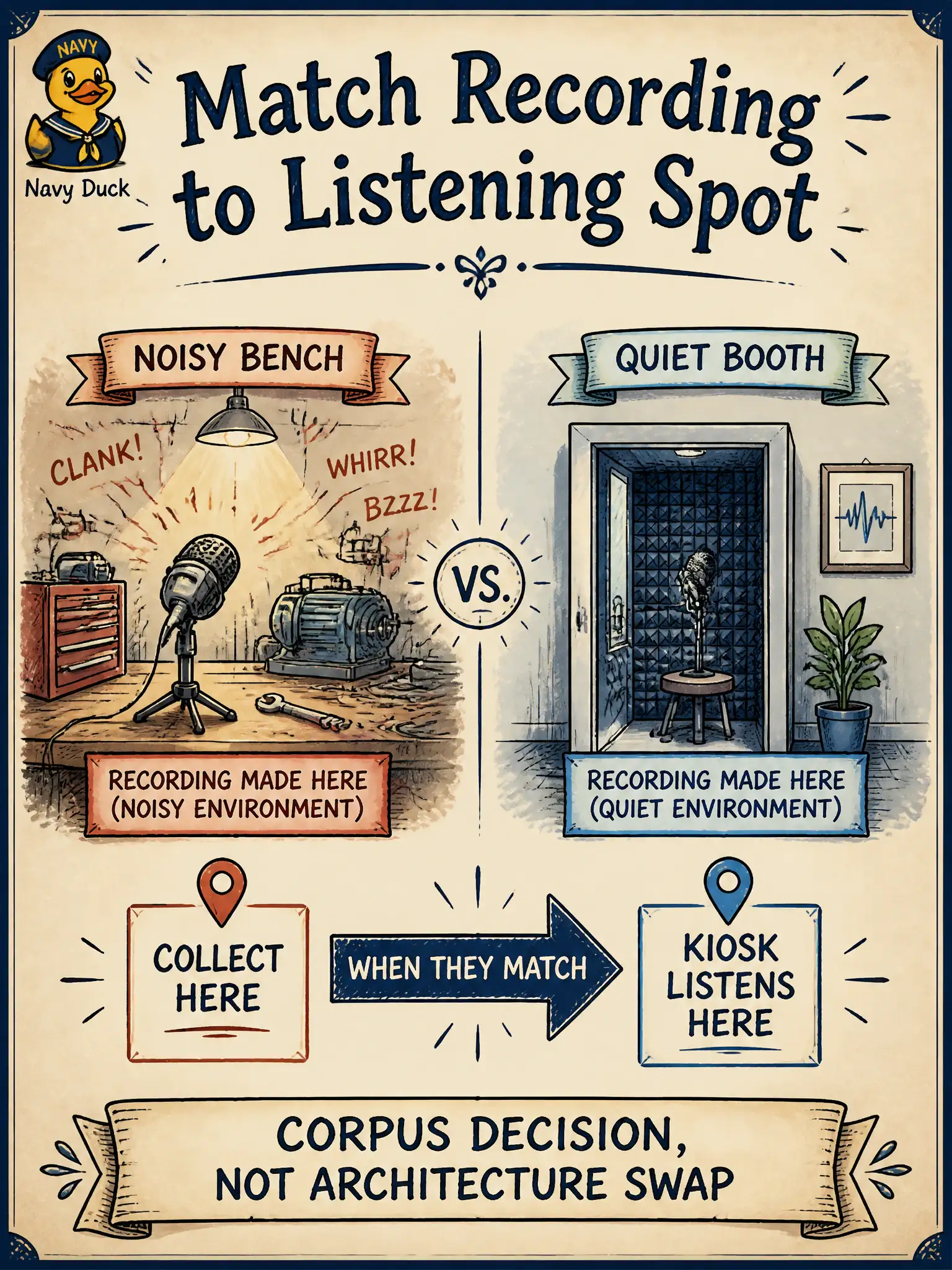
Train the ear where it will work. If the kiosk hears the scraping bench, collect ASR data that sounds like that room—not a silent booth that never matches real use.
Full Explanation
Choosing whether to record a parchment studio’s Riva ASR set over the scraping bench or in a quiet side room—when the finished kiosk will listen on the busy floor—is a corpus collection decision that should match the intended listening environment. It is not a Domain 2 architecture change swapping early for late fusion. It is not a CLIP caption-language problem. Noise does not justify skipping transcripts. Exam caveat: match recording conditions to deployment acoustics for ASR data. Operational check: record a pilot set on the busy floor (or carefully augment quiet data toward floor noise), keep transcripts, and evaluate recognition where the kiosk will actually listen. Record ASR evaluation on the busy parchment floor, matching kiosk acoustics. Collect parchment ASR under acoustics matching the busy-floor kiosk; keep transcripts regardless of noise. Acoustic mismatch between quiet closets and busy kiosk floors is a corpus decision, not a fusion-architecture change. Close q141 with a municipal evidence note that records why the correct mechanism fits this civic multimodal scenario, why each of the three distractors fails by a distinct concept, and which operational check was observed in logs or dataset cards before promotion. File that note with the run packet so later maintenance cannot silently revive a rejected framing.