
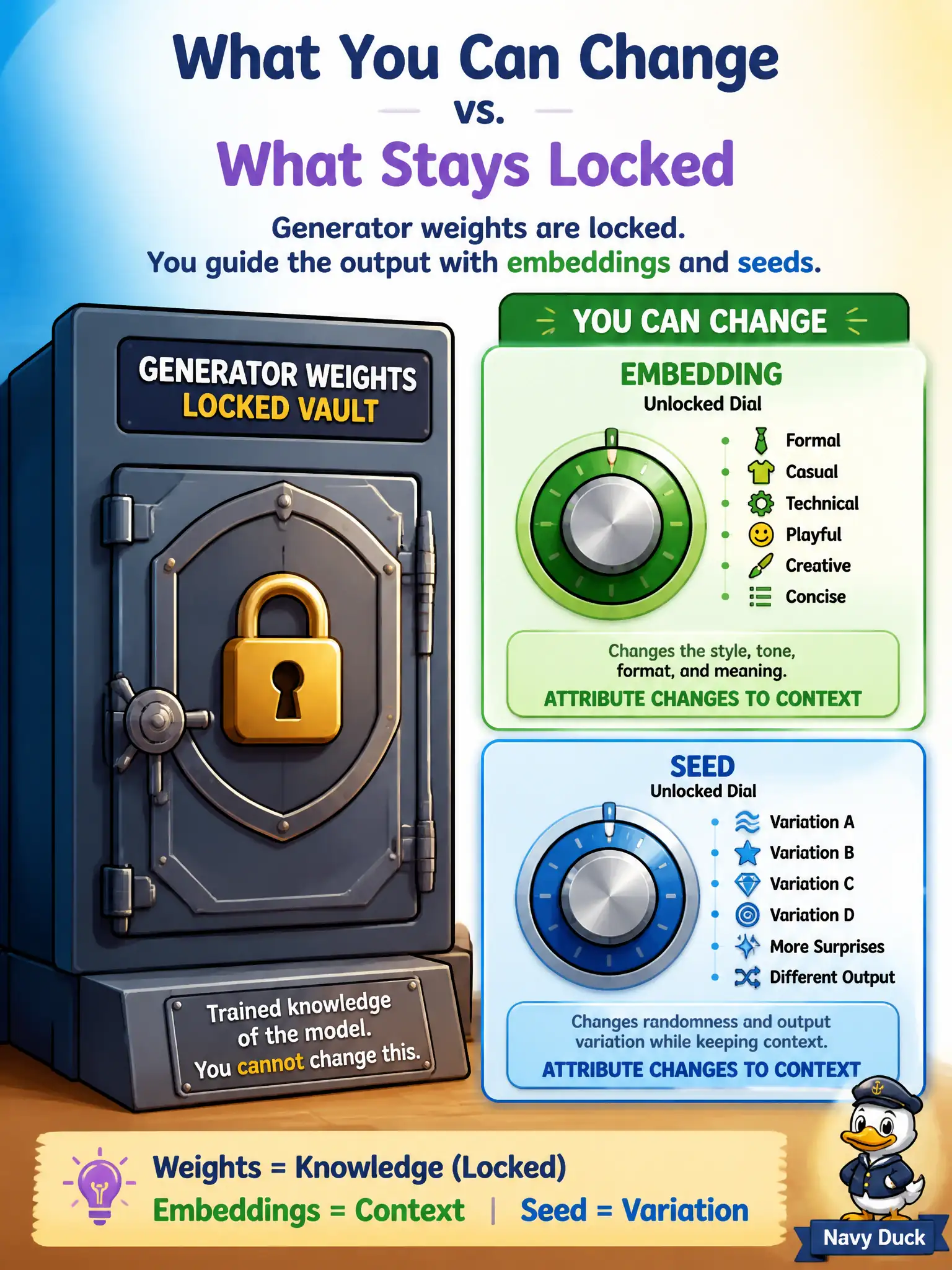
A quilt room freezes the generator weights and spends a week only on embeddings and seeds. Why defend that freeze?
Select an answer to reveal the explanation.
Short Explanation
If the oven settings never move, any new look came from the recipe card and the seed—not from secretly rebuilding the oven. That freeze makes the embedding week readable.
Full Explanation
A quilt room that freezes the generator weights and spends a week only on embeddings and seeds should defend that freeze so every visual change can be attributed to the context experiment—the control that makes test-and-refine interpretable. Civic textile labs owe the public readable weeks: if oven weights never move, new looks came from recipe cards and seeds, not from secretly rebuilding the model. That discipline keeps associate embedding work scientifically usable for later go/no-go decisions.
Freezing so every visual change can be blamed on Kubernetes autoscaling fails by inventing a packaging attribution story unrelated to embeddings. Freezing so staff can swap diffusion for RAPIDS mid-week unnoticed fails by smuggling an out-of-scope dataframe stack into an image week. Freezing so the team can change weights daily without recording it contradicts the freeze and destroys attribution.
Exam caveat: weight freezes make embedding/seed weeks attributable; do not use “freeze” as cover for autoscaling myths, RAPIDS swaps, or silent weight edits. Operational check: checksum or lock generator checkpoints at week start, allow only embedding and seed changes in the change log, and attribute all visual diffs to those controls in the civic trial report.