
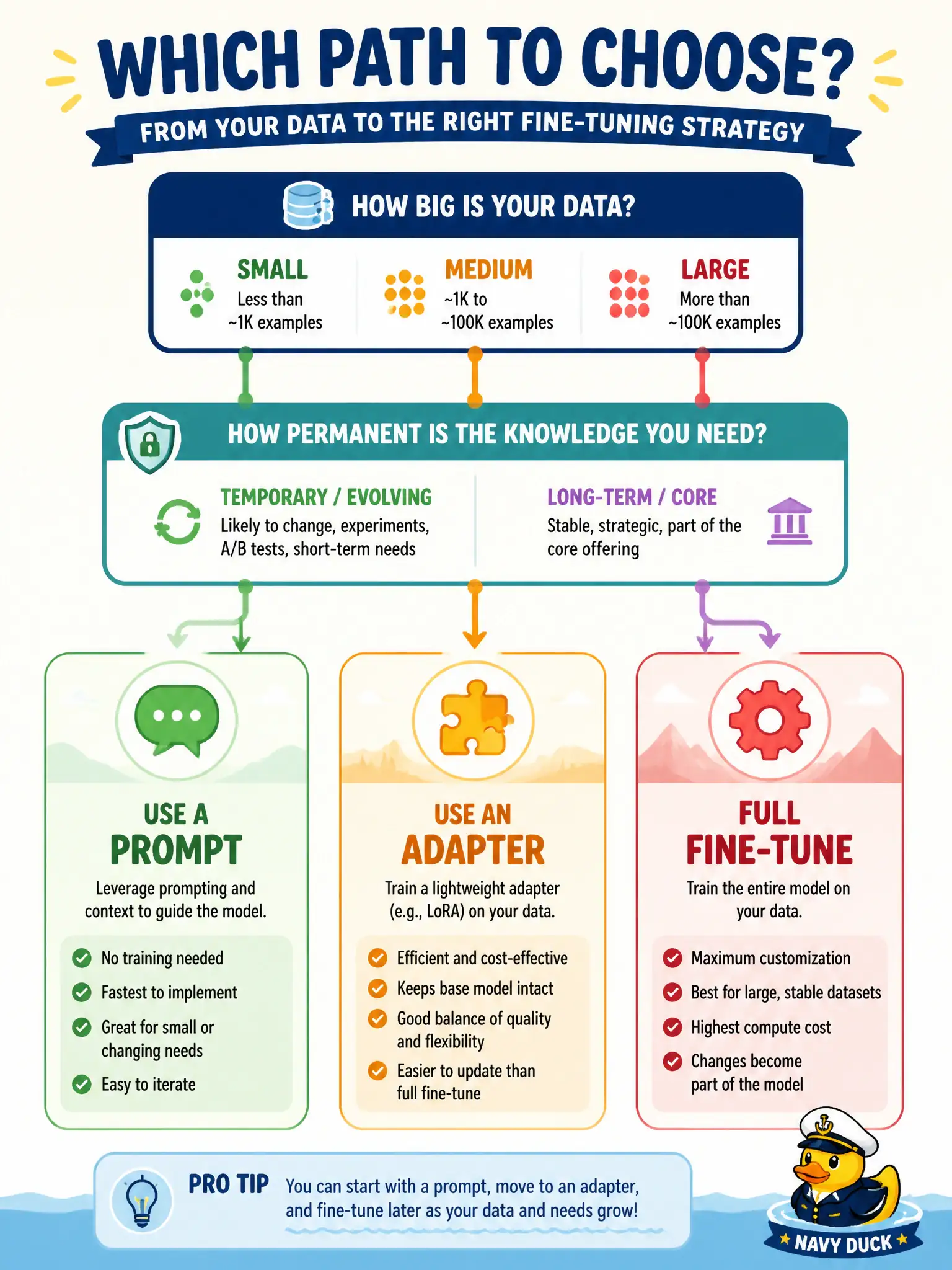
A smokehouse wants house style on future cards and can keep iterating sentences, attach a small adapter, or fine-tune the whole generator. How should the associate choose?
Select an answer to reveal the explanation.
Short Explanation
Few photos and a temporary look? Start by rewriting sentences. Need a sticky house style with a little data? Try a small adapter. Lots of photos and a lasting look? Fine-tune may fit. Match the lever to the job.
Full Explanation
A smokehouse that wants house style on future cards and can keep iterating sentences, attach a small adapter, or fine-tune the whole generator should pick prompt iteration vs adapter vs full fine-tune based on data size and how permanent the style must be. Civic brands and market stalls protect public and small-business creative budgets by matching lever intensity to photo count and permanence needs rather than always fine-tuning first or forever prompting only.
Always full fine-tuning first even with almost no photos fails by over-escalating when scarce house photos cannot support a full retrain. Always only prompting forever even when style must be permanent across many cards fails by refusing stronger levers when permanence is required. Picking solely from NCA-GENL PEFT quiz trivia unrelated to images fails by importing the wrong exam family’s LLM adapter lore as the decision rule.
Exam caveat: choose prompt vs adapter vs full fine-tune from data size and permanence—image+text house style is not a GENL PEFT trivia contest. Operational check: inventory labeled house photos and whether style must stick across a card catalog; start with prompts if scarce/temporary, try a small adapter for sticky style with modest data, and fine-tune only when data and permanence justify it—then compare renders on a fixed eval set.