
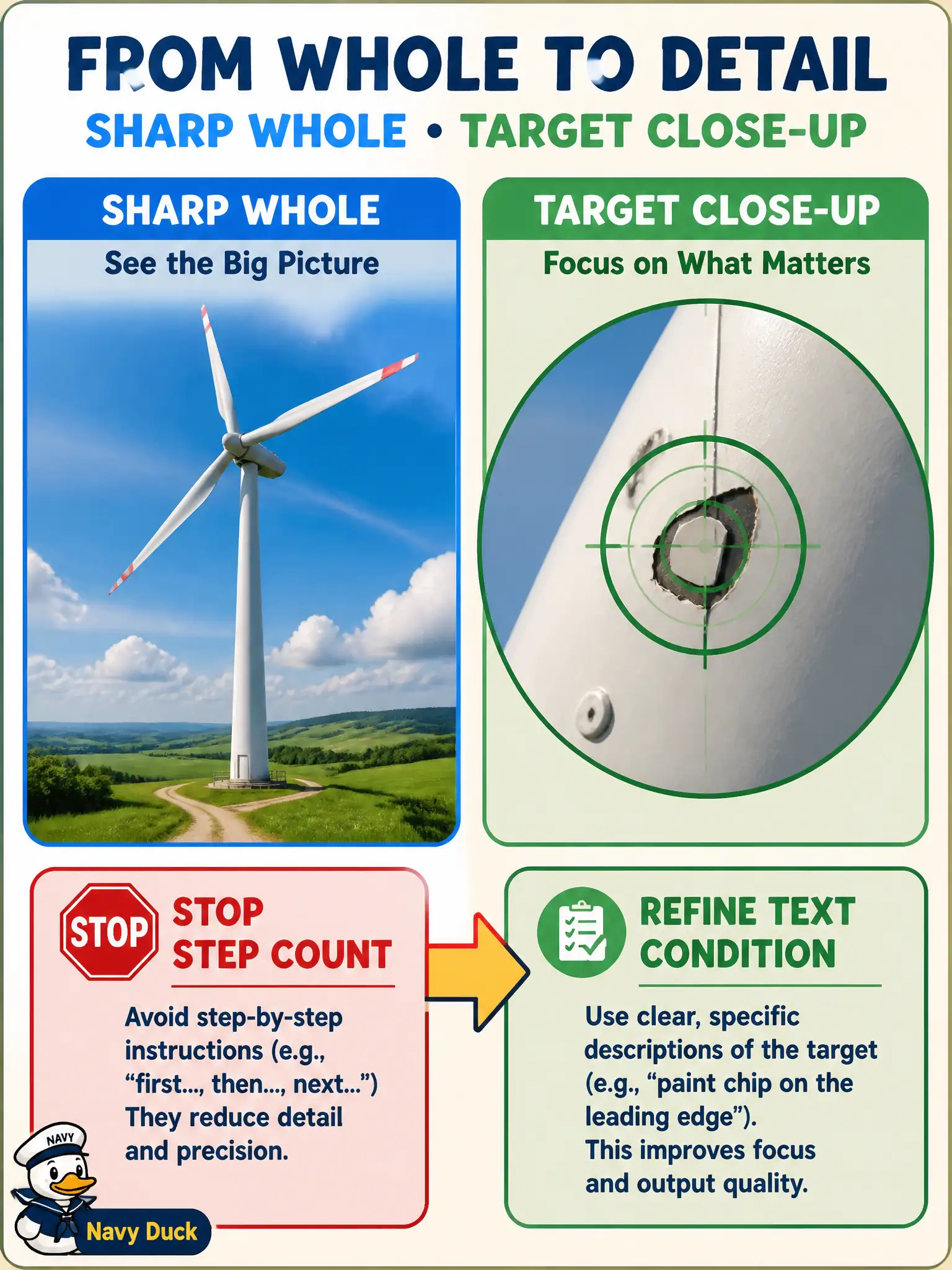
A wind-farm still keeps showing a whole turbine when the note asked for a close trailing-edge chip. Doubling denoising steps only makes the tower sharper. What should the associate do next?
Select an answer to reveal the explanation.
Short Explanation
If the recipe called for a close-up chip and you keep getting a whole turbine, more baking time will not fix the wrong recipe card. Fix the wording that steers the picture, not just the step count.
Full Explanation
A wind-farm still that keeps showing a whole turbine when the note asked for a close trailing-edge chip—and where doubling denoising steps only sharpens the tower—should stop the step experiment and move the next trial to the language or context condition. Civic inspection imagery fails safety review when the wrong subject is beautifully rendered; more steps cannot fix a steering problem in the text condition. Associate practice moves the lever that matches the failure mode.
Keeping doubling steps until the tower disappears fails by persisting with the wrong factor after steps only increase sharpness of the wrong subject. Replacing the image trial with an NCCL all-reduce benchmark fails by escaping into fabric benchmarking. Declaring the GPU broken because sharper pixels prove hardware failure fails by misreading successful denoising of the wrong content as device failure.
Exam caveat: when content mismatches the prompt, revise language/context—not endless step-ups—on the associate diffusion path. Operational check: freeze steps at a known good quality setting, rewrite the note to demand the trailing-edge chip close-up, regenerate with the same seed policy, and confirm subject match before reopening step sweeps.