
After a good lab run of a new Riva vocabulary, a foghorn museum wants 10% of kiosk pods on the new chart values and the rest on last week’s. What is that?
Select an answer to reveal the explanation.
Short Explanation
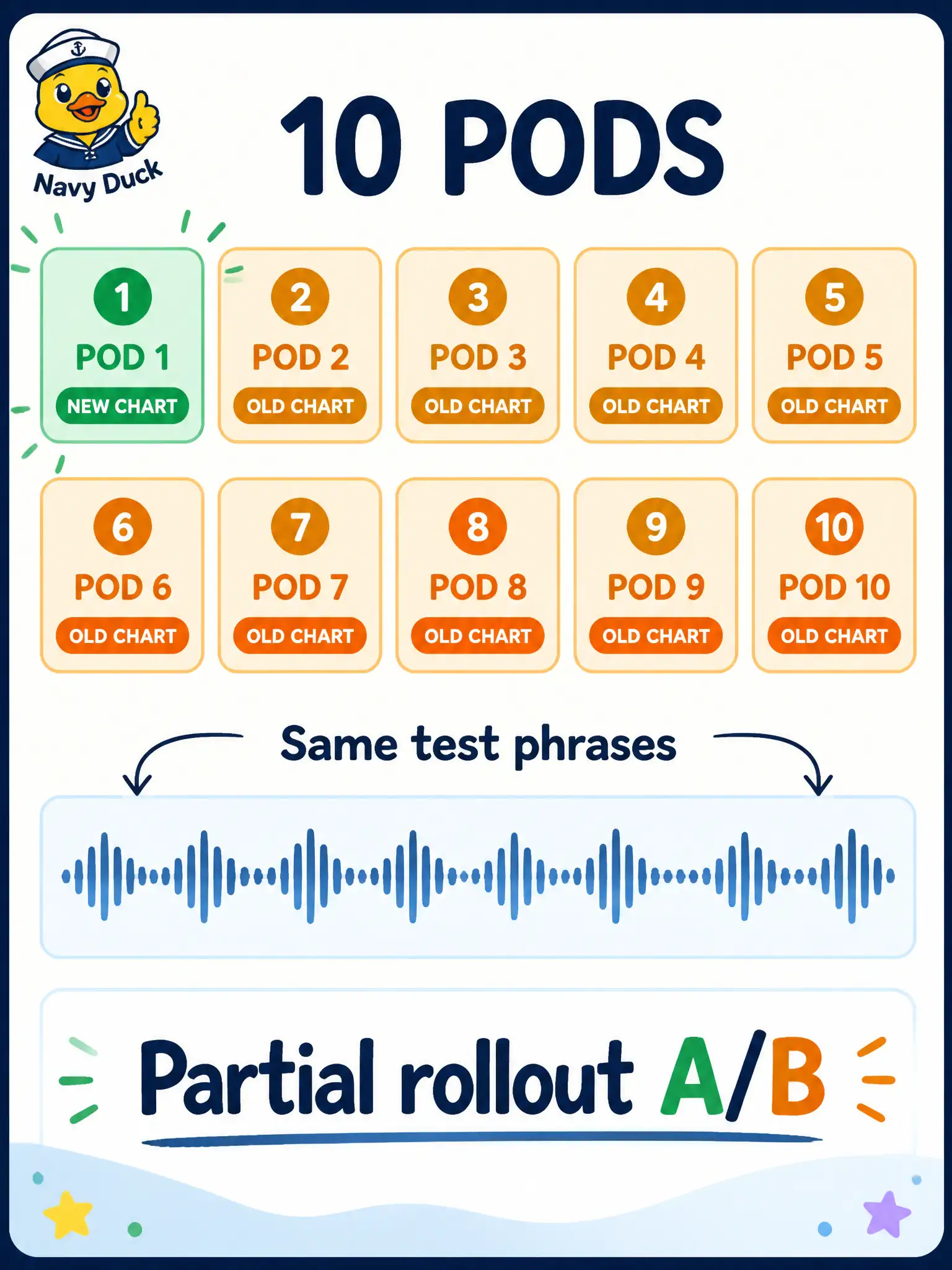
Ten percent on the new chart, ninety on last week’s—that is a live A/B after the lab already passed. Same spoken test phrases, partial rollout. It is not a fresh training job.
Full Explanation
After a good lab run of a new Riva vocabulary, a foghorn museum that wants 10% of kiosk pods on the new chart values and the rest on last week’s is running a production experiment: a partial Helm rollout as a live A/B with the same spoken test phrases. Civic museums can validate lab wins under real visitor load without treating canary pods as a brand-new training job. Partial rollout protects the public majority on the prior chart while measuring the new vocabulary in production conditions that hallway tests cannot simulate.
Calling it a brand-new training job that must re-collect all site audio fails by restarting data collection when the lab vocabulary already passed held-out checks. Claiming Helm cannot carry different ASR values across pods fails by inventing a false packaging limitation that blocks canary design. Asserting canaries require rewriting CUDA kernels in the recognizer fails by injecting out-of-scope kernel work into a straightforward rollout experiment.
Exam caveat: after lab success, partial Helm rollout is a live A/B packaging experiment—not retraining, not kernel authorship. Operational check: pin identical spoken test phrases for both chart cohorts, route about 10% of pods to new values, compare word-error and visitor-task metrics for a fixed window, then promote or roll back from evidence.