
A cheese-aging cave has only forty labeled rind notes next to cave photos held fixed. One trial uses a pretrained token classifier as-is; another trains a small tagger from random weights on those forty notes. Which experiment is more sensible?
Select an answer to reveal the explanation.
Short Explanation
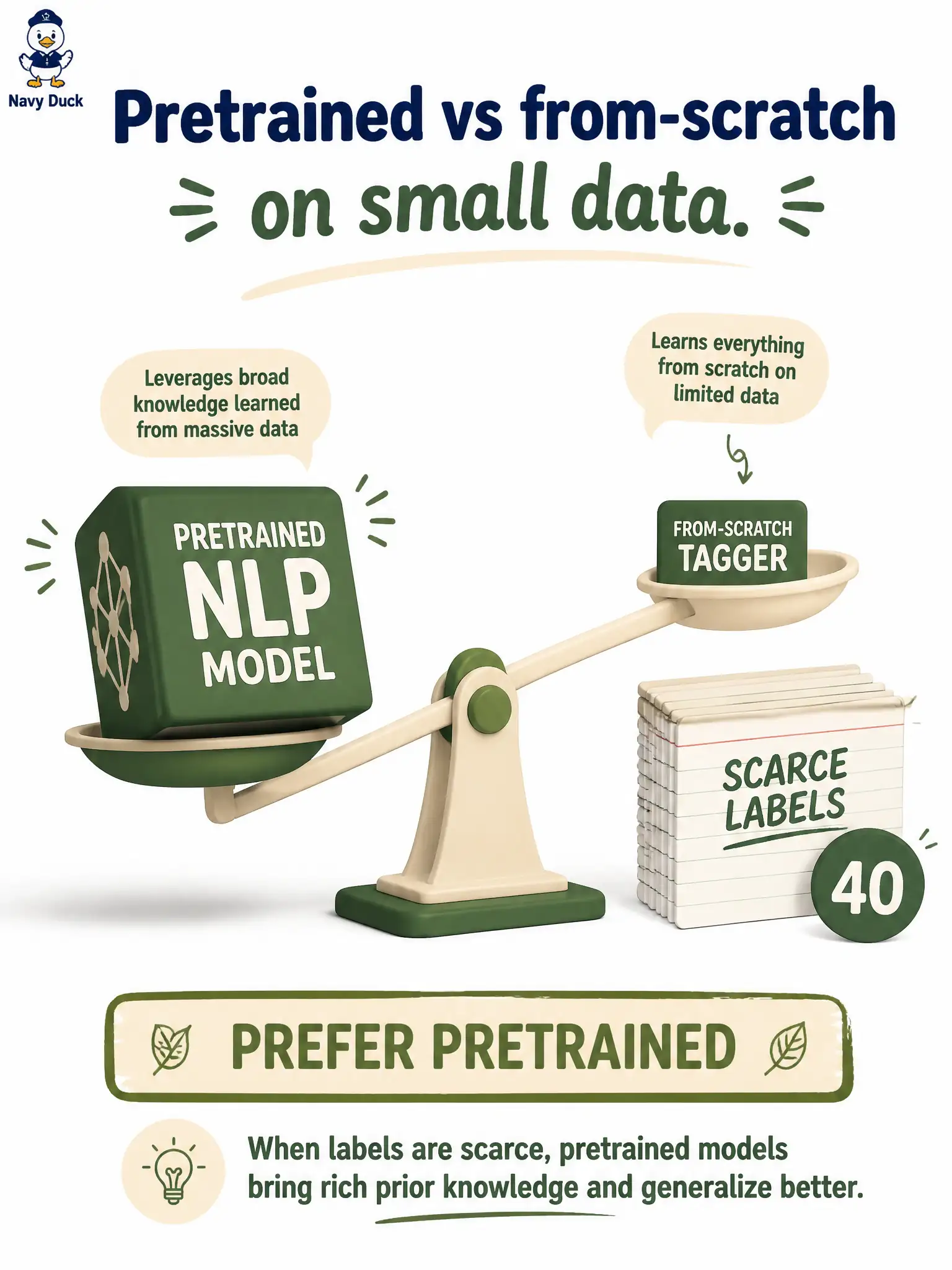
Forty sticky notes are a thin notebook. Starting from a model that already knows language is wiser than teaching a blank tagger from scratch on that tiny pile.
Full Explanation
A cheese-aging cave with only forty labeled rind notes beside fixed cave photos should prefer a pretrained NLP head over from-scratch training on that tiny multimodal set. Transfer of language knowledge reduces data hunger on the text arm while photos stay held fixed, which is the sensible first experiment when civic food-heritage labs cannot invent thousands of new labeled notes. Protecting public documentation quality means starting from pretrained token classification rather than burning scarce labels on a randomly initialized tagger.
Training from scratch because forty notes are enough for any tagger fails by overestimating what a small civic label set can teach a cold model. Discarding the notes and labeling only pixels before any text trial fails by throwing away the text evidence the desk already collected and forcing an immediate vision campaign. Merging both models into one without comparing them fails by destroying experimental contrast—associate practice needs a readable comparison between pretrained and from-scratch arms.
Exam caveat: scarce multimodal labels favor pretrained text heads first; forty notes are not a license for from-scratch bravado. Operational check: freeze photos, run the pretrained classifier and the scratch tagger on the same forty-note split with a held-out score, and keep the pretrained arm if it wins on tagging quality before collecting more labels.