
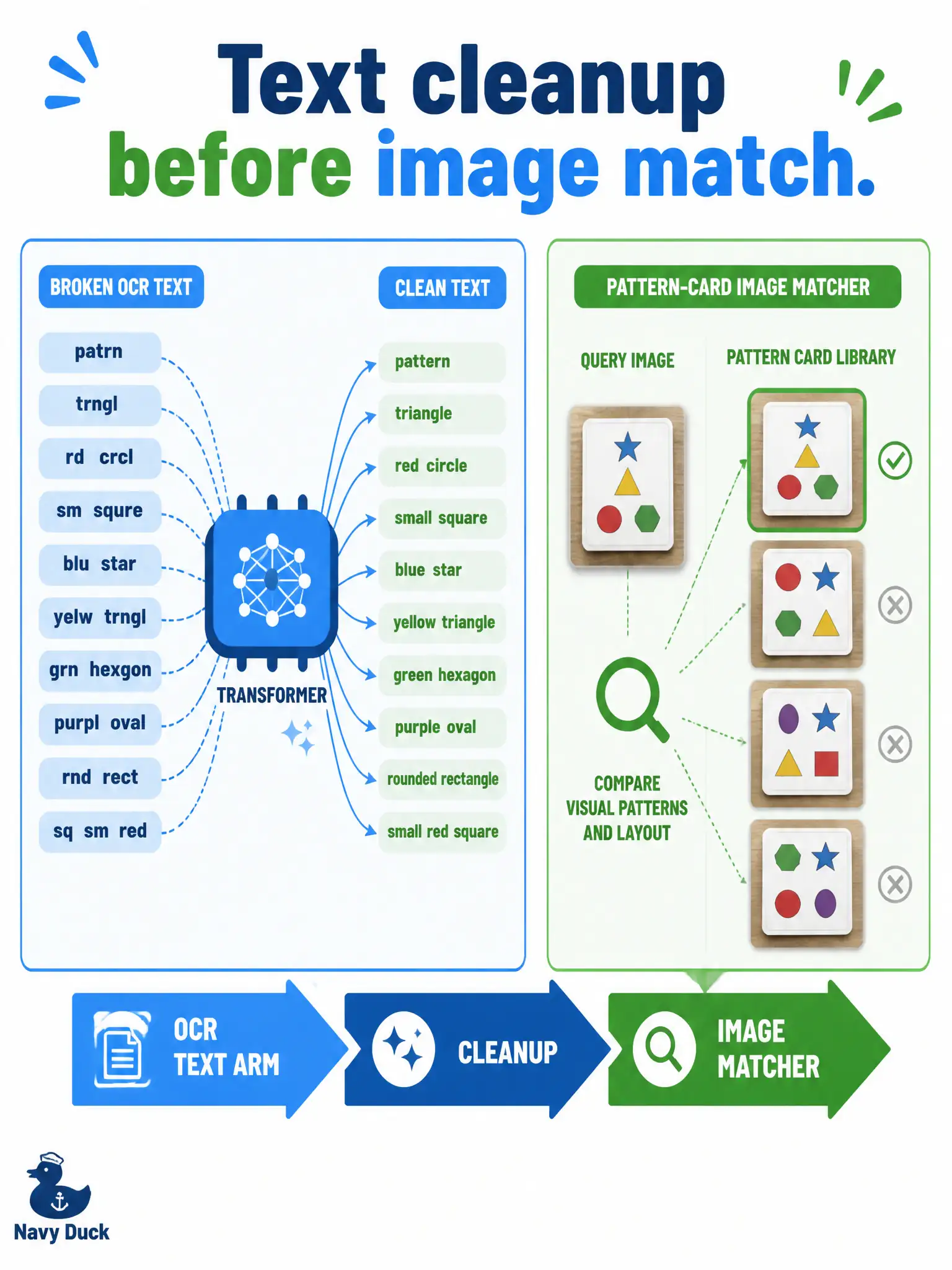
A lace-making archive scans pattern cards whose optical readout is full of broken words. Before a still-image matcher runs, a volunteer wants a transformer to tidy that text. What is the soundest first experiment?
Select an answer to reveal the explanation.
Short Explanation
Think of the messy OCR as a muddy label stuck to a photo. Washing the label with a transformer is a fair first experiment, but you still need the photo matcher. Cleaning text does not replace the visual arm.
Full Explanation
In a civic lace-making archive, broken OCR on pattern cards is a text-arm problem that sits beside a still-image matcher, not a reason to abandon visual retrieval. Running a transformer cleanup stage on the OCR while keeping the image matcher as a separate trial arm is sound because it isolates whether tidier words improve the multimodal handoff without discarding the photo path volunteers already trust for pattern identity. Public collections often inherit muddy labels on otherwise good scans; cleaning the label is a fair first experiment, but the civic catalog still needs the visual arm so taxpayers are not left with text-only lookup that fails when wording remains imperfect.
Skipping the visual matcher and treating cleaned OCR as the only retrieval key fails by collapsing a multimodal catalog into a single fragile text index. Regenerating every scan from noise before any text model touches the archive fails by substituting an image-generation experiment for the OCR-cleanup question the desk actually asked. Replacing the image matcher with a speech synthesizer that reads broken OCR aloud fails by changing modality entirely—TTS does not answer whether text cleanup helps paired still lookup.
Exam caveat: associate experimentation asks which modality arm you vary first, not whether every archive asset must be regenerated. Operational check: freeze the still-image matcher, apply transformer cleanup only to OCR, and score whether retrieval improves on the same held-out pattern cards before expanding scope.