
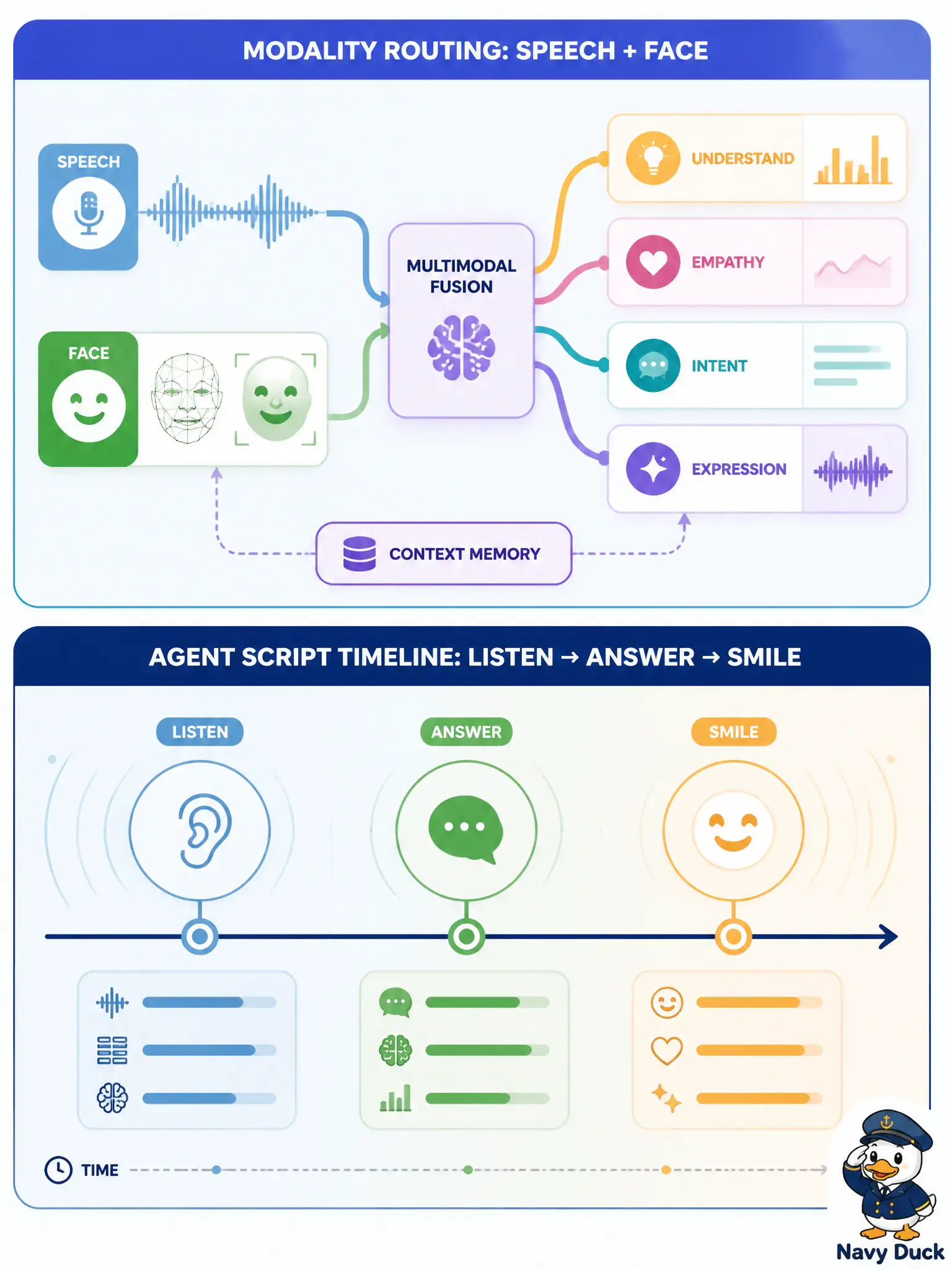
A bell-foundry visitor desk can stream speech and drive a face (ACE / Riva / Audio2Face / NeMo LLM from official additional material) and can also follow a “listen, answer, smile” script. How should those concerns be split?
Select an answer to reveal the explanation.
Short Explanation
Microphones and faces are the ingredients; listen–answer–smile is the recipe card. Split modality orchestration (speech+face) from agent orchestration (the action script).
Full Explanation
At a bell-foundry visitor desk, streaming speech and driving a face with ACE / Riva / Audio2Face / NeMo LLM (from official additional material) are modalities under modality orchestration, while a “listen, answer, smile” script is agent orchestration. Both are not late fusion scores that measure smile sharpness. Both are not OCR readiness steps for badges. Reversing the split—calling the action script modality orchestration and speech/face only agent steps—swaps the definitions. Exam caveat: speech/face = modalities; listen–answer–smile = agent script. Operational check: maintain two civic diagrams—one routing speech and face stacks, one sequencing listen/answer/smile acts—and keep fusion/quality metrics out of both labels unless explicitly needed. Split foundry visitor docs into modality (speech/face) versus agent (listen–answer–smile) sections. Speech/face stacks are modalities; listen–answer–smile is the agent script at the foundry desk. Split foundry visitor documentation: modality sheet for Riva/Audio2Face/NeMo speech-and-face paths; agent sheet for listen–answer–smile sequencing. Close q135 with a municipal evidence note that records why the correct mechanism fits this civic multimodal scenario, why each of the three distractors fails by a distinct concept, and which operational check was observed in logs or dataset cards before promotion. File that note with the run packet so later maintenance cannot silently revive a rejected framing.