
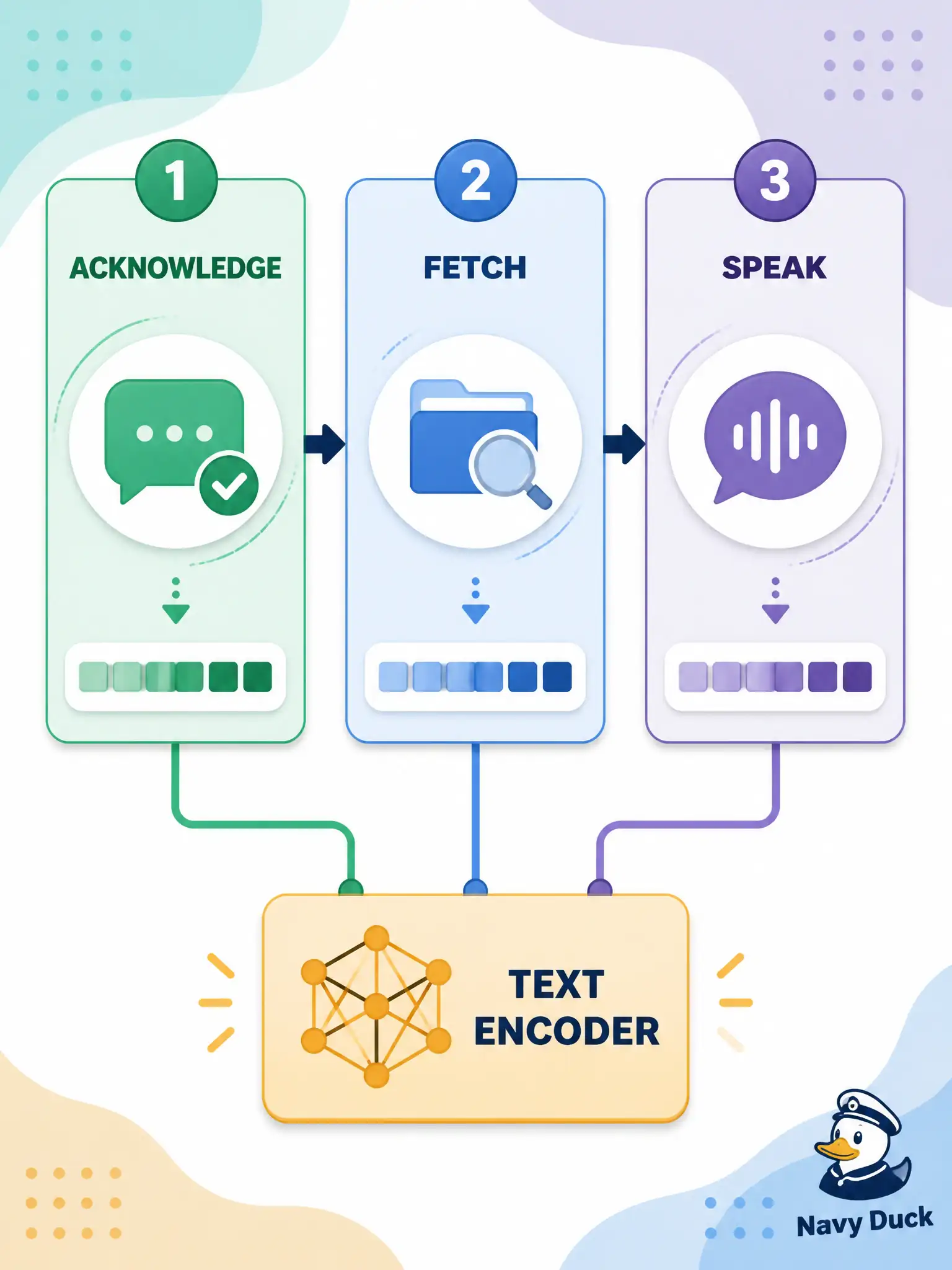
A calliope workshop script says: acknowledge the visitor, fetch the tune card, then speak the title. Even if every step uses the same text encoder, what is this script?
Select an answer to reveal the explanation.
Short Explanation
Acknowledge, fetch, speak is still a playbill of roles even if every line uses the same text encoder. Agent orchestration cares about the job sequence, not the modality count.
Full Explanation
A calliope workshop script that says acknowledge the visitor, fetch the tune card, then speak the title is agent orchestration—a multi-step role script—even if every step uses the same text encoder. Three steps do not imply three early-fusion raw concats. Reusing one encoder does not make the sequencing problem disappear into a modality-only issue. Intermediate fusion of tune-card pixels with spoken spectrograms describes representation joining, not the visitor script. Exam caveat: agent scripts remain agent orchestration regardless of encoder count. Operational check: keep the acknowledge–fetch–speak checklist as the agent plan; separately document whether any step also needs multimodal fusion. Keep the calliope acknowledge–fetch–speak script under agent orchestration even when one encoder is reused. Multi-step calliope scripts remain agent orchestration even when every step reuses one text encoder. Keep the calliope acknowledge–fetch–speak checklist under agent orchestration even when a single text encoder is reused for every line. Operators validating q131 should capture evidence of the correct mechanism in civic logs before release. Close q131 with a municipal evidence note that records why the correct mechanism fits this civic multimodal scenario, why each of the three distractors fails by a distinct concept, and which operational check was observed in logs or dataset cards before promotion. File that note with the run packet so later maintenance cannot silently revive a rejected framing.