
An ice-fishing shack tags each hole photo “safe,” “thin,” or “open water.” How should those categorical tags be made neural-network ready for a training loss?
Select an answer to reveal the explanation.
Short Explanation
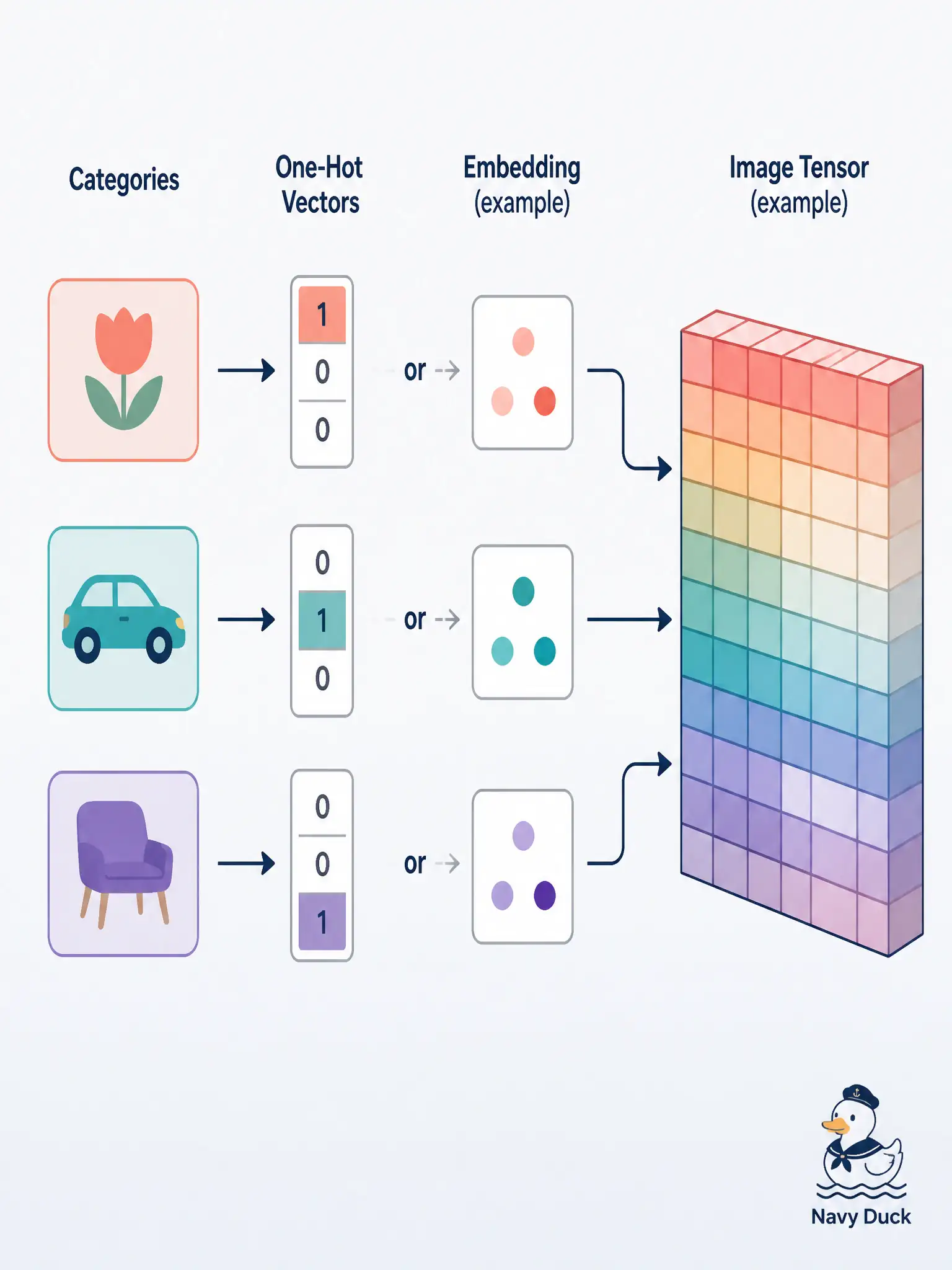
Losses count numbers, not sticky-note words. Turn “safe / thin / open water” into a one-hot or a small embedding—do not shove the phrase into the pixel tensor.
Full Explanation
Categorical tags such as “safe,” “thin,” or “open water” on ice-fishing hole photos must be converted into a numeric label form—commonly a one-hot vector or a small class embedding—for a training loss to consume. Pasting the words as free text inside vision tensor channels confuses label encoding with image channels. Leaving tags as spoken audio only never supplies a discrete class target for supervised vision training. Storing only the photographer’s phone number as the class id is not a semantic label encoding. Exam caveat: discrete civic tags become numeric class targets for the loss. Operational check: map each hole tag to a class index or one-hot vector, confirm the loss receives those targets beside image tensors, and keep a legend in the dataset card. Publish the safe/thin/open-water class map used for one-hot or embedding targets. Map safe/thin/open-water tags to numeric class targets for the loss; phone numbers and channel-pasted words are not labels. Store the ice-fishing class map (safe/thin/open water) with one-hot or embedding targets in the dataset card so the loss always receives numeric labels. Close q115 with a municipal evidence note that records why the correct mechanism fits this civic multimodal scenario, why each of the three distractors fails by a distinct concept, and which operational check was observed in logs or dataset cards before promotion. File that note with the run packet so later maintenance cannot silently revive a rejected framing.