
A soap-boiling shed records the kettle and a volunteer passes only the recording’s filename string into a speech model. What must happen before the model can run?
Select an answer to reveal the explanation.
Short Explanation
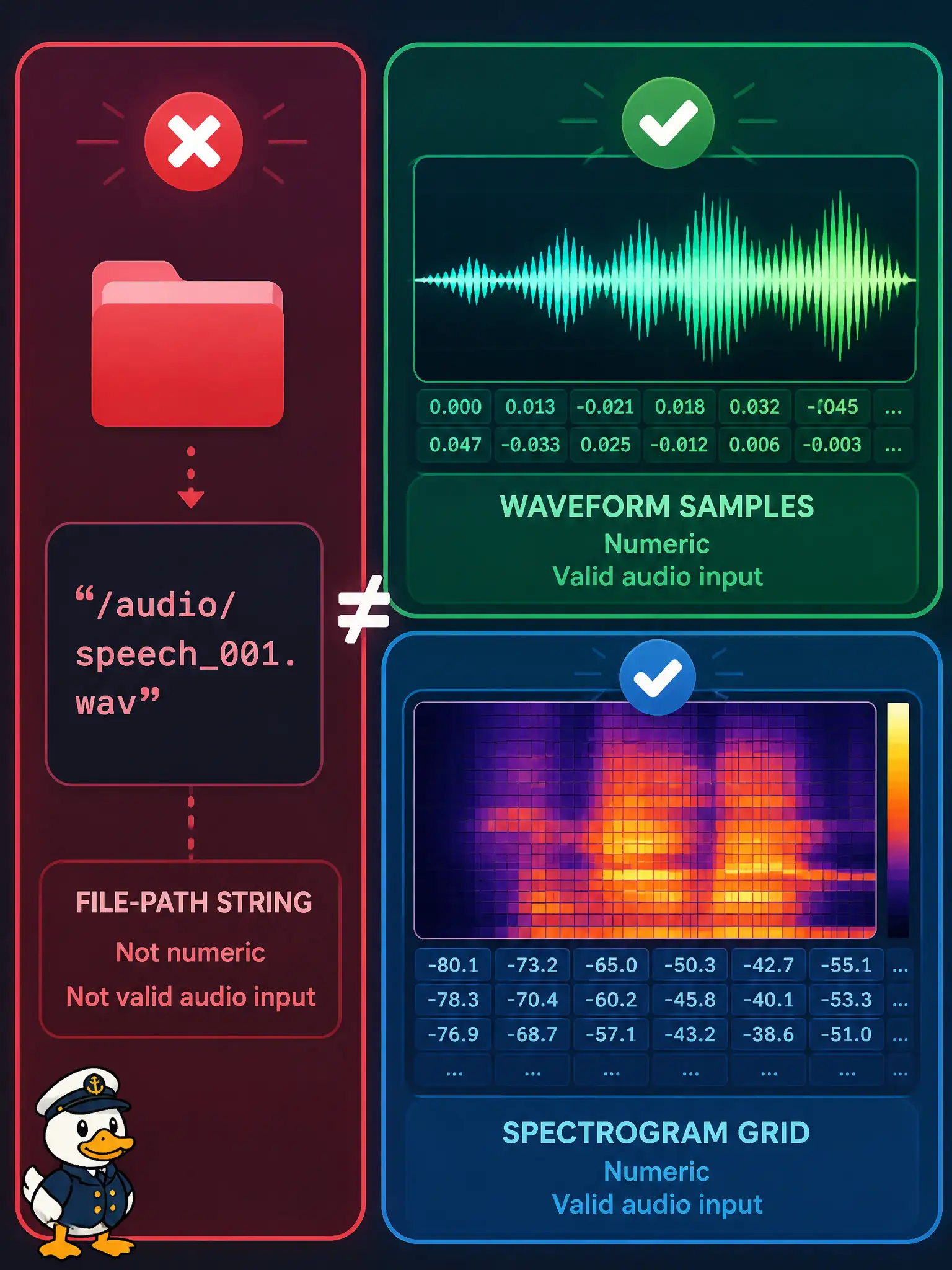
A filename is a label on a jar, not the soup. The model needs waveform samples or a spectrogram—actual numeric audio—before speech or sound inference can start.
Full Explanation
Before a speech model can run on a soap-boiling shed recording, the system must provide a numeric audio form such as waveform samples or a spectrogram. A volunteer passing only the recording’s filename string does not supply audio features—paths are not waveforms. Skipping audio to train only on kettle stills abandons the speech modality. Renaming the file with more vowels does not make a path model-ready. Exam caveat: speech readiness is decoded numeric audio, not filenames. Operational check: load the kettle recording, resample to the model’s expected rate, and feed waveform or spectrogram tensors—never the path string alone—into the speech front end. Gate speech jobs on successful waveform load from kettle recordings, not on filename presence. Speech models consume waveform or spectrogram tensors from kettle recordings; filenames and vowel-heavy renames are not audio. Require kettle-recording loaders to emit waveform or spectrogram tensors at the speech model’s sample rate; fail the soap-shed pipeline if only a path string is present. Close q110 with a municipal evidence note that records why the correct mechanism fits this civic multimodal scenario, why each of the three distractors fails by a distinct concept, and which operational check was observed in logs or dataset cards before promotion. File that note with the run packet so later maintenance cannot silently revive a rejected framing.