
A cobbler bench places a care sentence next to a sole photo. Before the language stack can run on that sentence, what must happen to the text?
Select an answer to reveal the explanation.
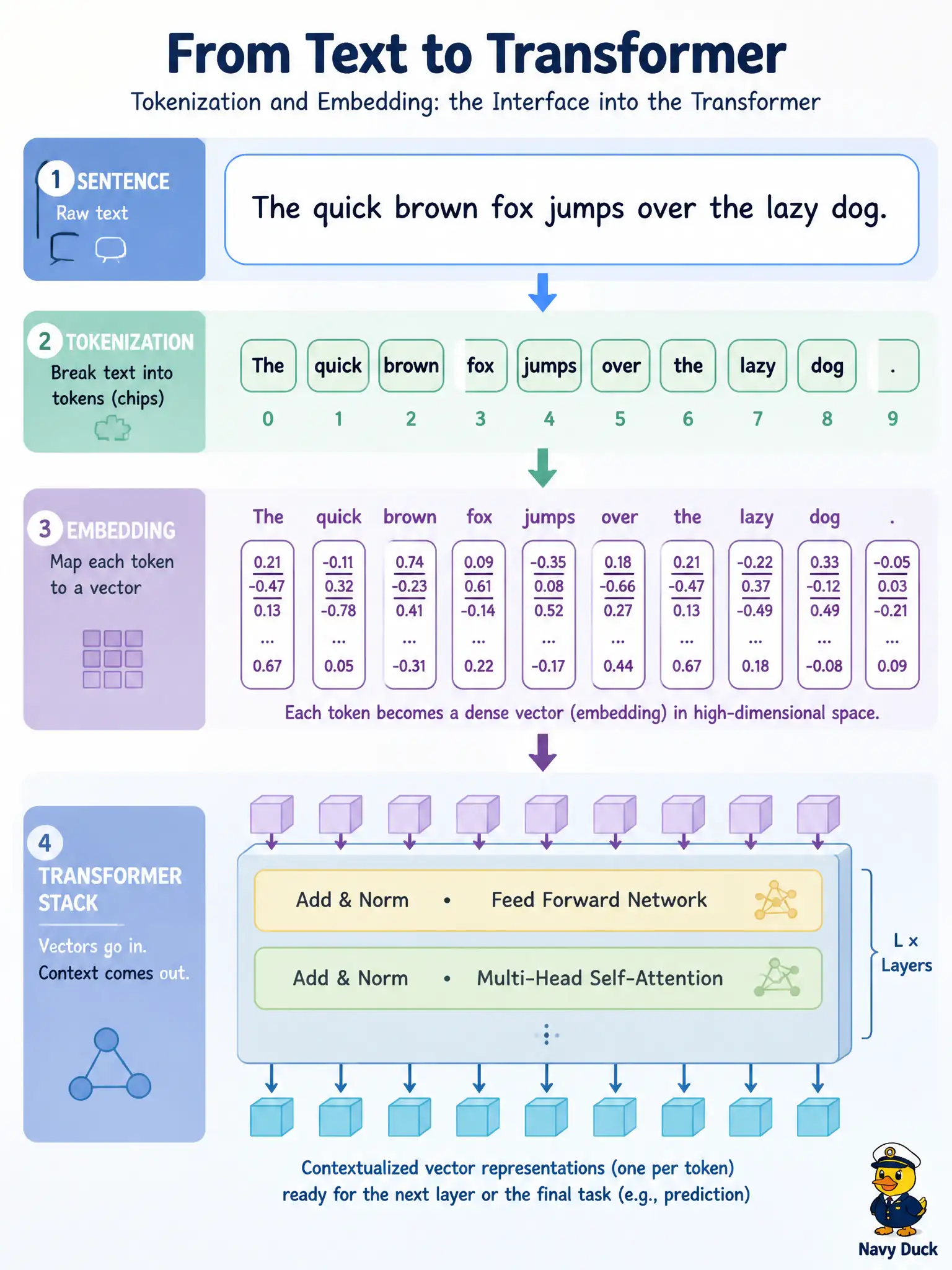
Short Explanation
The language stack does not sip a whole sentence like a smoothie; it chops it into bite-size tokens and turns each bite into a vector. Tokenization plus embedding is the interface. Raw strings and raw pixels are not what that stack consumes for the text path.
Full Explanation
Before a language stack can run on a cobbler bench’s care sentence beside a sole photo, the sentence must be split into tokens and each token mapped to an embedding vector. That tokenization-plus-embedding interface is how text becomes neural-network ready. Feeding a raw unbroken character blob skips the designed text interface. Replacing the sentence with sole-photo pixels drops the text path entirely. Embedding only the filename while discarding the care sentence throws away the linguistic content the language stack should consume. Exam caveat: multimodal systems still tokenize and embed text even when a still sits nearby. Operational check: print token ids and embedding shapes for the care sentence; refuse pipelines that pass only filenames or raw undecoded strings into the language stack. Unit-test that care-sentence embeddings change when tokens change, proving the text path is live beside the sole photo. Tokenize and embed the cobbler care sentence; filenames and sole pixels do not satisfy the language stack’s text interface. Unit-test that embedding outputs change when the care wording changes. Close q099 with a municipal evidence note that records why the correct mechanism fits this civic multimodal scenario, why each of the three distractors fails by a distinct concept, and which operational check was observed in logs or dataset cards before promotion. File that note with the run packet so later maintenance cannot silently revive a rejected framing.