
A spice-mill captioner asks what is actually stacked inside the language model that will later sit beside stills. What is the reusable transformer unit?
Select an answer to reveal the explanation.
Short Explanation
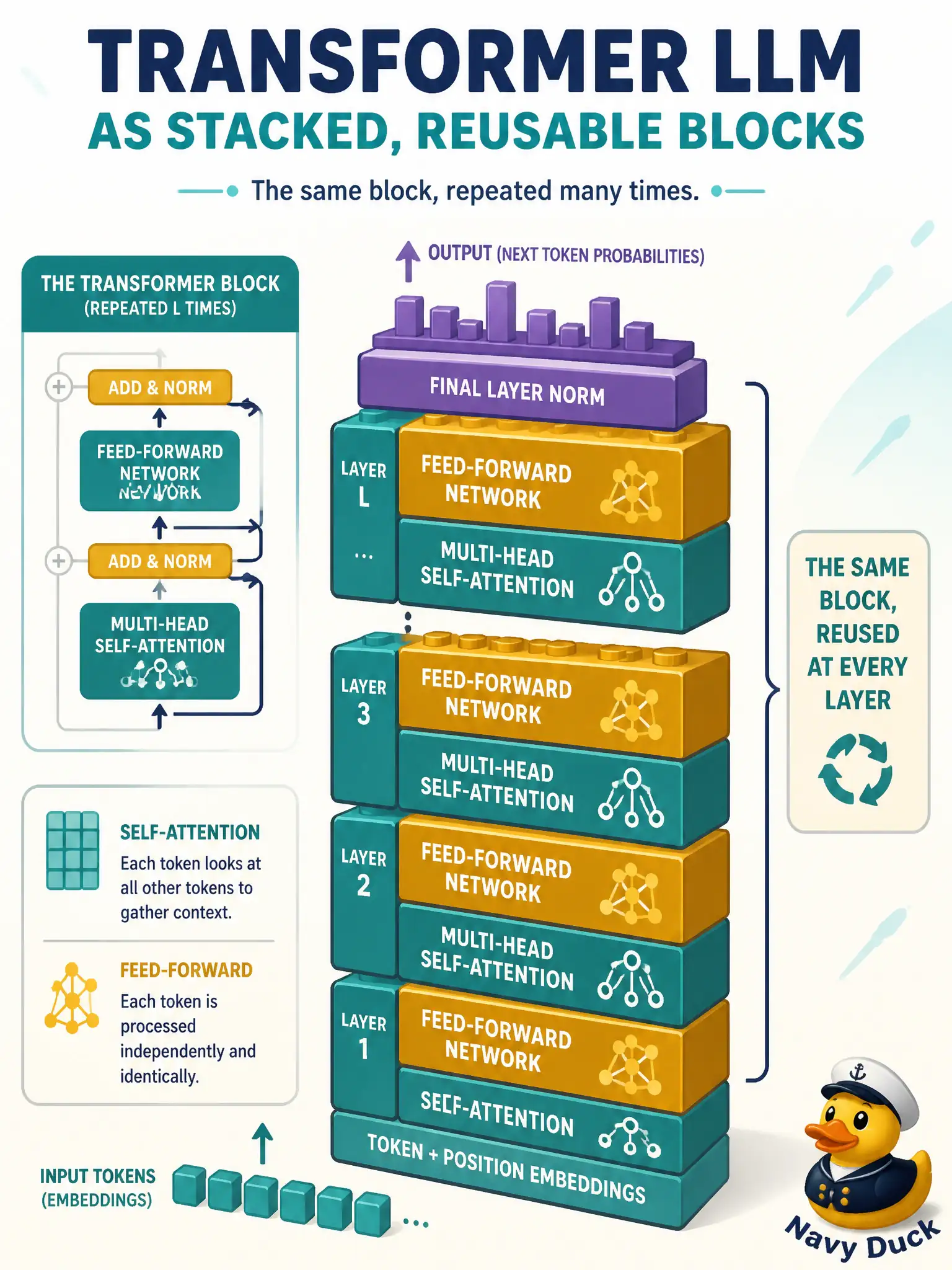
Inside the mill’s language tower, the same clever brick is laid again and again. That brick is self-attention plus a feed-forward block. Those repeated units are what make a modern transformer LLM.
Full Explanation
Inside the language model that will sit beside spice-mill stills, the reusable transformer unit is self-attention together with the feed-forward block, stacked repeatedly. That repeated unit—not a random learning-rate dial—is what modern transformer LLMs are built from. A single CUDA kernel replacing every transformer block is out of associate scope and is not the architectural unit. A Helm chart that deploys Riva contains deployment config, not the attention-plus-feed-forward brick definition. Exam caveat: name the block composition; do not substitute infrastructure charts for architecture. Operational check: when reading a civic LLM diagram beside stills, count stacked blocks and confirm each shows attention and a feed-forward sublayer before discussing learning-rate schedules. When counting spice-mill LLM layers, require attention+FFN in each block description in the model card. The reusable LLM brick is self-attention plus feed-forward, stacked; Helm charts and lone CUDA kernels are not that unit. Model cards for spice-mill text towers should name those sublayers explicitly. Close q098 with a municipal evidence note that records why the correct mechanism fits this civic multimodal scenario, why each of the three distractors fails by a distinct concept, and which operational check was observed in logs or dataset cards before promotion. File that note with the run packet so later maintenance cannot silently revive a rejected framing.