
A 63-year-old with prolonged fever, productive cough and right upper lobe cavitation has three negative sputum smears, persistent infiltrate after antibiotics and new neutropenia limiting expectoration in a medical ICU. CT shows bronchiectasis with mucus plugging. Which diagnostic recommendation best obtains lower airway samples for this nonresolving pneumonia?
Select an answer to reveal the explanation.
Short Explanation
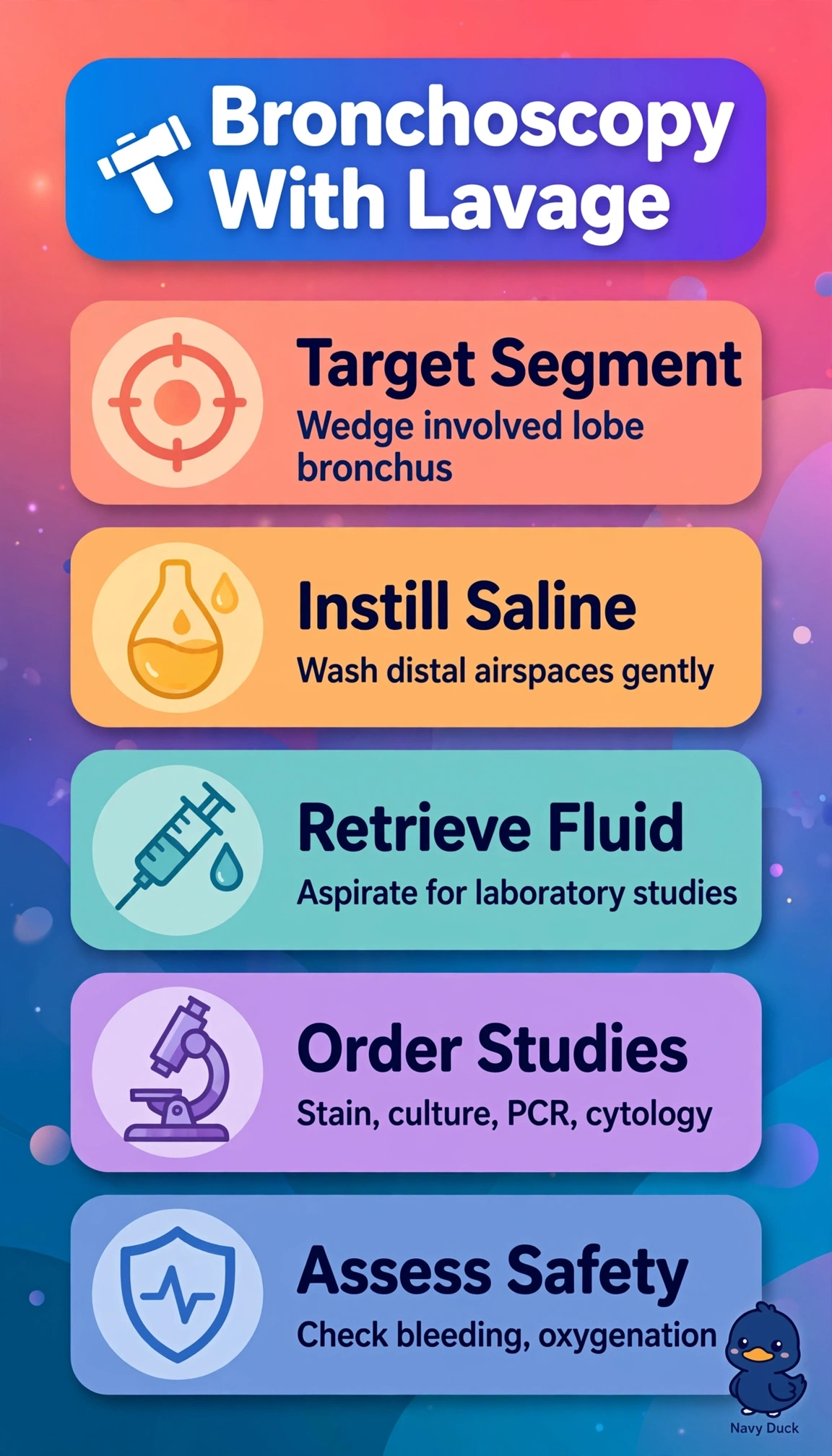
You need answers from deep in the lung when sputum keeps missing. Washing and sampling the involved segment gives microbiology its best shot, and targeted lavage often cracks the case.
Full Explanation
Flexible bronchoscopy with bronchoalveolar lavage is ideal for nonresolving cavitary pneumonia with three negative smears because it directly samples distal airways for stain, mycobacterial and fungal culture, and cytology to evaluate tuberculosis, fungi, and malignancy while bypassing poor expectoration and mucus plugging from bronchiectasis in this ICU patient. Sputum induction with hypertonic saline is standard for AFB diagnosis but fails on adequacy because repeat noninvasive upper airway samples cannot substitute for lower airway sampling after multiple negatives and persistent plugging. CT-guided transthoracic aspiration is valuable for peripheral nodules but fails on target because focal lung puncture does not provide diffuse airway microbiology and cytology and increases pneumothorax risk without accessing plugged segments. Protected brush sampling for quantitative bacterial culture is common in ICU pneumonia but fails on breadth because bacterial culture alone omits stains and cytology required for cavitary tuberculosis, fungal disease, and tumor. Exam caveat: with cavitation plus nonresolution and negative smears, choose broad lower airway stain, culture, and cytology over repeat sputum or narrow bacterial tests. Practical check: verify oxygenation, bleeding risk, and antibiotic hold, then coordinate with microbiology and cytopathology for lavage handling.