
A 62-year-old with COPD exacerbation needs a radial arterial blood gas to guide ventilation. The therapist performs Allen testing, cleans with chlorhexidine, uses a preheparinized syringe, and notes a small air bubble after a brisk arterial puncture. The sample must travel 10 minutes to the lab on ice. Which sampling technique for arterial blood gas collection best avoids pre-analytic error?
Select an answer to reveal the explanation.
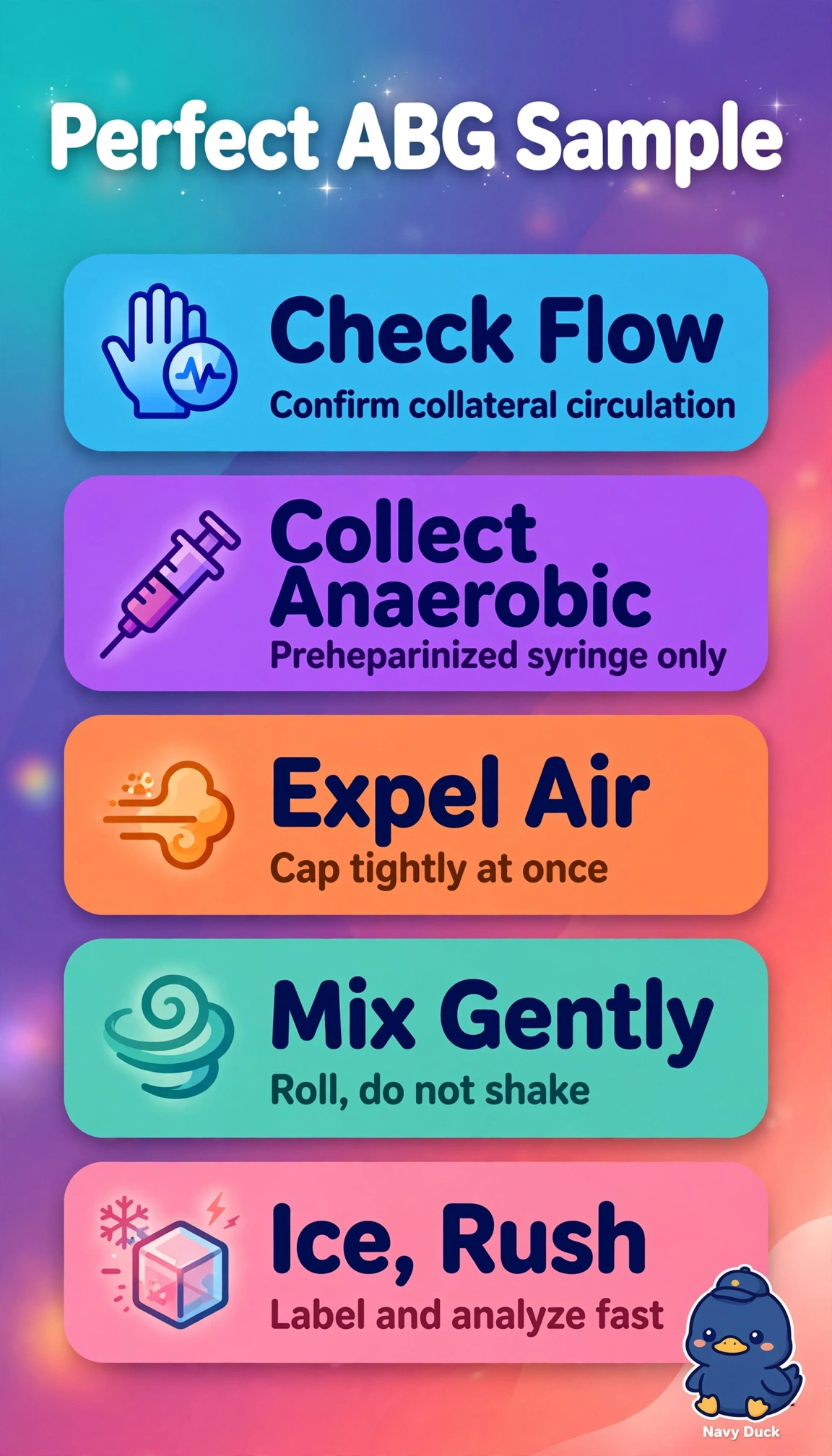
Short Explanation
You're guarding that syringe like fresh evidence from contamination. Air-tight handling is your winner, since even tiny bubbles and delays can skew oxygen and pH fast.
Full Explanation
Correct handling preserves in vivo tensions by keeping the specimen anaerobic, anticoagulated and metabolically quiet until prompt analysis, which is essential to guide ventilation in COPD exacerbation where PaO2, PaCO2 and pH drive decisions; expelling all air and capping prevents room-air equilibration, gentle mixing distributes dry heparin without cell injury, and labeled ice transport slows leukocyte metabolism during the 10-minute transit. The room-temperature variant fails on metabolic control because blood cells continue to consume oxygen and produce carbon dioxide at ambient temperature, lowering PaO2 and pH while raising PaCO2, an effect iced slurry specifically suppresses for delayed analysis. The vigorous-shaking variant fails on mechanical integrity because forceful agitation shears erythrocytes causing hemolysis and microbubble entrainment, which degrades sample quality despite correct capping and cooling. The retained-bubble variant fails on anaerobic integrity because residual air equilibrates toward atmospheric PO2 near 150 mmHg and PCO2 near zero, falsely raising PaO2 and lowering PaCO2 with greater error after mixing and icing time. Exam caveat is to separate arterial gas stringency from venous chemistry tolerance and to recall that liquid heparin excess dilutes CO2 while dry preheparinized syringes require only gentle rolling. Practical check is to inspect the capped syringe at eye level for zero air, roll gently to confirm no clot or froth, place fully in ice, and record draw time, site, FiO2 and temperature.