
A 24-year-old with severe traumatic brain injury has ICP 26 mm Hg, CPP 55 mm Hg, PaCO2 48 mm Hg on volume control, and transient desaturation during suctioning. Pupils are sluggish, sedation is light, and head of bed is flat for a procedure. The team needs stable ventilation without raising intracranial pressure. Which ventilation adjustment best manages brain injury with intracranial hypertension?
Select an answer to reveal the explanation.
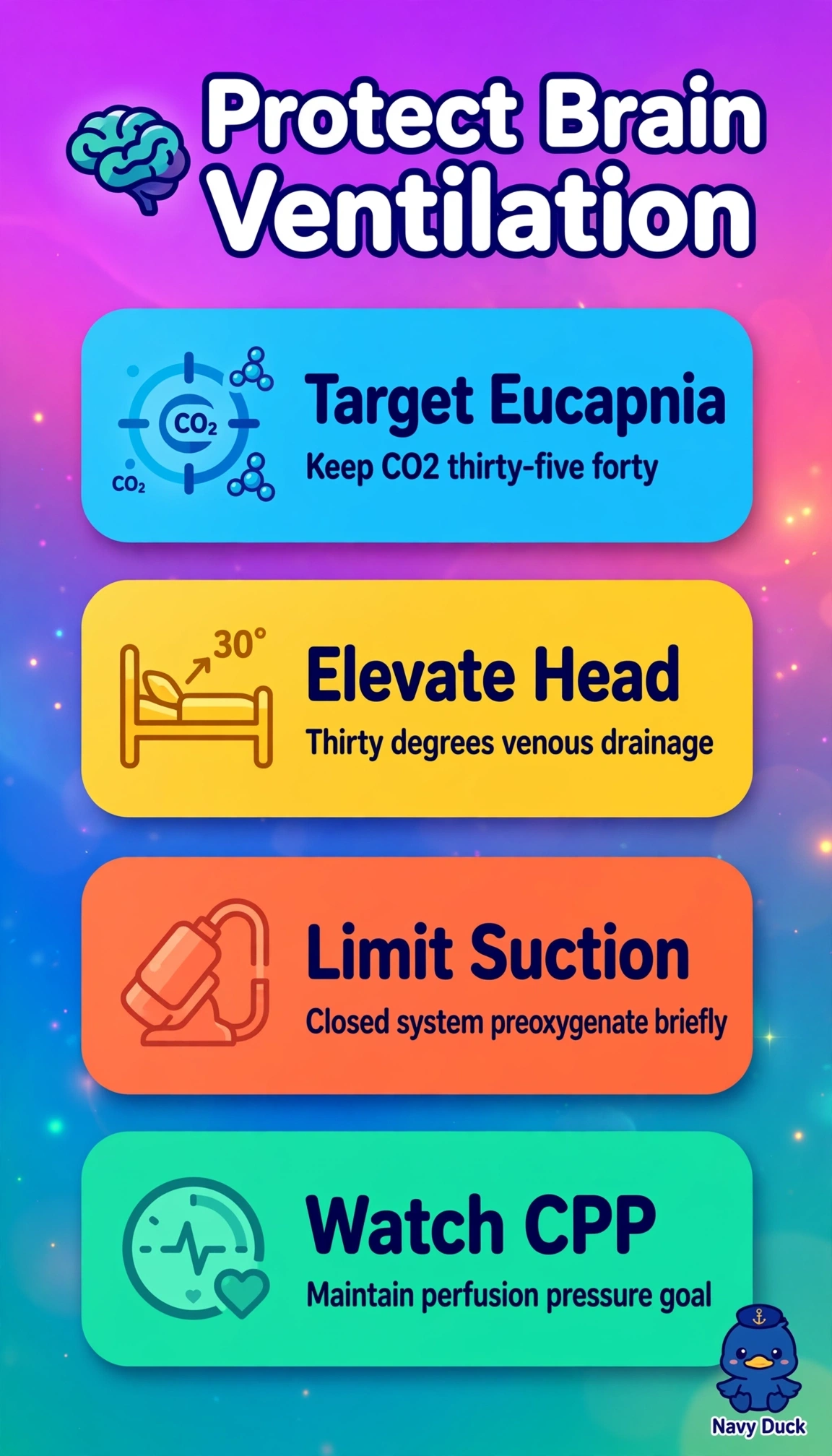
Short Explanation
Your brain needs steady blood flow, not swings. Eucapnia keeps vessels calm, like holding a steady speed through a tight curve.
Full Explanation
Elevated CO2 dilates cerebral vessels and raises intracranial blood volume and ICP, while aggressive hypocapnia constricts vessels and risks ischemia, so restoring normal PaCO2 around 35 to 40 mm Hg with adequate sedation, head elevation, and closed suctioning with preoxygenation stabilizes ICP and perfusion. Sustained hyperventilation to very low PaCO2 only briefly lowers ICP at the cost of marked vasoconstriction and ischemia and is reserved for imminent herniation as a temporizing bridge. Permissive hypercapnia, useful in ARDS lung protection, is contraindicated with intracranial hypertension because acidosis and vasodilation directly increase ICP and lower cerebral perfusion pressure. Frequent open suctioning with disconnection causes hypoxia, hypercapnia, and intrathoracic pressure swings that spike ICP, and flat positioning impairs venous drainage. Exam caveat is that Brain Trauma Foundation principles prioritize eucapnia, adequate CPP, and avoiding hypoxia and suction-related surges. Practical check is to monitor end-tidal CO2, arterial gases, ICP waveform, CPP, and pupillary response after each ventilator or positioning change.