
A 12-year-old with asthma uses a metered-dose inhaler with valved holding chamber but continues coughing, has poor symptom control, white residue on the tongue, and actuates multiple puffs in rapid succession without inhaling slowly. Which inhaler technique correction should the therapist teach to improve drug delivery from a pressurized inhaler and chamber?
Select an answer to reveal the explanation.
Short Explanation
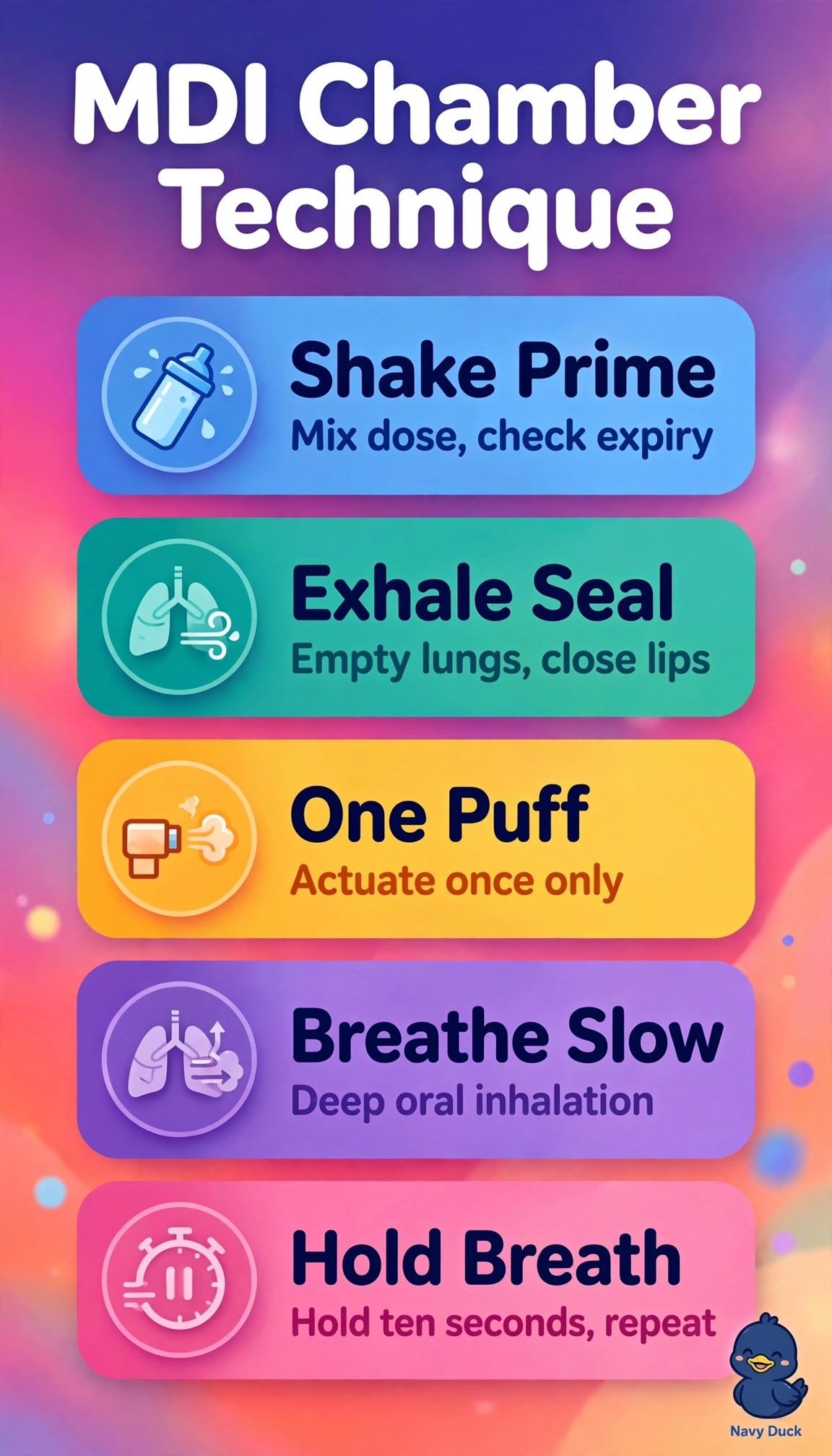
You'll get way more relief when you shake, breathe out, seal your lips around the chamber, then take just one slow puff with a good breath-hold, like sipping hot cocoa instead of gulping it. That gentle flow lets the mist drift deep into your lungs instead of coating your tongue.
Full Explanation
Pressurized metered-dose inhalers deliver high-velocity aerosol that impacts the oropharynx unless plume velocity is baffled by a valved holding chamber and inspiratory flow is slow to favor sedimentation in lower airways, with shaking ensuring uniform suspension and breath-holding allowing particle deposition. Single actuation followed by slow deep inhalation through the mouthpiece with end-inspiratory hold maximizes lung dose and minimizes tongue residue and cough from cold propellant effect. Multiple rapid puffs with nasal shallow breaths fail by overwhelming chamber volume, causing particle coalescence and wall loss, while nasal and rapid shallow flow filters drug in the nose and upper airway. Maximally fast forceful inhalation fails by flow concept appropriate for dry-powder inhalers, not pressurized inhalers, because high flow increases inertial impaction in the throat and reduces peripheral delivery. Spraying onto the tongue without chamber and swallowing fails by route because inhaled asthma therapy requires airway deposition, not gastrointestinal absorption, and omitting the chamber restores hand-breath coordination difficulty. Exam caveat is to match inspiratory maneuver to device type and to rinse after corticosteroids. Practical check is to demonstrate, watch return demonstration, check chamber valve movement, and reassess cough, technique, and symptom diary.