
A 71-year-old with right middle lobe pneumonia has SpO2 87% on 2 L/min, coarse crackles on the right, productive cough with thick sputum, and ability to turn with assistance. Chest X-ray shows dense right-sided infiltrate without effusion, hemodynamics are stable, and the good left lung is normal. Which positioning and airway clearance combination should the therapist use to minimize hypoxemia?
Select an answer to reveal the explanation.
Short Explanation
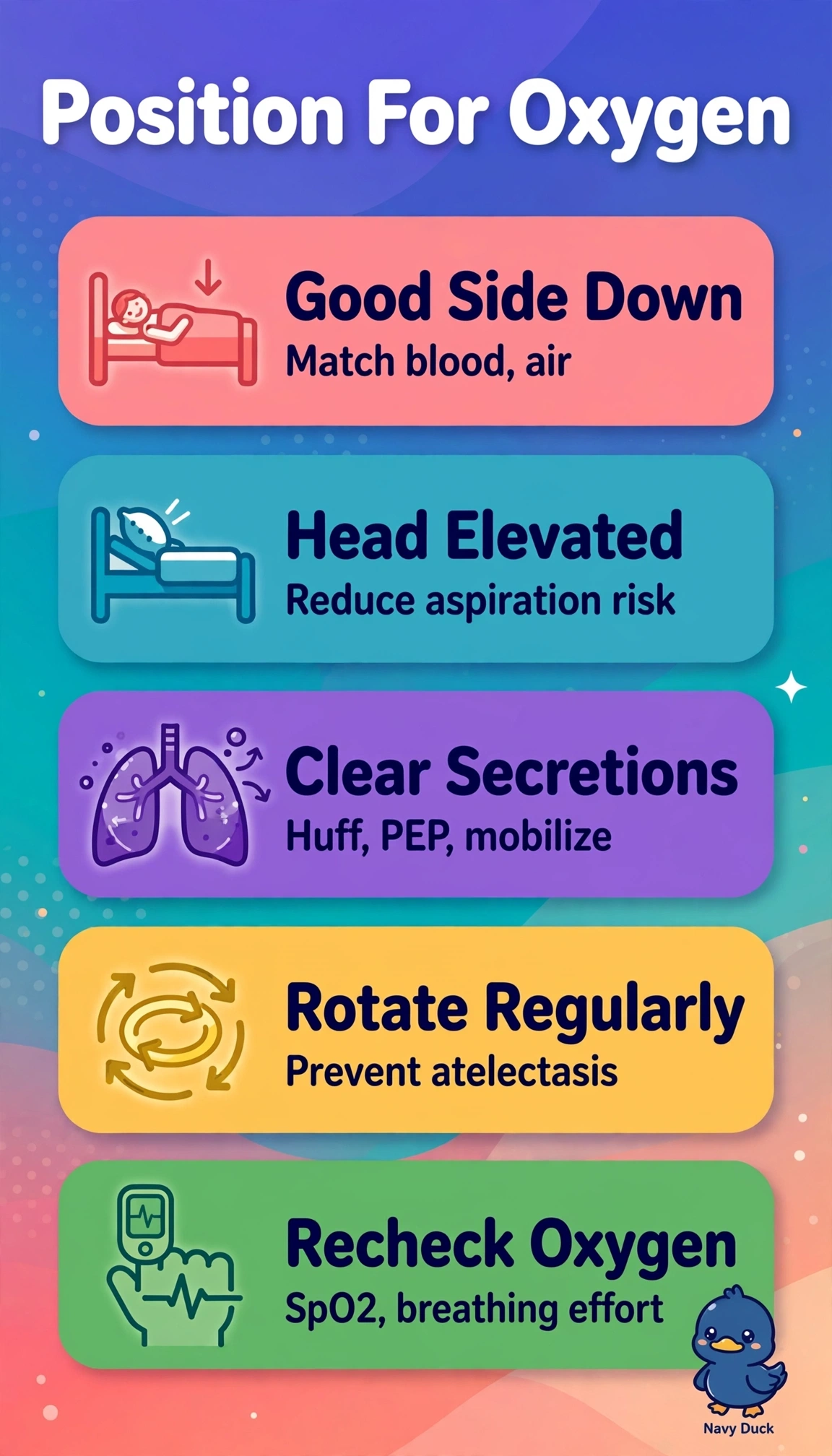
You want gravity to send blood where air actually flows. Laying on the good side is like opening the best lane on a highway. That smart match is classic dependent-good-lung positioning plus clearance.
Full Explanation
Placing the healthy left lung dependent optimizes ventilation-perfusion matching because gravity directs pulmonary blood flow to the dependent normal alveoli while the diseased nondependent right lung receives less perfusion, thereby reducing shunt and raising SpO2 in unilateral pneumonia without effusion, and head elevation increases functional residual capacity, improves diaphragmatic mechanics, and lowers aspiration risk while assisted turning plus directed cough and huff mobilize thick secretions signaled by coarse crackles and productive cough. Positioning with the diseased right lung dependent with elevation and clearance is commonly taught for postural drainage of the middle lobe but fails the oxygenation goal here because perfusing the consolidated dependent lung increases venous admixture and worsens hypoxemia despite adequate clearance. Maintaining good-lung-dependent positioning flat without head elevation preserves the correct lateral advantage and clearance but sacrifices the stated need for upright mechanics, increasing dyspnea, atelectasis risk, and aspiration potential, especially in an older adult with dense infiltrate. Encouraging dependent good-lung positioning with elevation but rest without assisted clearance supports oxygenation posture yet ignores the productive thick sputum that requires active evacuation, allowing retention, plug formation, and persistent crackles. Exam caveat: do not confuse drainage positions that place the affected lung dependent for secretion movement with oxygenation positions that place the healthy lung dependent to minimize shunt when hypoxemia dominates. Practical check: reassess SpO2, respiratory rate, crackles, sputum volume, and tolerance after turning, keep assistance for safe repositioning, and escalate oxygen or therapy if desaturation persists.